Author Archives: Keith Weiner

Unknown's avatar

About Keith Weiner

Dr. Keith Weiner is the president of Gold Standard Institute USA, and CEO of Monetary Metals. Keith is a leading authority in the areas of gold, money, and credit and has made important contributions to the development of trading techniques founded upon the analysis of bid-ask spreads. Keith is a sought after speaker and regularly writes on economics. He is an Objectivist, and has his PhD from the New Austrian School of Economics. He lives with his wife near Phoenix, Arizona.

The Theory of Interest and Prices in Practice

Medieval thinkers were tempted to believe that if you throw a rock it flies straight until it runs out of force, and then it falls straight down. Economists are tempted to think of prices as a linear function of the “money supply”, and interest rates to be based on “inflation expectations”, which is to say expectations of rising prices.

The medieval thinkers, and the economists are “not even wrong”, to borrow a phrase often attributed to physicist Wolfgang Pauli. Science has to begin by going out to reality and observing what happens. Anyone can see that in reality, these tempting assumptions do not fit what occurs.

In my series of essays on interest rates and prices[1], I argued that the system has positive feedback and resonance, and cannot be understood in terms of a linear model. When I began this series of papers, the rate of interest was still falling to hit a new all-time low. Then on May 5,2013, it began to shoot up. It rose 83% over a period of exactly four months. That may or may not have been the peak (it has subsided a little since then).

Several readers asked me if I thought this was the beginning of a new rising cycle, or if I thought this was the End (of the dollar). As I expressed in Part VI, the End will be driven by the withdrawal of the gold bid on the dollar. Since early August, gold has become more and more abundant in the market.[2] I think it is safe to say that this is not the end of the dollar, just yet. The hyperinflationists’ stopped clock will have to remain wrong a while longer. I said that the rising rate was a correction.

I am quite confident of this prediction, for all the reasons I presented in the discussion of the falling cycle in Part V. But let’s look at the question from a different perspective, to see if we end up with the same conclusion.

In the gold standard, the rate of interest is the spread between the gold coin and the gold bond. If the rate is higher, that is equivalent to saying that the spread is wider. If the rate is lower, then this spread is narrower.

A wider spread offers more incentive for people to straddle it, an act that I define as arbitrage. Another way of saying this is that a higher rate offers more incentive for people to dishoard gold and lend it. If the rate falls, which is the same as saying if the spread narrows, then there is less incentive and people will revert to hoarding to avoid the risks and capital lock-up of lending. Savers who take the bid on the interest rate (which is equivalent to taking the ask on the bond) press the rate lower, which compresses the spread.

It goes almost without saying, that the spread could never be compressed to zero (by the way, this is true for all arbitrage in all free markets). There are forces tending to compress the spread, such as the desire to earn interest by savers. But the lower the rate of interest, the stronger the forces tending to widen the spread become. These include entrepreneurial demand for credit, and most importantly the time preference of the saver—his reluctance to delay gratification. There is no lending at zero interest and nearly zero lending at near-zero interest.

I emphasize that interest is a spread to put the focus on a universal principle of free markets. As I stated in my dissertation:

“All actions of all men in the markets are various forms of arbitrage.”

Arbitrage compresses the spread that is being straddled. It lifts up the price of the long leg, and pushes down the price of the short leg. If one buys eggs in the farm town, then the price of eggs there will rise. If one sells eggs in the city center, then the price there will fall.

In the gold standard, hoarding tends to lift the value of the gold coin and depress the value of the bond. Lending tends to depress the value of the coin and lift the value of the bond. The value of gold itself is the closest thing to constant in the market, so in effect these two arbitrages move the value of the bond. How is the value of the bond measured—against what is it compared? Gold is the unit of account, the numeraire.

The value of the bond can move much farther than the value of gold. But in this context it is important to be aware that gold is not fixed, like some kind of intrinsic value. An analogy would be that if you jump up, you push the Earth in the opposite direction. Its mass is so heavy that in most contexts you can safely ignore the fact that the Earth experiences an equal but opposite force. But this is not the same thing as saying the Earth is fixed in position in its orbit.

The regime of irredeemable money behaves quite differently than the gold standard (notwithstanding frivolous assertions by some economists that the euro “works like” the gold standard). The interest rate is still a spread. But what is it a spread between? Does arbitrage act on this spread? Is there an essential difference between this and the arbitrage in gold?

Analogous to gold, the rate of interest in paper currency is the spread between the dollar and the bond. There are a number of differences from gold. Most notably, there is little reason to hold the dollar in preference to the government bond. Think about that.

In the gold standard, if you don’t like the risk or interest of a bond, you can happily hold gold coins. But in irredeemable paper currency, the dollar is itself a credit instrument backed by said government bond. The dollar is the liability side of the Fed’s balance sheet, with the bond being the asset. Why would anyone hold a zero-yield paper credit instrument in preference to a non-zero-yield paper credit instrument (except as speculation—see below)? And that leads to the key identification.

The Fed is the arbitrager of this spread!

The Fed is buying bonds, which lifts up the value of the bond and pushes down the interest rate. Against these new assets, the Fed is issuing more dollars. This tends to depress the value of the dollar. The dollar has a lot of inertia, like gold. It has extremely high stocks to flows, like gold. But unlike gold, the dollar’s value does fall with its quantity (if not in the way that the quantity theory of money predicts). Whatever one might say about the marginal utility of gold, the dollar’s marginal utility certainly falls.

The Fed is involved in another arbitrage with the bond and the dollar. The Fed lends dollars to banks, so that they can buy the government bond (and other bonds). This lifts the value of the bond, just like the Fed’s own bond purchases.

Astute readers will note that when the Fed lends to banks to buy bonds, this is equivalent to stating that banks borrow from the Fed to buy bonds. The banks are borrowing short to lend long, also called duration mismatch.

This is not precisely an arbitrage between the dollar and the bond. It is an arbitrage between the short-term lending and long-term bond market. It is the spread between short- and long-term interest rates that is compressed in this trade.

One difference between gold and paper is that, in paper, there is a central planner who sets the short-term rate by diktat. Since 2008, Fed policy has pegged it to practically zero.

This makes for a lopsided “arbitrage”, which is not really an arbitrage. One side is not free to move, even the slight amount of a massive object. It is fixed by law, which is to say, force. The economy ought to allow free movement of all prices, and now one point is bolted down. All sorts of distortions will occur around it as tension builds.

I put “arbitrage” in scare quotes because it is not really arbitrage. The Fed uses force to hand money to those cronies who have access to this privilege. It is not arbitrage in the same way that a fence who sells stolen goods is not a trader.

In any case, the rate on the short end of the yield curve is fixed near zero today, while there is a pull on the long bond closer to it. Is there any wonder that the rate on the long bond has a propensity to fall?

Under the gold standard, borrowing short to lend long is certainly not necessary.[3] However, in our paper system, it is an integral part of the system, by its very design.

The government offers antiseptic terms for egregious acts. For example, they use the pseudo-academic term “quantitative easing” to refer to the dishonest practice of monetizing the debt. Similarly, they use the dry euphemism “maturity transformation” to refer to borrowing short to lend long, i.e. duration mismatch. Perhaps the term “transmogrification” would be more appropriate, as this is nothing short of magic.

The saver is the owner of the money being lent out. It is his preference that the bank must respect, and it is for his benefit that the bank lends. When the saver says he may want his money back on demand, and the bank presumes to lend it for 30 years, the bank is not “transforming” anything except its fiduciary duty, its integrity, and its own soundness. Depositors would not entrust their savings to such reckless banks, without the soporific of deposit insurance to protect them from the consequences.

Under the gold standard, this irrational practice would exist on the fringe on the line between what is legal and what is not (except for the yield curve specialist, a topic I will treat in another paper), a get-rich-quick scheme—if it existed at all (our jobs as monetary economists are to bellow from the rooftops that this practice is destructive).

Today, duration mismatch is part of the official means of executing the Fed’s monetary policy.

I have already covered how duration mismatch misallocates the savers’ capital and when savers eventually pull it back, the result is that the bank fails. I want to focus here on another facet. Pseudo-arbitrage between short and long bonds destabilizes the yield curve.

By its very nature, borrowing short to lend long is a brittle business model. One is committed to a long-term investment, but this is at the mercy of the short-term funding market. If short-term rates rise, or if borrowing is temporarily not possible, then the practitioner of this financial voodoo may be forced to sell the long bond.

The original act of borrowing short to lend long causes the interest rate on the long bond to fall. If the Fed wants to tighten (not their policy post-2008!) and forces the short-term rate higher, then players of the duration mismatch game may get caught off guard. They may be reluctant to sell their long bonds at a loss, and hold on for a while. Or for any number of other proximate causes, the yield curve can become inverted.

Side note: an inverted yield curve is widely considered a harbinger of recession. The simple explanation is that the marginal source of credit in the economy is suddenly more expensive. This causes investment in everything to slow.

At times there is selling of the short bond, at times aggressive buying. Sometimes there is a steady buying ramp of the long bond. Sometimes there is a slow selling slide that turns into an avalanche. The yield curve moves and changes shape. As with the rate of interest, the economy does best when the curve is stable. Sudden balance sheet stress, selloffs, and volatility may benefit the speculators of the world[4], but of course, it can only hurt productive businesses that are financing factories, farms, mines, and hotels with credit.

Earlier, I referred to the only reason why someone would choose to own the Fed’s liability—the dollar—in preference to its asset. Unlike with gold, hoarding paper dollar bills serves no real purpose and incurs needless risk of loss by theft. The holder of dollars is no safer. He avoids no credit risk; he is exposed to the same risk as is the bondholder is exposed. The sole reason to prefer the dollar is speculation.

As I described in Theory of Interest and Prices in Paper Currency, the Fed destabilizes the rate of interest by its very existence, its very nature, and its purpose. Per the above discussion, the Fed and the speculators induce volatility in the yield curve, which can easily feed back into volatility in the underlying rate of interest.

The reason to sell the bond is to avoid losses if interest rates will rise. Speculators seek to front-run the Fed, duration mismatchers, and other speculators. If the Fed will “taper” its purchase of bonds, then that might lead to higher interest rates. Or at least, it might make other speculators sell. Every speculator wants to sell first.

Consider the case of large banks borrowing short to lend long. Let’s say that you have some information that their short-term funding is either going to become much harder to obtain, or at least significantly more expensive. What do you do?

You sell the bond. You, and many other speculators. Everyone sells the bond.

Or, what if you have information that you think will cause other speculators to sell bonds? It may not even be a legitimate factor, either because the rumor is untrue (e.g. “the world is selling Treasury bonds”) or because there is no valid economic reason to sell bonds based on it.

You sell the bond before they do, or you all try to sell first.

I have been documenting numerous cases in the gold market where traders use leverage to buy gold futures based on an announcement or non-announcement by the Fed. These moves reverse themselves quickly. But no one, especially if they are using leverage, wants to be on the wrong side of a $50 move in gold. You sell ahead of the crowd, and you buy ahead of the crowd. And they try to do it to you.

I think it is likely that one of these phenomena, or something similar, has driven the rate on the 10-year Treasury up by 80%.

I would like to leave you with one take-away from this paper and one from my series on the theory of interest and prices. In this paper, I want everyone to think about the difference between the following two statements:

  1. The dollar is falling in value
  2. The rate of interest in dollars must rise

It is tempting to assume that they are equivalent, but the rate of interest is purely internal to the “closed loop” dollar system. Unlike a free market, it does not operate under the forces of arbitrage. It operates by government diktats, and hordes of speculators feed on the spoils that fall like rotten food to the floor.

From my entire series, I would like the reader to check and challenge the sacred-cow premises of macroeconomics, the aggregates, the assumptions, the equations, and above all else, the linear thinking. I encourage you to think about what incentives are offered under each scenario to the market participants. No one even knows the true value of the monetary aggregate and there is endless debate even among economists. The shopkeeper, miner, farmer, warehouseman, manufacturer, or banker is not impelled to act based on such abstractions.

They react to the incentives of profit and loss. Even the consumer reacts to prices being lower in one particular store, or apples being cheaper than pears. If you can think through how a particular market event or change in government policy will remove old incentives and offer new incentives, then you can understand the likely first-order effects in the market. Of course each of these effects changes still other incentives.

It is not easy, but this is the approach that makes economics a proper science.

P.S. As I do my final edits on this paper (October 4, 2013), there is a selloff in short US T-Bills, leading to an inversion at the short end of the yield curve. This is due, of course, to the possible effect of the partial government shutdown. The government is not going to default. If this danger were real, then there would be much greater turmoil in every market (and much more buying of gold as the only way to avoid catastrophic losses). The selloff has two drivers. First, some holders of T-Bills need the cash on the maturity date. They would prefer to liquidate now and hold “cash” rather than incur the risk that they will not be paid on the maturity date. Second, of course speculators want to front-run this trade. I put “cash” in scare quotes because dollars in a bank account are the bank’s liability. The bank will not be able to honor this liability if its asset—the US Treasury bond—defaults. The “cash” will be worthless in the very scenario that bond sellers are hoping to avoid by their very sales. When the scare and the shutdown end, then the 30-day T-Bill will snap back to its typical rate near zero. Some clever speculators will make a killing on this move.

Theory of Interest and Prices in Paper Currency Part VI (The End)

In Part I, we looked at the concepts of nonlinearity, dynamics, multivariate, state, and contiguity. We showed that whatever the relationship may be between prices and the money supply in irredeemable paper currency, it is not a simple matter of rising money supply –> rising prices.

In Part II, we discussed the mechanics of the formation of the bid price and ask price, the concepts of stocks and flows, and the central concept of arbitrage. We showed how arbitrage is the key to the money supply in the gold standard; miners add to the aboveground stocks of gold when the cost of producing an ounce of gold is less than the value of one ounce.

In Part III, we looked at how credit comes into existence via arbitrage with legitimate entrepreneur borrowers. We also looked at the counterfeit credit of the central banks, which is not arbitrage. We introduced the concept of speculation in markets for government promises, compared to legitimate trading of commodities. We also discussed the prerequisite concepts of Marginal time preference and marginal productivity, and resonance.

In Part IV, we discussed the rising cycle. The central planners push the rate of interest down, below the marginal time preference and unleash a storm whose ferocious dynamics are more than they bargained for. The hapless subjects of the regime have little recourse but they do have one seeming way out. They can buy commodities. The cycle is a positive feedback loop of rising prices and rising interest rates. Ironically, their clumsy attempt to get lower interest results in rising interest. Alas, the cycle eventually ends. The interest rate and inventory hoards have reached the point where no one can issue more bonds or increase their hoards.

In Part V, we discussed the end of the rising cycle. There was a conflict between commodity speculation and leverage. Leverage won.  Liquidations impaired bank balance sheets, and the result was a spike in the interest rate. It finally rose over marginal time preference. Unfortunately, it rose over marginal productivity as well. Slowly at first, the bond market entered a new bull phase. It becomes ferocious, as it pushes down the interest rate which bleeds borrowers of their capital. Companies find it harder to make money and easier to borrow. They are obliged to borrow to get a decent return on equity. In short, they become brittle.

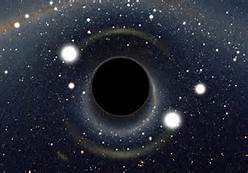
In this Part VI, we look at The End. At the beginning of Part I, I noted in passing that we now have a positive feedback loop that is causing us to spiral into the black hole of zero interest. In astrophysics, the theory says that a black hole is a singularity with infinite gravity at the center. There is a radius called the event horizon, and everything including light that gets inside this radius is doomed to crash into the singularity.

black hole
Black Hole

For years, I have been thinking that this is a perfect analogy to the falling rate of interest. At zero interest on long-term debt, the net present value is infinite. There is a positive feedback loop that tends to pull the rate ever downward, and the closer we get to zero the stronger the pull. But an analogy is not a mechanism for causality.

In the fall of 2012, I attended the Cato Institute Monetary Conference. Many of the presenters were central bankers past or present, or academics who specialize in monetary policy. It was fascinating to hear speaker after speaker discuss the rate of interest. They all share the same playbook, they all follow the Taylor Rule (and indeed John Taylor himself presented), and they were all puzzled or disappointed by Fed Chairman Bernanke not raising interest rates. Their playbook called for this to begin quite a while ago now, based on GDP and unemployment and the other variables that are the focus of the Monetarists.

Then it clicked for me.

The Chairman is like the Wizard of Oz. He creates a grand illusion that he is all-powerful. When he bellows, markets jump. But when the curtain is pulled back, it turns out that he has no magical powers.

At that conference, after hearing so many speakers, including some of Bernanke’s subordinates, discuss when and why and how much the rate should be higher, I became certain that it is not under his control. It is falling, falling.[1]

One cannot go from analogy to theory. It has to be the other way around. And yet, the black hole analogy corresponds to the falling rate in several ways. First, zero interest is like a singularity. I have repeatedly emphasized the fact that debt cannot be paid off; it cannot go out of existence. It is only shifted around. Therefore, regardless of whatever nominal duration is attributed to any bond or loan, it is in effect perpetual. At zero interest, a perpetual debt has an infinite net present value.

The next part of the analogy is the strong gravitational pull from a very far distance. The rate of interest has indeed been falling since the high of 16% in 1981, and it was pulled in to a perigee of 1.6% before making an apogee (so far) of 2.9%. The analogy still holds, objects spiral around and into black holes; they do not fall in directly.

There is also a causal mechanism for the falling interest rate. As discussed in Part V, the interest rate is above marginal productivity. So long as it remains there, the dynamic is given motive power. In Part V, we discussed the fact that due to the arbitrage between interest and profit, at a lower interest rate one will see lower profit margins. This is what puts the squeeze on the marginal business, who borrowed previously at a higher rate. The marginal business is unable to make a profit when competing against the next competitor who borrowed more cheaply.

It is worth saying, as an aside, that this process of each new competitor borrowing money to buy capital that puts older competitors out of business who borrowed too expensively is a process of capital churn. It may look a lot like the beneficial process of creative destruction[2], but it is quite different. Churn replaces good capital with new capital, at great cost and waste.

In falling rates, no one has pricing power, and generally one must borrow to get a decent return on equity. The combination of soft consumer demand, shrinking margins, and rising debt makes businesses brittle.

Consumer demand is softened by the soft labor market. The labor market is soft because there is always a tradeoff between labor and capital invested. For example, in India Wal-Mart does not use automation like it does in the US. Labor is preferred over capital, because it is cheaper. With falling interest rates, capital equipment upgrades become a more and more attractive relative to labor. Many attribute the high unemployment to high minimum wages and generous welfare schemes. This is part of it, but it does not explain unemployment of skilled workers and professionals.

As the interest rate falls, the marginal productivity of labor rises. This may sound good, and people may read it as “productivity rises” or “average productivity rises”. No, it means that the bar rises. Each worker must get over a threshold to be employed; he must produce more than a minimum. This threshold is rising, and it makes more and more people sub-marginal.

Unemployed people do not make a robust bid on consumer goods.

The next-to-final element of the analogy is the event horizon. In the case of the black hole, astrophysicists will give their reasons for why everything inside this radius, including light, must continue down into the singularity. What could force the interest rate to zero, once it falls below an arbitrary threshold?

Through a gradual process (which occurs when the rate is well above the event horizon), the central bank evolves. The Fed began as the liquidity provider of last resort, but incrementally over decades becomes the only provider of credit of any resort (see my separate article on Rising Interest Rates Spoil the Party).

Savers have been totally demoralized, discouraged, and punished. Borrowers have become more brazen in borrowing for unproductive purposes. And total debt continues to rise exponentially. With lower and lower rates offered, and higher and higher risk, no one would willingly lend. The Fed is obliged to be the source of all lending.

A proper system is one in which people produce more than they consume, and lend the surplus, which is called “savings”. The current system is one in which institutions borrow from the government or the Fed and lend at a higher rate. Today, one can even borrow in order to buy bonds. Most in the financial industry shrug when I jump up and down and wave my arms about this practice. Other than a bank borrowing from depositors (with scrupulously matched duration!) there should not be borrowing to buy bonds. A free market would not offer a positive spread to engage in this practice, and rational savers would withdraw their savings if they got wind of such a scheme.

Thus, the system devolves. Sound credit extended by savers drives a proper system. Now, the Fed becomes the ultimate issuer of all credit, and this credit is taken from unwilling savers (those who hold dollars, thinking it is “money”) and is increasingly extended to parties (such as the US government) who haven’t got the means or the intent to ever repay it.

The actual event horizon is when the debt passes the point where it can no longer be amortized. Debtors, especially the ultimate debtors that are the sovereign governments, and most especially the US government, depend on deficits. They borrow more than their tax revenues not only to fund welfare programs, but also to pay the interest on the total accumulated debt.

That singularity at the center beckons. Every big player wants lower rates. The government can only keep the game going so long as it can refinance its old debts at ever-lower rates. The Fed can only pretend to be solvent so long as its bond portfolio is at least flat, if not rising. The banks’ balance sheets are similarly stuffed with bonds. Businesses, long since made brittle by three decades of falling rates, likewise depend on the bond market to roll their old bonds by selling new ones. No debt is ever repaid, because there is no mechanism for it. An ever-greater total debt burden must be refinanced periodically. Lower rates are the enabler.

Recall from Part IV that the dollar system is a closed loop. Dollars can circulate at whatever velocity, and they can circulate to and from any parties. For interest rates, what matters is whether net credit is being created to finance net increases of commodities and inventories, or whether net sales of commodities are used to finance net purchases of bonds. The spreads of interest to time preference, and productivity to interest determine the direction of this flow.

So long as the interest rate is higher than marginal productivity and marginal time preference, the system is latched up. So long as the consumer bid is soft and getting softer, marginal productivity is falling. So long as debtors are under a rising burden of debt, and creditors have the upper hand, then time preference is falling.

The final element of our analogy to the black hole is that, according to newer theories that may be controversial (I don’t know, I am not a physicist, please bear with me even if the science isn’t quite right) if enough matter and energy crash into the singularity quickly enough, then it can cause an enormous explosion.

black hole bubble
Black Hole Ejecting Matter and Energy

Here is my prediction of the end: permanent gold backwardation[3]. The lower the rate of interest falls, the more it destabilizes the system because it makes the debtors more brittle. The dollar system has, to borrow a phrase from Ayn Rand, blackmailed people not by their vices, but by their virtues. People want to participate in the economy and benefit from the division of labor. Subsisting on one’s own efforts alone provides a very low quality of life. The government forces people to choose between using bogus Fed paper vs. dropping out of the economy. People naturally choose the lesser of these two evils.

But, as the rate of interest falls, as the nominal quantity of debt rises, as the burden of each dollar of debt rises, and as the debtors incur ever-greater risks, the marginal saver reaches the point where he prefers gold without a yield and with price risk too, over bonds even with a yield. We are in the early stages of this process now. A small proportion of the population of Western countries is buying a little gold, typically a small proportion of their savings.

What happens when this process accelerates, as it must inevitably do? What happens when people will borrow dollars to buy gold, as they had borrowed dollars to buy commodities in the postwar period?

By then, the bond markets may be so volatile that this could cause a spike in interest rates. Or it may not. It will pull all the remaining gold out of the bullion market and into private hoards. At that point, gold will begin to plunge deeper and deeper into backwardation. As I explained in my dissertation[4], a persistent and significant backwardation in gold will pull all liquid commodities into the same degree of backwardation. Desperate, panicky people will buy commodities not to hoard them or consume them, but as a last resort to get through the side window into gold after the front door is closed. When they cannot trade dollars for gold, they can trade dollars for crude oil and then trade crude oil for gold.

Of course, this will very quickly the drive prices of all commodities in dollars to rapidly skyrocket to arbitrary levels. At that point, there could even be a short-lived rising cycle where people sell bonds to buy commodities, or this may not occur (it may be over and done too quickly).

In any case, this is the final death rattle of the dollar. People will no longer be able to use the dollar in trade, even if they are willing (which is quite a stretch). Then the interest rate in dollars will not matter to anyone.

My description of this process should not be taken as a prediction that this is imminent. I think this process will play out within weeks once it gets underway, but that the starting point is still years away.

The interest rate on the 10-year Japanese government bond fell to 80 basis points. I think that the rate on the US Treasury can and will likely go below that. We must continue to watch the gold basis for the earliest possible advance warning.

This completes the series on interest and prices. There is obviously a lot more to discuss, including the yield curve and what makes it abruptly flip between normal and inverted, and of course mini rising cycles within the major falling cycle such as the one that is occurring as I write this. I would welcome anyone interested in doing work in this area to contact me at keith (at) goldstandardinstitute (dot) us.


[1] To briefly address the 80% increase in the 10-year interest rate over the past few months: it is a correction, nothing more. The rate will resume its ferocious descent soon enough.

[2] Joseph Schumpeter coined this term in 1942 in his book Capitalism, Socialism and Democracy (1942)

Oscillation, Feedback, and Resonance

I just saw this fascinating video of a bunch of metronomes that begin ticking out of sync with one another, but slowly line up until they all beat in unison. I really love the title slide where it says “NONLINEAR DYNAMICAL SYSTEMS”, how apropos! Watch the video, the outcome is counterintuitive.

The metronomes show some principles of a non-linear, dynamic system including periodic inputs of energy, oscillation, resonance, and positive feedback. These are key concepts in my series on the Theory of Interest and Prices in Paper Currency. In Part I, I discuss the assumption that the monetary system is linear and static. Later in Part III, I discuss periodic input of energy, oscillation, and resonance. In Part IV, I discuss feedback, both negative which damps a system and positive which runs away.

Our monetary system cannot be understood in terms of the quantity of money. It is convenient, tempting, and easy to assume that if the money supply doubles*, then prices should eventually double sooner or later. It was convenient for the Medievals to assume that if you throw a rock then it first flies straight until it sooner or later runs out of force and falls straight down. Both are errors of rationalism, of sitting in an armchair imagining how the world ought to be, how it should fit with preconceived notions.

But neither rocks nor money work that way. Science must begin by observation, and only then is one entitled to try to generalize and form a theory. What would the simplistic linear quantity theory of metronomes predict? One would assume that the more metronomes one had ticking away (assuming they were not synchronized manually), the more that the sound would approach white noise. The average interval between ticks would be 1/N where N is the number of metronomes. As N became sufficiently large the ticks would blur into a continual sound.

As the video shows, it just does not happen that way. Instead, there is periodic input of energy from each metronome to the shelf on which they sit, and periodic input of energy from the shelf to each metronome. This creates both positive feedback and negative feedback. A metronome that is slightly “behind” the average is given more energy to accelerate, and one that is “ahead” is drained.

With the harmless experiment of a bunch of ticking pendulums, the end result is that they all end up in tight sync with one another. There is negative feedback to ensure this. Without negative feedback, the oscillations would grow and grow until either the devices began to leap off the shelf, or the shelf fell out of its brackets, or maybe the shelf broke (as in the Tacoma Narrows Bridge).

With the current monetary experiment, the result is cycles of rising and falling interest rates and booms and busts, with increasing amplitude. The positive feedbacks in the system are overwhelming the negative feedbacks, which have been removed or suppressed by deliberate government policy.

If there is one take-away that I hope every reader gets from this article and my series on interest and prices, it is that the monetary system is non-linear, dynamic, stateful, discontiguous, and multivariate. It is time we stop obsessing over the quantity of money (and boldly issuing predictions about prices that never come true). We must start thinking about the system dynamics and the unstable interest rate before it collapses into the black hole of zero.


* Ignoring that we don’t have money in our system today, we have only credit.

Magical Thinking Drags on Economics

Many economists often attempt to set arbitrary thresholds. For example, if debt hits X% of GDP (or whatever measure) then it is “too” large and “impedes economic growth”.  This article on Acting Man blog cites Carmen Reinhart attempting to do just this.

It is the wrong approach entirely.

To understand why, let’s look at productive debt and contrast with government debt. If Joe borrows money to build a factory to produce Supersmart phones, then paying the interest and principle on this bond does not impede anything. His revenues would not exist without borrowing the money, and so we can say with certainty that this debt is good for Joe, it is good for Joe’s customers, and it is good for everyone else including Joe’s employees, Joe’s vendors, etc.

By contrast, what if John borrows to live a lavish lifestyle that his income would not otherwise support? EVERY PENNY spent to service this debt is a drag on John. At first, he was seemingly able to buy things without real cost. But when the first credit card bill comes due, then he incurs cost without being able to buy things. There is no magic number, no arbitrary threshold, no line in the sand. This debt is bad for John, and for everyone else that John touches. (I don’t think that there would be much, if any, consumer lending in a world where savers had to lend their hard-earned gold, a world in which the Fed was not the ultimate source of credit, but that is a different discussion).

Government debt is not like Joe’s debt; it is like John’s. The government borrows so that it can buy more than its tax revenues. Initially, this creates an illusion of prosperity. But soon, the government must begin paying to service the debt (it can never actually pay the principle because there is no extinguisher of debt). EVERY PENNY of this debt service is a drag on the economy. The government is buying fewer goods than what could be paid for by its tax revenues.

Contrary to the threshold idea, the drag really begins with the first dollar of debt and it is proportional to the debt.

Two factors obscure this and makes it harder to see. One is that the government can borrow more. So long as the government has access to unlimited credit, it can borrow to pay the interest and borrow to consume. A major theme of my writing is that this can only go on while people are willing to feed perfectly good capital to the government so that the government may consume it. When they are no longer willing, or when their capital is depleted, then the game ends. It ended in Greece and it will end in the US at some point.

The other is that it can force down the rate of interest. This makes it cheaper to “roll” its debt, to pay off old bonds as they mature by selling new bonds. If the new bonds have a lower rate, then the government can service more debt for the same payment. Another major theme of my writing is that a falling interest rate destroys capital.

It is no accident that both factors masking the drag of debt have to do with capital destruction. Nevertheless, the drag of the nearly-$17T of debt that the government acknowledges plus the far larger liability that they carry off the balance sheet is very real. One can see it almost everywhere one looks, from the weak labor market to the increasing reliance on the Fed as the only source of credit.

Rising Interest Rates

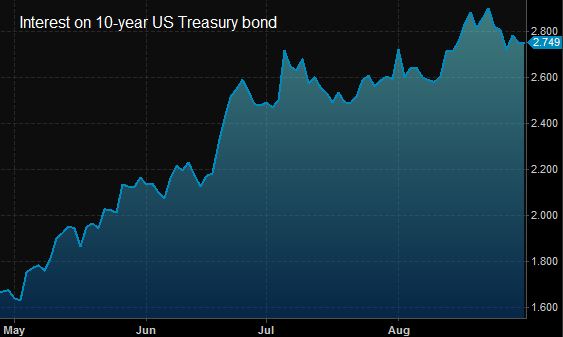
Interest rates have risen since May of this year, from under 1.7% to over 2.7%. By any measure, that is an enormous move.

UST-10

I have mostly written about how falling interest rates cause capital destruction, because that is the environment we have been in since 1981. There are, however, occasional corrections when interest rates rise. Rising rates means bond prices fall (the relationship between interest rate and bond price is a rigid mathematical inverse, like a teeter totter).

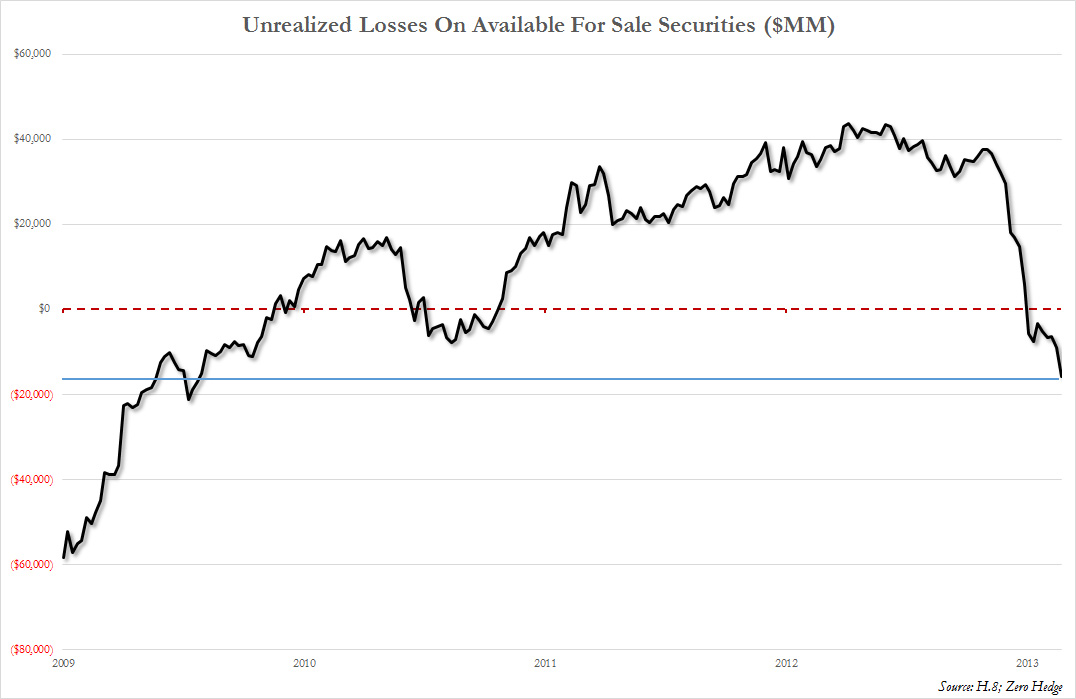
Here is a picture from Zero Hedge worth 1000 words in explaining the consequences on this side of unstable rates. Banks are taking big (unrealized, so far) losses.

Unrealized Losses on AFS

If you buy a bond, and then the interest rate rises, you suffer a capital loss. If you borrowed money to buy bonds with leverage, you could be in big trouble very quickly.

On the other side of the trade, some bond issuers are breathing a little easier as the burden of their debt has fallen. Unfortunately, most of them have a different problem. They generally must “roll” liabilities, which means selling new bonds to pay old bonds. They are forced to replace lower-interest borrowing with higher-interest borrowing. This is pinching their cash flow.

Whether the wrecking ball swings to one side of the street when rates fall, or to the other side when rates rise, destruction is the result either way. We need the monetary system that provides a stable interest rate.

“Central bankers have given up on fixing global finance”

That is the title of this opinion piece in the FInancial Times.

It turns out that in the present regime of “floating” exchange rates, countries have a choice of the tiger, or the tiger. Either they can accept the wild volatility of hot money flows driven by Federal Reserve policy, or they can impose capital controls. According to the FT’s Robin Harding, the central bankers who gathered at Jackson Hole last week, accept this dilemma fatalistically.

One would be tempted to say “good” and leave it at that. As anyone who has been through Alcoholics Anonymous can tell you, the first step to fixing the problem is to say, “Hi, I’m a central banker and I have a problem.”

Unfortunately, Mr. Harding says that “unconventional monetary policy ” and “big upgrades to financial regulation” (e.g. Dodd-Frank?) are successes. They’re just not enough, according to Mr. Harding to “tackle imbalances”. So we are doomed to more crises, and the problem is getting worse.

One academic wonk who presented at the conference proposes “targeted capital controls, tough bank regulation, and domestic policy to cool off credit booms”. Presumably she envisions even more draconian regulations than Sarbanes-Oxley and Dodd-Frank enacted around the world, plus control boards to determine who can have access to dollars and who is forced to remain stuck in the local currency.

Imposing capital controls will be one of the last panicky moves of flailing socialist leaders, before they get really nasty. The so-called “soft” socialism that now covers much of the globe allows the relatively free movement of capital across borders, along with people and goods. The “hard” socialism of Hitler and Stalin could not allow anything to move, except as commanded. And, of course armies. Armies move across borders, when peaceful people cannot cross with goods and money.

Any academic who apologizes and justifies this evil, is merely acting as the witch doctor who gives moral support to tyrants. People don’t go along with such naked evil, unless they believe it is somehow good, or at least necessary. Until recently, the witch doctors have been successful. Most Americans have not thought a lot about monetary policy, and have generally accepted the Fed and the paper dollar. They have started to become restive following the “unconventional monetary policy” and its “big success” in the economy since 2009.

While Mr. Harding is not on board the agenda of that particular academic, it is because he seems to prefer the ultimate monetary shaman: John Maynard Keynes. What is his proposal to fix, once and for all, the broken monetary system run by national central planners? A system administered by international central planners.

He says that the current system suffers from a “lack of a mechanism to force any country with a current account surplus to reduce it.” But don’t worry, the new regime of international central planning will work because it will have “penalties for countries that run a persistent surplus.” Think about this. What could possibly cause every country in the world to submit to an externally imposed penalty if they don’t run their affairs in accord with Mr. Harding’s central plan?

The solution is not more regulations, central plans, and penalties. We need to rediscover freedom and free markets. We need to rediscover the gold standard.

Theory of Interest and Prices in Paper Currency Part V (Falling Cycle)

In Part I, we looked at the concepts of nonlinearity, dynamics, multivariate, state, and contiguity. We showed that whatever the relationship may be between prices and the money supply in irredeemable paper currency, it is not a simple matter of rising money supply –> rising prices.

In Part II, we discussed the mechanics of the formation of the bid price and ask price, the concepts of stocks and flows, and the central concept of arbitrage. We showed how arbitrage is the key to the money supply in the gold standard; miners add to the aboveground stocks of gold when the cost of producing an ounce of gold is less than the value of one ounce.

In Part III, we looked at how credit comes into existence via arbitrage with legitimate entrepreneur borrowers. We also looked at the counterfeit credit of the central banks, which is not arbitrage. We introduced the concept of speculation in markets for government promises, compared to legitimate trading of commodities. We also discussed the prerequisite concepts of Marginal time preference and marginal productivity, and resonance.

In Part IV, we discussed the rising cycle. The central planners push the rate of interest down, below the marginal time preference and unleash a storm whose ferocious dynamics are more than they bargained for. The hapless subjects of the regime have little recourse but they do have one seeming way out. They can buy commodities. The cycle is a positive feedback loop of rising prices and rising interest rates. Ironically, their clumsy attempt to get lower interest results in rising interest. Alas, the cycle eventually ends. The interest rate and inventory hoards have reached the point where no one can issue more bonds or increase their hoards.

In this Part V, we discuss the end of the rising cycle and the start of the falling cycle. We examine its dynamics and its mode of capital destruction. Lastly we look at the response of the central bank.

It is not possible to pay debts with inventories of completed or partially completed product, nor even with raw commodities. In order to circulate as money, a good must have an extremely narrow bid-ask spread. Commodities have a wide spread, especially in the environment of the late stages of the rising cycle. Liquidations are pushing the bid down. The ask side is still being pushed up, by those businesses which are still buying. Work in progress of course could not be sold, except to another company in the same industry.

Recall that the rising cycle is driven by selling bonds to build inventories. This creates a conflict: the desire to accumulate more inventories because prices are rising rapidly vs. the need for cash to service the debt. In any conflict between want and need, between speculation and leverage, the latter must win in the end. At the same time that the marginal utility of the unit of hoarded goods is falling, the amount owed is rising.

The backdrop is layoffs and liquidations, as each time a company’s capital and plant must be renewed, it is harder and harder to make a business case. If it is profitable to borrow at 7% to buy machines to manufacture cameras, it may not be profitable at 14%. So factories are closed, resulting in liquidations. People lose their jobs, resulting in increasing softness in the consumer bid for goods.

Eventually, as it must, the trend comes to its ignominious end.  The interest rate spikes up one final step higher as banks are taking capital losses and become even more reluctant (or able) to lend. The rate of interest is now, finally, above marginal time preference. That spread is reverted to normalcy. Unfortunately, the other spread discussed in Part III inverts.

That other spread is marginal productivity to the rate of interest; the latter is now above the former. I mentioned in Part IV that many people credit Paul Volcker for “breaking the back of inflation” in 1981. The central planners cannot change the primary trend, and in any case the problem was not caused by the quantity of money, so the solution could not have been reducing the money supply. At best, if he pushed up the rate of interest he accentuated the trend and helped get to the absolute top. The 10-year Treasury bond traded at a yield around 16%.

The rising cycle was driven by rising time preference that caused rising interest as businesses borrowed to finance inventories which caused time preference to rise further. During this process, at first one by one and then two by two, enterprises were forced to close and liquidate their inventories, as their businesses could not earn the cost of capital. This force opposed the rising cycle.

Now it fuels the falling cycle.  The only good thing to be said is that interest rates are not rising and therefore viable companies are not squeezed out due to rising cost of capital. The wrecking ball of rising rates has finished on that side of the street. It is done destroying capital by rendering it sub-marginal, when it cannot produce enough to justify borrowing at the higher rate of interest.

As we shall see, that wrecking ball will not repair the damage it has done when it swings to the other side. A falling rate destroys capital also, though by a different mechanism. It causes the Net Present Value (NPV) of every bond to rise.  This is because the NPV of a stream of future payments is calculated by discounting each future payment by the interest rate. The lower the interest, the lower the discount for all future payments. This is why the bond price rises.

Falling interest rates benefit one group. The bond speculators get rich. They can buy bonds, wait a little while, and sell them for a profit. The bond bull market starts off slowly but becomes ferocious over time. In nature, if a source of readily usable energy exists then a specialized organism will evolve to exploit it and feed off it. This is true for plants and animals in every niche on dry land, and it is for strange sea creatures near volcanic vents on the icy sea floor. Plants convert sunlight into sugars and animals eat plants, etc. The same is true for free profits being offered in the bond market. A whole parasitic class develops to feed off the free capital being offered there.

Savers and pension funds cannot profit from falling rates because they hold until maturity. The more the interest rate falls, the more they are harmed. The lack of savings is another blow to the economy, as it is savings that is the prerequisite to investment and investment is the prerequisite to jobs and rising wages.

By contrast, the speculators are not in the game for the interest payments. They are in for capital gains.

Where does their free profit come from? It comes from the capital accounts—from the balance sheets—of bond issuers. Anyone who has sold a bond or borrowed money with a fixed-rate loan should mark up the liability, to market value. I have written previously on the topic of falling interest rates and the destruction of capital.[1]

On the way up, businesses could seemingly dictate whatever prices they felt like charging. Recall my example of cans of tuna fish in the 1970’s; stores were re-stickering them with higher prices even in the short time they sat on the shelves. My theory predicts that gross margins must have been rising everywhere, especially if companies managed their inventory to move from input to final sales over a long period of time (this would be worth researching in further papers).

But today, they have not this power. Even in industries where prices have been rising, the consumer is reluctant and sluggish to pay and there are many competing alternatives. In other industries (recall my example of Levis jeans, which applies to clothing in general) there seems to be no pricing power. Many stores in the mall have permanent signs offering big discounts; I regularly see 60% off.

What is it about rising interest rates that allows for aggressively expanding prices and margins, and falling rates that compresses margins and prices?

We said in Part III:

What is the bond seller—the entrepreneur—doing with the money raised by selling the bond? He is buying real estate, buildings, plant, equipment, trucks, etc. He is producing something that will make a profit that, net of all costs, is greater than the interest he must pay. He is doing arbitrage between the rate of interest and the rate of profit.

As the interest rate ticks upwards, every producer in every business must adapt his business model to the higher cost of capital. They must earn a higher gross margin, in order to pay the higher interest rate. Higher rates must necessarily drive higher gross margins. We have discussed two ways to get a higher margin: (1) a long lag between purchase of inputs and sale of outputs and (2) higher prices. Strategy #1 is the reaction to the inverted interest to time preference spread. Strategy #2 is the reaction to higher interest rates and thinning competition.

The burden of debt is falling when the interest rate is rising, and we can see it in the reduced competitive pressures on margins. Of course, we are now in the falling cycle and the opposite applies. If one wants to track the “money supply”, one can think of the money going, not into consumer goods or commodities, but into productive capacity. I propose that one should think of inflation not in terms of the “money supply” but in terms of counterfeit credit.[2] In the rising cycle, counterfeit credit is going into commodities. In the falling cycle, by contrast, it is going into bonds that finance government and also productive capacity.

I call it a “ferocious” bull market in bonds because it is gobbling up the capital of businesses who borrow (and they have to borrow in order to keep up with their competitors). The competition is ferocious, because each new business can borrow at lower rates than incumbent competitors. The new entrant has a permanent competitive advantage over the old. Then the rate falls further and the next new entrant enters. The previous new entrant is now squeezed, doubly so because unemployment is rising. The prior incumbent is wiped out, its workforce is laid off, and its plant and inventory is sold off. Unemployed workers are not able to aggressively bid up prices. There is, by the way, another reason why falling rates cause unemployment. There is always a trade-off between capital invested to save labor vs. employing labor. At lower cost of borrowing money, the balance tilts more heavily in favor of investment.

In the falling cycle, a vicious one-two punch is delivered to productive enterprises. Low margins make it necessary, and low interest makes it possible, to use big leverage relative to its equity. There is a term for a company with low and shrinking margins and high leverage.

“Brittle”.

Lladro_Porcelain-Great_Blue_Dragon-Sculpture-3

If you have ever owned one of those impossibly delicate glass figurines with long tendrily tails, whiskers, manes, and tongues, you know that the slightest bump causes it to break. The same is true for many businesses in the falling cycle. In any case, it is only a matter of a sufficient drop in the interest rate for many to be wiped out.

Opposite to Fekete’s Dilemma, the problem now is that the cheaper one finds the cost of borrowing, the more meager are the opportunities to profit combined with the higher the price of capital goods.

The falling cycle is a cycle of capital churn. Perfectly good capital is wiped out by the dropping interest rate, which gives incentive to a new entrepreneur to borrow to build what is essentially a replacement for the old capital. And then his capital is replaced by churn, and so on.

So long as the interest rate remains above marginal productivity (and marginal time preference), people choose to buy the bond over buying commodities. The burden of debt is rising. As Irving Fisher wrote in 1933, “…the more debtors pay, the more they owe.” It is better to be a creditor than a debtor (until the debtor defaults).

Businesses, struggling under this burden, do everything possible to squeeze inventory and fixed capital out of their businesses, and buy back some of their debt. This adds more oil to the fire of rising bond prices and falling interest rates. It is no coincidence that Lean, the Toyota Way, began to be widely adopted in the 1980’s. It was not well suited to the rising cycle of the post WWII era, but it was demanded by the falling cycle after Volcker.

Meanwhile, the central bank is not idle. What does every central bank in the world say today? They are fighting the monster of “deflation”. How? They want to increase the money supply. How? They buy bonds.

The bond bull market is ferocious indeed.

The last falling cycle ended just after World War II. The situation today is unlike that of 1947. One key difference is that credit expansion to fuel the falling cycle was limited by the ties to gold that were still partially in place after FDR’s 1933 gold confiscation and kept in place in the Bretton Woods Treaty in 1944. Today, there is no such constraint and so the end of the falling cycle will be quite different, as we explore in Part VI.

The Significance of Detroit’s Bankruptcy

Detroit has, by some estimates, $18.5B in debt. Its population is just 714,000, which means that the debt load is about $26,000 for every man, woman, and child in the city. Children don’t work and therefore cannot pay a debt, nor do retirees. A very large proportion of its working-age able-bodied citizens are unemployed, I have seen estimates from 16% to this Bureau of Labor Statistics site which claims 23.1%. The reality is far worse, because unemployment does not count people who have dropped out of the work force for any reason. By any estimate, there is no way that Detroit’s taxpayers can bear the burden of Detroit’s debt.

But that is not the issue today.

The issue is that Detroit finally defaulted. It failed to service this debt. Servicing has nothing to do with paying it back. Servicing only means paying the interest.

I read an article earlier today with a headline announcing Detroit was “insolvent”. I was witness to a discussion in which one person asked what insolvency means and another said liabilities are greater than assets. Fair enough, I thought, but my first response was that we now have a vastly more lenient standard. Insolvency is when a debtor can’t make a payment, can’t service the debt.

But upon further thought, there is a simple answer. Detroit’s asset is the stream of tax revenues it anticipates collecting from taxpayers. Any stream of payments may be discounted by the interest rate to calculate its Net Present Value (NPV). Insolvency is when NPV of tax revenues < NPV of debt.

By this metric, Detroit was insolvent a long time ago. Now, hopefully in bankruptcy court, they can separate the pension fund, which will get whatever assets were held against pension liabilities. Hopefully they give the secured creditors whatever assets were used as collateral. These ought to be in private hands anyways. Along those lines, hopefully they sell off productive assets and give those to creditors.

Also, hopefully, they will renegotiate the contracts with police, fire, teachers, and other city workers to provide a realistic, market-based wage and more importantly no defined-benefit pension plan.

Then, free from the burden of the debt, their taxpayers can breathe easier and, perhaps, begin to prosper once again.

Unfortunately, the problem of bankruptcy will roll on to the next bank, insurer, pension fund, or annuity. Who owns Detroit’s bonds? I bet some of them are owned by other pension funds.

Unemployment and the JOBS Act

Let’s start with an analogy to the federal deficit. Both the political Left and the Right talk about the deficit. There are two basic approaches. One is zero-sum: to increase taxes (favored by the Left). The other is positive-sum: to cut spending (generally favored by the Right, but few specific program cuts have any real support).

It is similar with unemployment. The Left (and the Right) favor the zero-sum approach: cutting the number of job seekers, via curbing immigration. The positive-sum approach is job creation. While everyone from Bill Clinton to Ben Bernanke has an opinion about how to create jobs, obviously it hasn’t been working. Hint: no act of government can durably increase employment.

Two things should be clear: when a new company is started and when it grows, it hires people. Starting and growing a company takes capital.

Unfortunately, capital formation is heavily restricted. Prior to the JOBS Act, entrepreneurs were barred from openly soliciting for investors. All investors had to be “accredited” (an SEC term that basically means “rich”). Non-rich people could buy all the bonds of bankrupt cities like Detroit they wanted, all the overhyped and overpriced stocks they wanted, and many other products made on Wall Street. But they could not invest in startups.

The recent JOBS Act was supposed to ease this regulatory burden. Indeed it does reduce one little regulation in one corner of the capital markets. It allows entrepreneurs to openly solicit for investors. But what Congress can give, the SEC can taketh away. Under the new rules, investors that are openly solicited must meet a higher burden of proof. A signed statement is no longer sufficient. Now they must either provide their tax returns, or a letter by their lawyer, accountant, or broker.

Would you be willing to give your tax forms to a startup company in order to be allowed to have the privilege of giving them your money? Would you want to pay your accountant or lawyer for a letter?

Qui bono? The beneficiaries of this regime are the big corporations and the lawyers. Big corporations have no problem getting access to capital (indeed they are drowning in a flood of unlimited liquidity from the Fed).

Just as a free market does not regulate what size soft drink you can buy (even if drinking 44oz of sugar soda is bad for you), it does not regulate what you can invest in (even if losing your money in a startup is bad for you).

Theory of Interest and Prices in Paper Currency Part IV (Rising Cycle)

In Part I, we looked at the concepts of nonlinearity, dynamics, multivariate, state, and contiguity. We showed that whatever the relationship may be between prices and the money supply in irredeemable paper currency, it is not a simple matter of rising money supply –> rising prices.

In Part II, we discussed the mechanics of the formation of the bid price and ask price, the concepts of stocks and flows, and the central concept of arbitrage. We showed how arbitrage is the key to the money supply in the gold standard; miners add to the aboveground stocks of gold when the cost of producing an ounce of gold is less than the value of one ounce.

In Part III, we looked at how credit comes into existence via arbitrage with legitimate entrepreneur borrowers. We also looked at the counterfeit credit of the central banks, which is not arbitrage. We introduced the concept of speculation in markets for government promises, compared to legitimate trading of commodities. We also discussed the prerequisite concepts of Marginal time preference and marginal productivity, and resonance.

Part III ended with a question: “What happens if the central bank pushes the rate of interest below the marginal time preference?”

To my knowledge, Antal Fekete was the first to ask this question[1]. It is now time to explore the answer.

We are dealing with a cycle. It is not a simple or linear relationship between quantity X and quantity Y, much to the frustration of students of economics (and central planners).

The cycle begins when the central bank pushes the rate of interest down, below the rate of marginal time preference. Unlike in the gold standard, under a paper currency, the disenfranchised savers cannot turn to gold. Perhaps it has been made illegal as it was in the U.S. from 1933 to 1975. Or it could merely be taxed and creditors placed under duress to accept repayment in irredeemable paper. Whatever the reason, the saver cannot perform arbitrage between the gold coin and the bond[2], as he could in the gold standard. He is trapped. The irredeemable paper currency is a closed loop system. The saver is not entirely without options, however.

He can buy commodities or finished goods.

I can distinctly recall as a boy in the late 1970’s, when my parents would buy cans of tuna fish, they would buy 50 or 100 cans (we ate tuna on Sunday, two cans). Prices were rising very rapidly, and so it made sense to them to hold capital in the form of food stocks rather than dollars. Indeed, prices rose so frequently that grocery stores were going to the expense of manually applying new price stickers on top of the old ones on inventory on the shelves. This is extraordinary, because grocers sell through inventory quickly. Some benighted people began agitating for a law to prohibit this practice (perhaps descendants of King Canute, reputed to have ordered the tide to recede?).

Consumers are not the only ones to play the game, and they don’t have a direct impact on the rate of interest. Corporations also play. When the rate of interest is below the rate of marginal time preference, we know that it is also below the rate of marginal productivity. Corporations can sell bonds in order to buy commodities. They can also accumulate inventory buffers of each input, partially completed items at each state of production, and finished products.

What happens if corporations are selling bonds in order to expand holdings of commodities and goods made from commodities? If this trade occurs at large enough scale, it will push up the rate of interest as well as prices. Let the irony sink in. The cycle begins as an attempt to push interest rates down. The result is the opposite.

Analysts of this phenomenon must be aware that the government or its central bank cannot change the primary trend. They can exaggerate it and fuel it. In this case, the trend goes opposite to their intent and there is nothing they can do about it. King Canute could not do anything about the waves, either.

Wait. The problem was caused when interest was pushed below time preference. Now interest has risen. Are we out of the woods yet?

No. Unfortunately, marginal time preference rises. Everyone can see that prices are rising rapidly, and in such an environment, are no longer satisfied with the rate of interest that they had previously wanted. The time preference to interest spread remains inverted.

This is a positive feedback loop. Prices and interest move up. And then this encourages another iteration of the same cycle. Prices and interest move up again.

Positive feedback is very dangerous, because it runs away very quickly. Think of holding an electric guitar up to a loudspeaker with the amplifier turned up to 10. The slightest sound is amplified and fed back and amplified until there is a horrible squeal. Electrical systems contain circuits to prevent self-destruction, but alas there is no such thing in the economy.

There are, however, other factors that begin to come into play. The regime of irredeemable currency forces actors in the economy to make a choice between two bad alternatives. One option is to earn a lower rate of interest than one’s preference. Meanwhile, prices are rising, perhaps at a rate faster than the rate of interest. Adding insult to injury, as the interest rate rises, it imposes capital losses on bondholders. Bonds were once called “certificates of confiscation”. There is but one way to avoid the losses meted out to bondholders.

One can hold commodities and inventory. There is a problem with this alternative too. The marginal utility of commodities and inventory is rapidly falling. This means that the more one accumulates, the lower the value of the next unit of the good. This is negative feedback. Another problem is that it is not an efficient allocation of capital to lock it up in illiquid inventory. Sooner or later, errors in capital allocation accumulate to the harm of the enterprise.

There is another problem with commodity hoarding. Unlike gold hoarding, which harms no one, hoarding of goods that people and businesses depend on hurts people. As we shall see below, growth in hoarding is not sustainable. What the economy needed was an increase in the interest rate. An unstable dynamic that causes prices to rise along with interest rates is no substitute.

The choice between losing money in bonds, vs. buying more goods that one needs less and less, is a bitter choice. This choice is imposed on people as an “unintended” (like all the negative effects of central planning) consequence of the central bank’s attempt to drive interest rates lower. I propose that this should be called Fekete’s Dilemma in the vein of the Triffin Dilemma and Gibson’s Paradox.

Another negative feedback factor is that rising interest rates destroy productive enterprises. Consider the example of a company that manufactures TVs. When they built the factory, they borrowed money at 6%. With this cost of capital, they are profitable. Eventually, the equipment becomes worn out and/or obsolete. Black and white TVs are no longer in demand by consumers, who want color. Making color TVs requires new equipment. Unfortunately, at 12% interest, there is no way to make a profit. Unable to continue making a profit on black and white, and unable to profitably start making color, the company folds.

The more the interest rate rises, and the longer it remains high, the more companies go bankrupt. This of course destroys the wealth of shareholders and bondholders, and causes many workers to be laid off. Its effect on interest rates is to pull in both directions. When bondholders begin taking losses, bonds tend to sell off. A falling bond price is the flip side of a rising interest rate (bond price and yield are inverse). On the other hand, with each bankruptcy there is now one less bidder pushing up prices. Additionally, the inventories of the bankrupt company must be liquidated; creditors need to be paid in currency, not in half-finished goods, or even in stockpiles of iron ingots.

A third factor is that a rising interest rate causes a reduced burden of debt for those who have previously borrowed at a fixed rate, such as corporations who have sold bonds. They could buy back their own bonds, and realize a capital gain. Or, especially if the price of their own product is rising, they have additional capacity to borrow more to finance further expansion of their inventory buffers. This will tend to be a positive feedback.

These three phenomena are by no means the only forces set in motion by the initial suppression of interest rates. The take-away from this discussion should be that one must begin one’s analysis with the individual actors in the economy, and pay attention to their balance sheets as well as their profit and loss.

The above depiction of a rising cycle, where rising interest rates drive rising prices, and rising prices drive rising interest rates is not merely hypothetical. It is a picture of what happened in the U.S. from 1947 to 1981.

Many people predicted that the monetary system was going to collapse in the 1970’s. It may have come very close to that point. The Tacoma Narrows Bridge swung to one side before moving even more violently to the other. The dollar might have ended with prices and interest rates rising faster and faster, until it was no longer accepted in trade for goods.

But this is not what, in fact, occurred. Things abruptly turned around. Fed Chairman Paul Volcker is now credited with “breaking the back of inflation”. Interest rates did indeed spike up briefly to about 16% on the 10-year Treasury in 1981. After that, they fell, rose once more in 1984, and then settled into a falling trend (with some volatility) that continues through today. But remember what we said above, that a central bank can exaggerate the trend but it cannot reverse it.

Interest rates and prices had peaked. When the marginal utility of each additional unit of accumulated goods falls without bound, it eventually crosses the threshold of zero marginal utility. Then it can no longer be justified. Meanwhile, bankruptcies, with their forced liquidations, increase. A final upwards spike of interest rates discourages any further borrowing. What company can borrow at such an extreme interest rate and still make a profit?

At last, the time preference to interest spread is back to normal; interest is above the time preference. Unfortunately, there is another problem that causes the cycle to slam into reverse. The cycle continues its dynamic of destroying wealth, confounding central planners and economists.

The central planning fools think that they can magically gin up some more credit-money, or extract liquidity somehow to rectify matters. Surely, they think, they just have to find the right money supply value. Their own theory acknowledges that there are “leads and lags” so they work their equations to try to figure out how to get ahead of the cycle.

A blind man would sooner hit the bulls-eye of an archery target.

In Part V, we will examine the mechanics of the cycle reversal, and the other side of the unstable oscillation. Without spoiling it, let’s just say that a different dynamic occurs which drives both interest and prices down.


[1] Fekete wrote about the connection between interest rates and prices at least as early as 2003, in “The Ratchet and the Linkage” and “Between Scylla and Charybdis”. He published Monetary Economics 102: Gold and Interest (http://www.professorfekete.com/articles/AEFMonEcon102Lecture1.pdf). The idea he proposed in those three pages has been fleshed out and extended by myself, and incorporated into this series of papers on the theory of interest and prices, principally in parts IV and V. I would like to note that Fekete regards the flow of money from the bond market to the commodity market as inflation and the reverse flow as deflation. I agree with his description of these pathologies, but prefer to reserve the term inflation to refer to counterfeit credit. I call it the rising cycle and falling cycle instead.

[2] https://keithweinereconomics.com/2012/06/06/in-a-gold-standard-how-are-interest-rates-set/