Author Archives: Keith Weiner

Unknown's avatar

About Keith Weiner

Dr. Keith Weiner is the president of Gold Standard Institute USA, and CEO of Monetary Metals. Keith is a leading authority in the areas of gold, money, and credit and has made important contributions to the development of trading techniques founded upon the analysis of bid-ask spreads. Keith is a sought after speaker and regularly writes on economics. He is an Objectivist, and has his PhD from the New Austrian School of Economics. He lives with his wife near Phoenix, Arizona.

Theory of Interest and Prices in Paper Currency Part III (Credit)

In Part I, we looked at the concepts of nonlinearity, dynamics, multivariate, state, and contiguity. We showed that whatever the relationship may be between prices and the money supply in irredeemable paper currency, it is not a simple matter of rising money supply –> rising prices.

In Part II, we discussed the mechanics of the formation of the bid price and ask price, the concepts of stocks and flows, and the central concept of arbitrage. We showed how arbitrage is the key to the money supply in the gold standard; miners add to the aboveground stocks of gold when the cost of producing an ounce of gold is less than the value of one ounce.

In this third part, we look at how credit comes into existence (via arbitrage, of course) with legitimate entrepreneur borrowers. We also look at the counterfeit credit of the central banks (which is not arbitrage). We introduce the concept of speculation in markets for government promises, compared to legitimate trading of commodities. We also discuss the prerequisite concepts. Marginal time preference and marginal productivity are absolutely essential to the theory of interest and prices. That leads to the last new concept resonance.

In the gold standard, credit comes into existence when one party lends and another borrows. The lender is a saver who prefers earning interest to hoarding his gold. The borrower is an arbitrager who sees an opportunity to earn a net profit greater than the rate of interest.

As with all markets, there is a bid and an offer (also called the “ask”) in the bond market. The bid and the offer are placed by the saver and the entrepreneur, respectively. The saver prefers a higher rate of interest, which means a lower bond price (price and interest rate vary inversely). The entrepreneur prefers a lower rate and a higher bond price.

Increased savings tends to cause the interest rate to fall, whereas increased entrepreneurial activity tends to cause a rise. These are not symmetrical, however. If savings fall, then the interest rate must go up. The mechanism that denies credit to the marginal entrepreneur is the lower bond price. But, if savings rise, interest does not necessarily go down much. Entrepreneurs can issue more bonds. Savings is always finite, but the potential supply of bonds is unlimited.

What is the bond seller—the entrepreneur—doing with the money raised by selling the bond? He is buying real estate, buildings, plant, equipment, trucks, etc. He is producing something that will make a profit that, net of all costs, is greater than the interest he must pay. He is doing arbitrage between the rate of interest and the rate of profit.

It may seem an odd way to think of it, but consider the entrepreneur to be long the interest rate and short the profit rate. Looking from this perspective will help illustrate the principle that arbitrage always has the effect of compressing the spread. The arbitrager lifts the offer on his long leg and presses the bid on his short leg. The entrepreneur is elevating the rate of interest and depressing the rate of profit.

Now let’s move our focus to the Fed and its irredeemable dollar. The Fed exists to enable the government and favored cronies to borrow more, at lower interest, and without responsibility to extinguish their debts.

People often use the shorthand of saying that the Fed “prints” dollars. It is more accurate to say that it borrows them into existence, though there is no (knowing) lender. The Fed has the sole discretion to create these dollars ex nihilo, unlike a normal bank that must persuade a saver to deposit them. By this reason alone, the Fed’s credit is counterfeit. The very purpose of the Fed is to cause inflation, which I define as an expansion of counterfeit credit[1].

These borrowed dollars are the Fed’s liability. It uses them to buy assets such as bonds or to otherwise lend. Those bonds or loans are its assets. While the Fed can create its own funding, its own liabilities, it still must heed its balance sheet. If the value of its assets ever falls too far, the market will not accept its liability. Gold owners will refuse to bid on the dollar. Through a process of arbitrage (of course), the dollar will collapse.[2]

What does the government get from this game? It diverts resources away from value-creating activities into the government’s welfare programs, graft, regulatory agencies, and vast bureaucracy. By suppressing interest rates and enabling debts to be perpetually rolled, the Fed enables the government to consume much more than it could in a free market. Politicians are enabled to buy votes without raising taxes.

Earlier, I said there is no knowing lender. Let’s look at this mysterious unknowing lender. He is industrious and frugal, consuming less than he produces, keeping the difference as savings. He feeds this savings, the product of his hard work, into the government’s hungry maw. Unfortunately, the credit he extends is irredeemable. The paper promise he accepts has a warning written in fine print: it will never be honored. The lender is a self-sacrificial chump. Who is he?

He is anyone who has demand for dollars.

He is the trader who thinks that gold is “going up” (in terms of dollars). He is the businessman who uses the dollar as the unit of account on his income statement. He is the investor who measures his gains or losses in dollars. He is every enabler who does not distinguish between the dollar and money.

People don’t think of their savings in this light, that they are freely offering it to the government to consume. They don’t understand that savings is impossible using counterfeit credit.

Now we have covered the counterfeit credit of th Fed, let’s move on to cover another prerequisite topic: speculation. With arbitrage, I offered in Part II a much broader definition than the one commonly used. With speculation, I will now present a narrower concept than the usual definition. Let’s build up to it by looking at some examples.

The first example is the case of agricultural commodities, such as wheat. Production is subject to unpredictable conditions imposed by nature, like weather. If early rain reduces the wheat yield by 5%, then there could be a shortage. Think of the dislocations that would occur if the price of wheat remained low. Inventories from the prior crop would be consumed too rapidly at the old price. Then, when the reduced new crop was harvested, it would be too late for a small reduction in consumption. Grain consumers would suffer undue hardship.

Futures traders perform a valuable economic function. Their profit comes from helping to drive prices up (in this example) as soon as possible, and thus discourage consumption, encourage more production, and attract wheat to be shipped in from unaffected regions. Good traders study and anticipate nature-made risks to valuable goods and earn their profits by providing price signals to producers and consumers.

Trading commodities futures is a legitimate activity that helps people coordinate their activities. If such traders were removed, the result would be reduced coordination (i.e. waste). Therefore my definition of speculation excludes commodities traders.

There are two elephants in the room of the irredeemable currency regime: interest and foreign exchange rates. It is the profiteer in these games who earns the dubious label of speculator.

The price of each currency is constantly changing in terms of all others. To any business that operates across borders, this creates unbearable risk. They are forced to hedge. The banks that provide such hedging products must, themselves, hedge. One result is volatile currency markets.

The rate of interest presents the other big man-made risk. Unlike in gold, interest in irredeemable paper is always changing and is often quite volatile. For example, the interest rate on the 10-year Treasury bond has gone from 1.63% to 2.16% just during the month of May. As with currencies, there is a big need to hedge this risk, and hence, a massive derivatives market.
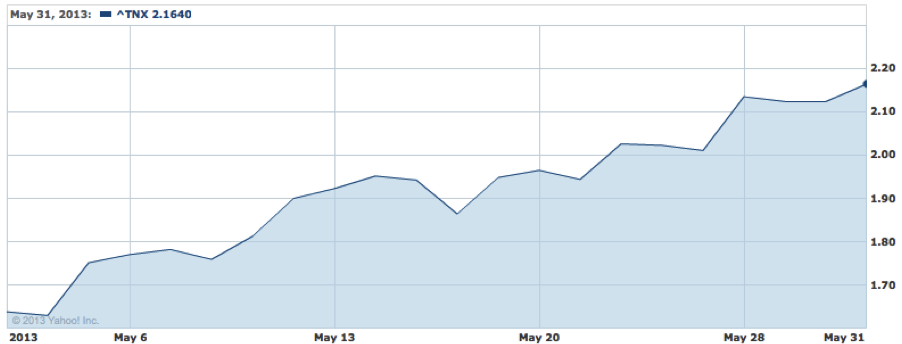
TNX May

Naturally, volatility attracts traders, in this case the speculators. Their gains are not profits from anticipating natural risks to the production of real commodities. They are not skilled in responding to nature. They are front-runners of the artificial risks created by the next move of the government or central bank. Worse still, they seek to influence the government and central bank to act favorably to their interests.

Unlike the trader in commodities, the speculator in man-made irredeemable promises is a parasite. This is not a judgment of any particular speculator, but rather an indictment of the entire dollar regime. It imposes risks, losses, and costs on productive businesses, while transferring enormous gains to speculators.

It is no coincidence that the financial sector (and the derivatives market) has grown as the productive sector has been shrinking. A good analogy is to call it a cancer that consumes the economic body, by feeding on its capital. A free market does not offer gains to those who add no value, much less to parasites who consume value and destroy wealth. The rise of the speculator is due entirely to the perverse incentives created by coercive government interference.[3]

In light of the context we’ve established, we are now ready to start looking at interest rates. In the gold standard, the mechanism is fairly simple as I wrote in “The Unadulterated Gold Standard Part III (Features)”:

This trade-off between hoarding the gold coin and depositing it in the bank sets the floor under the rate of interest.  Every depositor has his threshold.  If the rate falls (or credit risk rises) sufficiently, and enough depositors at the margin withdraw their gold, then the banking system is deprived of deposits, which drives down the price of the bond which forces the rate of interest up.  This is one half of the mechanism that acts to keep the rate of interest stable.

The ceiling above the interest rate is set by the marginal business.  No business can borrow at a rate higher than its rate of profit.  If the rate ticks above this, the marginal business is the first to buy back its outstanding bonds and sell capital stock (or at least not sell a bond to expand).  Ultimately, the marginal businessman may liquidate and put his money into the bonds of a more productive enterprise.[4]
 interest spread

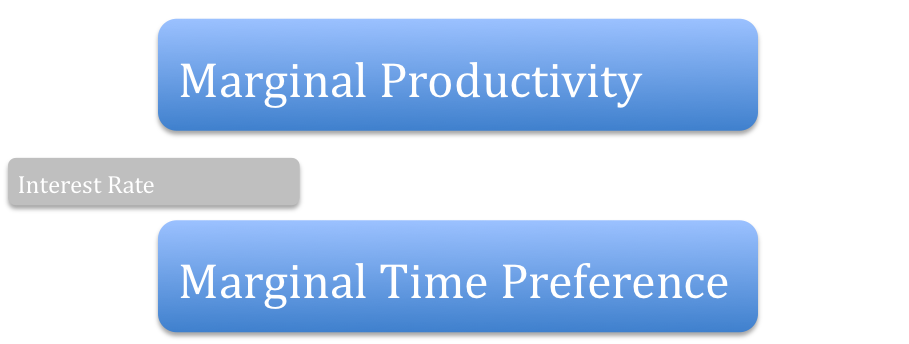
To state this in more abstract and precise terms, the rate of interest in the gold standard is always in a narrow range between marginal time preference and marginal productivity.[5]

The phenomena of time preference and productivity do not go away when there are legal tender laws. The government attempts to disenfranchise savers, to remove their influence over the rate of interest and their power to contract banking system credit.

In the gold standard, when one redeems a bank deposit or sells a bond, one takes home gold coins. This pushes up the rate of interest and forces a contraction of banking system credit. The reason to do this is because one does not like the rate of interest, or one is uncomfortable with the risk. It goes almost without saying that holding one’s savings in gold coins is preferable to lending with insufficient interest or excessive risk.

By contrast, in irredeemable currency, there is no real choice. A dollar bill is a zero yield credit. If one is forced to take the credit risk, then one might as well get some interest. Unlike gold, there is little reason to hoard dollar bills.

The central planners may impose their will on the market; it is within their power to distort the bond market. But they cannot repeal the law of gravity, increase the speed of light, or alter the nature of man. The laws of economics operate even under bad legislative law. There are horrible consequences to pushing the rate of interest below the marginal time preference, which we will study later in this series. The saver is not entirely disenfranchised. He can’t avoid harm, but his attempt to protect himself sets quite a dynamic in motion.

It should also be mentioned that speculators affect and are affected by the market for government credit. Their behavior is not random, nor scattered. Speculators often act as a herd, not being driven by arbitrage but by government policy. They anticipate and respond to volatility. They can often race from one side of a trade to the other, en masse. This is a good segue to our final prerequisite concept.

The linear Quantity Theory of Money tempts us to think that when the Fed pumps more dollars into the economy, this must cause prices to rise. If there were an analogous linear theory of airplane flight, it would predict that pulling back on the yoke under any circumstance would cause the plane to climb. Good pilots know that if the plane is descending in a spiral, pulling back will tighten the spiral. Many an inexperienced pilot has crashed from making this error.

The Fed adds another confounding factor: its pumping is not steady but pulsed. Both in the short- and the long-term, their dollar creation is not steady and smooth. Short term, they buy bonds on some days but not others. Long term, they sometimes pause to assess the results; they know there are leads and lags. They also provide verbal and non-verbal signals to attempt to influence the markets.

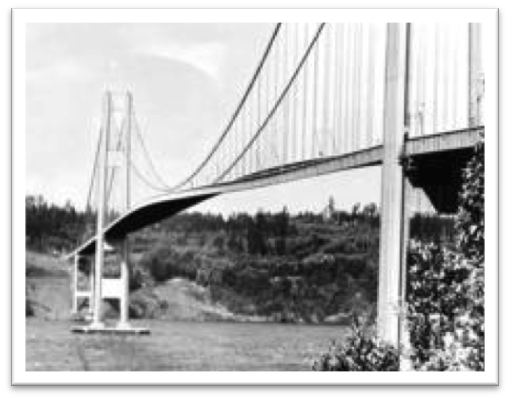
In a mechanical or electrical system, a periodic input of energy can cause oscillation. Antal Fekete first proposed that oscillation occurs in the monetary system. Here, he compares it to the collapse of an infamous bridge:
Tacoma

It is hyperdeflation [currently]. The Fed is desperately trying to fight it, but all is in vain. We are on a roller-coaster ride plunging the world into zero-velocity of money and into barter. In my lectures at the New Austrian School of Economics I often point out the similarity with the collapse of the Tacoma Bridge in 1941.[6]

I will end with a few questions. What happens if the central bank pushes the rate of interest below the marginal time preference? Could this set in motion a non-linear oscillation? If so, will this oscillation be damped via negative feedback akin to friction? Or will periodic inputs of credit inject positive feedback into the system, causing resonance?

In Part IV, we will answer these questions and, at last, dive in to the theory of prices and interest rates.


[3] See my dissertation for an extensive discussion of government interference: A Free Market for Goods, Services, and Money

[5] Interested readers are referred to the subsite on Professor Antal Fekete’s website where he presents his theory of interest and capital markets.

KeithGram: From Bismark to Schaeuble

Wolfgang Schäuble, German finance minister (CD...

Wolfgang Schäuble, German finance minister (CDU) on March 9th 2011, during a pre-election party in Bensheim (Hesse). (Photo credit: Wikipedia)

By Wolfgang Schaeuble’s own admission (he is finance minister of Germany), Europe has an intractable problem.

“We need to be more successful in our fight against youth unemployment, otherwise we will lose the battle for Europe’s unity,” Schaeuble said.

If U.S. welfare standards were introduced in Europe, “we would have revolution, not tomorrow, but on the very same day,” Schaeuble told a conference in Paris.

Uh, Mr. Schaeuble? Welfare causes unemployment. Its voracious apetite for capital defunds productive enterprise. Its perverse incentive encourages sloth and discourages work. Skyrocketing budget deficits crowd out private borrowers, and force central banks to lower the rate of interest to keep the budget deficit from exploding.

And now you have reached the endgame. You cannot provide employment to the youth. And you will soon fail to be able to provide welfare. The endgame of socialism and central planning is always the same.

We Have Gold Coins: Why Don’t They Circulate?

The question asked by the title of this article is not rhetorical. It came up in the debate about Arizona Senate Bill 1439, which recognized gold and silver as legal tender. The bill passed in both the Senate and the House but was vetoed by Governor Jan Brewer, who was concerned the state would lose revenues from taxing rare old coins. She recently promoted a major new welfare program, so at least she is consistent.

Dennis Hoffman, an economics professor at Arizona State University, asked the Arizona Republic, “Can you imagine going in to buy clothing or a pizza with a lump of gold? The retailer is going to look at you like you are crazy.”

I must correct Professor Hoffman on something. No one has ever had to be forced to accept gold. Modern laws don’t force us to accept gold; they force us to accept paper. Otherwise, no one would trade the hard-earned product of his labor in exchange for a mere piece of paper, an irredeemable promise. Today, most stores would not accept gold, but that is just reiterating the status quo. It’s not a reason to keep legal obstacles to the use of gold.

This is the short answer to my question. The government has established coercive barriers to gold circulation. Let’s look at some. First is the capital gains tax, as this was the subject of the Arizona bill.

When you sell gold or silver, you must report the gain or loss and pay a tax if there is a gain. You must keep records of your purchases. This is bad enough if you buy and hold for a long period of time. You may have more dollars but each of them is worth proportionally less. Then (in the US) the government takes away 28 percent of that increase in dollars, and most states take also. The end result is a loss measured objectively in gold, even if it appears as a gain measured in shrinking dollars.

Consider the practical concerns of using gold or silver in commerce. If you pay a restaurant bill with a one-ounce silver coin, the IRS considers this a sale of silver at the current market price. You must prove what you paid for that particular bit of metal and pay a tax if the price rose. Unlike in long-term holdings, you might have several small purchase transactions per day (e.g. gasoline, groceries, and coffee.) The reporting alone—not to mention the tax—makes it impractical to use precious metal coins.

Gold and silver coins are for hoarding only.

Hoarding is in the self-interest of every saver who wishes to avoid Cyprus-style losses when an insolvent counterparty defaults. But the trend of hoarding is leading towards a catastrophe: permanent gold backwardation. This is the first step in the process of gold withdrawing its bid on the dollar. Inevitably, gold will become unavailable in exchange for dollars. When that happens then the dollar will collapse.

Gold owners will no longer demand dollars, but the problem is that dollar holders will still want gold. They will buy whatever gold owners do demand, like commodities. Driven purely by their goal to exchange their dollars for gold, they will drive up the price of every good that can be used as an intermediary. Prices will go up faster and faster. At the end, the dollar will have no value.

Another obstacle to gold circulation is legal tender law that forces creditors to accept dollars as payment in full. No one would lend gold to a borrower who had the option to repay in dollars. As an aside, I believe that if this were the only problem, there would be ways to work around the law and write an enforceable contract.

Next, the taxpayer is forced to pay taxes in dollars. While this does not outright prevent the use of gold, it makes it more difficult. If one uses gold as the unit of account, then this dollar expense poses a risk in case the dollar rises during a tax year.

Further, taxpayers must keep their books in dollars. Anyone is free to keep another set of books in gold (for example my fund does), but this costs money and requires some rare and specialized expertise. Most businesses will not go to this length.

Now, let’s consider the concept of savings. After all expenses, one has some money left over. If this surplus is in the form of a gold coin, there are two possible things to do with it: invest it to earn a yield or hoard it. Today, there is no rate of interest on gold, so that forces the gold or silver saver into hoarding.

If people constantly remove metal from circulation then circulation would stop, even if it somehow started in the first place. There must be an interest rate, to lure gold out of hoards and into productive enterprises that spend it into circulation as they pursue profits. Otherwise it will all disappear.

Finally, we have all grown up in a dollar world. If I say, “I bought $10,000 worth of gold” then everyone knows what I mean. Shifting to the gold paradigm, if I said “I bought 7 ounces worth of dollars” then even longtime gold owners would pause. What is 7 ounces worth of dollars? (It’s about $10,000.)

People think of the value of their gold in terms of dollars. It is madness, like thinking of the length of a steel beam in terms of rubber bands. We all know that the dollar changes in value. Mostly, it falls, though there is some occasional volatility like April 12 and 15. And yet we use it to measure our wealth, our profit or loss, and shareholder’s equity.

One pundit who opposes the gold standard dismissed Arizona SB 1439 by demanding how merchants will know the value of gold or silver tendered in payment. How indeed? Of course, he meant the price in dollars, but I wonder how do merchants know the value of the dollar? People will one day be comfortable speaking of value in terms of ounces. Until then, this is a serious obstacle to gold circulation, if self-imposed.

The discussion of why gold does not and cannot circulate today leads to an insight about the price of gold measured in dollars or, as I prefer to think of it, the price of the dollar measured in gold (as of this writing about 21 milligrams). The recent drop in the price of gold is a pointed reminder that the price of gold has little to do with the quantity of dollars.

The gold price derives from the perceived quality of the dollar. While we still use the dollar to measure all economic values, it is hard to accept that the dollar is in terminal decline. The dollar is just an irredeemable promise, and it is based on bad debt that cannot possibly be paid. We measure the price of gold in dollars, and wait for others to bid up the gold price. Sometimes the timing is good and this happens, sometimes not. The chaotic motions of the dollar cause many goldbugs to have moments of doubt and pain.

The price of gold does not necessarily go up in a straight line or a smooth curve. Abrupt dislocations can occur such as the gold price drop on April 12 and 15, or the silver price jump in the early part of 2011.

The above reasons why gold cannot circulate explain why gold is not priced far higher in dollars. Every one of them could suddenly cease to be relevant. Most people are basically law abiding and pay their taxes. But they will feed their families over obeying the tax law, should they be forced to choose.

We should expect many abrupt, if not violent, moves across all financial markets not least of which will be gold.

It will not be the value of an ounce that changes. It will be the value of a dollar.

Theory of Interest and Prices in Paper Currency Part II (Mechanics)

In Part I, we looked at the concepts of nonlinearity, dynamics, multivariate, state, and contiguity. We showed that whatever the relationship may be between prices and the money supply in irredeemable paper currency, it is not a simple matter of rising money supply –> rising prices.

Here is a fitting footnote for Part I. I just bought a pair of Levis jeans at Macy’s for $45. I remember buying a pair of Levis Jeans in Macy’s in 1983 for $50. In 30 years, the price of Levis Jeans has fallen by 10%. By any conventional theory based on the money supply, the price should have risen by several hundreds of dollars.

In this part, we look at some mechanics, the understanding of which is a prerequisite to the theory of interest and prices. To truly understand anything, you have to know what happens in reality step by step. This is even more important in an abstract field like monetary science. We discuss stocks vs. flows, how prices are formed in a market, a broad concept of arbitrage, spreads, and how money comes into and goes out of existence.

Let’s drill down into a point I made in passing in Part I.

It is worth noting that money does not go out of existence when one person pays another.  The recipient of money in one trade could use it to pay someone else in another.  Proponents of the linear QTM[1] would have to explain why prices would rise only if the money supply increases.  This is not a trivial question. Prices rise whenever a buyer takes the offer, so no particular quantity of money is necessary for a given price (or all prices) to rise to any particular level.

It is seductive to respond by way of the common analogy of “too much money, chasing too few goods”. But, is that an accurate picture of how markets work?

Money supply is a quantity of stocks. One could theoretically add up all of the gold in human inventories, or all of the dollars in the financial system, and come up with a scalar number of ounces or dollars.

How about goods supply? This is a different meaning of the word supply. Unlike in money, the supply of goods means the flows of goods. To discuss copper or wheat, one must measure how much is mined or grown every year. This would be pounds or bushels per year.

Flows of goods cannot be compared in any meaningful way to the stocks of money; pounds per year cannot be compared to ounces. Just like in physics, length cannot be compared to velocity; one cannot compare meters to meters per second. That is not a proper approach to science—physical or monetary.

This brings us to an important fact. The stock of money is not consumed after a transaction. However, in the normal case, goods are. Other than the monetary commodities of gold and silver, only small inventories are normally kept as a buffer in all other goods. To state this in everyday terms, if Joe buys a loaf of bread from Sally for $1, he will eat the bread (or it will go bad) but Sally has the money until she spends it. If Acme Pipe buys 1000 pounds of copper, it will manufacture it into plumbing and sell the plumbing.

Now let’s move on to the mechanism of price discovery. In Part I, I stated:

In any market, buyers and sellers meet, and the end result is the formation of the bid price and ask price.

There is not just one monolithic price, but two prices: the bid, and the ask (also called the “offer”). If you come to market and you must buy, then you have to pay the offer. For example, you own an apartment building and your lease obligates you to provide heat for your tenants. So you go to the heating oil market. If heating oil is bid $99 and offered $101, you must pay $101. Note what happens next. The seller of that oil – assuming you just bought all of his oil – leaves. He has exchanged his oil for your dollars and he goes home. The next seller may ask $102. Now the market is bid $99 and offered $102.

Next, a heating oil distributor comes to market with the day’s production. He must sell, because tomorrow he will produce more. What price does he get? Did your purchase push up the price? You did not push up the bid price, and so the new heating oil vendor must take the bid of $99. Now this consumer is sated, he has the oil he wants. The next best bid could be $97.

There is a counterintuitive process here. The bid is formed by the competition of producers who keep selling until the marginal seller does not accept the bid. The ask is formed by the competition of consumers who keep buying until the marginal buyer does not accept the ask. This is a critical idea in Austrian School analysis, so I encourage readers to stop and think this through.

Buyers keep coming to market and taking the offer (thus lifting it) until a point is reached where the next would-be buyer balks. This buyer, the marginal buyer, may make his own bid, above the best bid but below the best offer. At the same time, sellers keep coming to market and taking the bid, until the marginal seller balks. This seller may set his own offer, below the best offer but above the best bid.

There is one other actor, the market maker. The market maker will act to keep a consistent bid-ask spread. If the ask is pushed up, then the market maker will raise his bid. If the bid is pressed down, then he will lower his ask. The market maker is the only one who can buy at the bid and sell at the offer. His profits come from the bid-ask spread, the wider the spread the more his profits. Of course, the next market maker will enter and force the spread to narrow, and so on until the margin al market maker balks and the spread does not narrow any further.

From the mechanics described here, we begin to build a picture of how prices are set where the “rubber meets the road” in the market. If there are more market participants who buy at the offer then the end result is that prices move upwards. If there are more who sell at the bid, then prices move downwards.

This may seem tautological. It is prerequisite material.

We return to my rhetorical question. Why would prices not keep rising in the case of a fixed quantity of money? After all, when Joe buys the loaf of bread from Sally for $1 there is no reason why Sue could not buy it from him for $2 and John couldn’t buy it from Sue for $3 and so on.

The observant reader may object on grounds that prices can only go up until people cannot afford the good. Bread cannot be $300 per loaf if no one has $300. This is comparing stocks to flows once again. What matters is not whether the consumer has $300 in stocks, but whether the consumer has $300 in flows. If the velocity of money (flows) rises, then the consumer could have $300 of daily income with which to pay the price of his daily bread.

As we see from the above discussion of price formation, neither the buyer nor the seller has an intrinsic advantage. Both come to market and must accept the market price (ask or bid, respectively). Size does not add any power to the seller. If anything, the seller has a disadvantage in trying to get a price he prefers, compared to the buyer. He has capital tied up in his productive enterprise, and certain fixed costs like payroll that must go on whether he sells or does not sell. Holding inventory does not normally do him any good. With the exceptions of food and energy, buyers can afford to be pickier. They do not face the same problem as sellers; if they go home at the end of the day with money as opposed to goods, this is not always a problem.

Without delving too deeply into this topic, I want to paint with a broad brush stroke. There is no force that guarantees a constant price even if the money supply is fixed. There are many reasons why buyers could lift the offer or sellers could press down the bid. Not only can prices rise with the same stocks of money, but they could also rise with the same flows of goods.

Next, let’s introduce the concept of arbitrage. People often use this term in a very narrow sense, to mean buying and selling the same good in different markets to shave off a small spread. For example, IBM stock is offered at $99.99 in London and bid at $100.00 in New York, so the arbitrager could simultaneously buy and sell to pocket a penny. Or, in the gold market, which I write about frequently, one could buy spot gold and sell December gold for a 0.3% annualized spread.

In this paper, I use the word arbitrage to refer to a much broader concept. I won’t fully explore it herein, but we need to discuss one relevant aspect.[2] Let’s go back to our example of the landlord. What is he doing? He is seeking to make a profit by renting out apartments to tenants. The rent is his gross revenue. How is the rent set? If he needs to rent a unit, he must take the bid.

What are his costs? Broadly, he must buy land, construction materials, construction labor, maintenance labor, heating oil, etc. We will address later that he must pay the rate of interest on the capital.

The landlord must buy these things at the offer. We can look at him as doing an arbitrage between his inputs—bought at the offer—and his output product—sold on the bid. The landlord’s spread is Rent(bid) – Inputs(ask).

In this light, what should he be the limit of what he is willing to pay for his inputs? A bit less than the rent he receives, at most.

I give this example to make it clear why we should not think the primary driver of markets is the consumer with a bank account balance as his budget. One might think of a consumer who has a total of $10. Let’s suppose he would want to pay $0.01 for a loaf of bread. But if he had $100 total, he would pay $0.10, and so on. This is the siren song of QTM luring one to think that increased stocks of money must lead to higher prices. It is often stated, “if everyone’s bank account grew by 10X, then prices will be 10X higher.”

Will a middle class consumer buy more food if he has more money?

At any rate, instead of the consumer, we should think of the entrepreneur. He is an arbitrager who will not normally buy inputs unless the bid on his output affords him an acceptable margin above the offer on his inputs. What will cause consumers to raise their bid on his outputs? This is a non-trivial question that will be addressed in a later part of this paper.

Up until now, we have been using the term “money” without regard to the distinction between gold and promises to pay, i.e. between money and credit. It is now necessary to make this distinction to continue the discussion. In the current monetary regime, money (gold) has no official role to play at all, though it assuredly plays a role. My permanent gold backwardation thesis[3] can be summarized as follows: the withdrawal of the gold bid on the dollar will bring about the collapse of the dollar because dollar holders will drive prices up exponentially by using commodities to get gold.

Money (gold), of course, can only come into existence via a slow and inelastic process of mining. Money does not go out of existence (though gold coins can be melted down to produce non-monetary objects). Both of these processes are themselves driven by arbitrage. When the inputs required to mine one ounce of gold cost less than one ounce, the gold miners spring into operation. When the inputs rise above one ounce, they shut down. When jewelry sells for more than the cost of its inputs (principally gold, labor, and perhaps gem stones) then jewelers spring into action. When monetary gold is worth more than jewelry, then it is melted down and returned to monetary form by arbitragers known as “Cash For Gold”.

Credit is an entirely different animal.

In Part III, we will discuss credit including an examination of the borrower, the borrower’s opportunities, and the borrower’s considerations.


[1] Quantity Theory of Money

[2] Those interested can read more about arbitrage in Disequilibrium Analysis of Price Formation by Antal Fekete, January 1, 1999

How Not to Trade the Dollar

I hope this essay provides some food for thought. It is not my intention to insult or belittle anyone, but using humor and cold logic, to help people understand an abstract topic with many counterintuitive principles. The ultimate goal is to protect what you have and make some more (in that order).

Gold is money. We have published a video to make the point that one should use gold to measure the economic value (i.e. price) of everything else including the dollar.

So what does that make the dollar? It is a form of credit, and its quality is constantly falling because the Fed is incessantly forcing more counterfeit credit into the market. The price of the dollar is in long term decline, starting at around 1.6g of gold in 1913 to around 21.3mg (yes milligrams) today.

The price of the dollar sometimes rises for reasons that may not be obvious. The financial system today is highly leveraged. Small changes at the margin, such as intermittent pressure on debtors, can be amplified by this gearing. In the casino of FX markets, traders chase momentum. The occasional crisis somewhere in the world can put enormous (if short term) buying pressure on the dollar. Fear, misinformation, and even delusion can make the crowd run the wrong way. How many people sold their gold on the rumor that Cyprus might sell 10 tons of gold on the market?

The dollar is not suitable to measure the value of gold. It is too volatile, not to mention that it is generally falling. This idea has profound implications on investing and trading. I address one of them in this article.

The central fact of gold today is both self-evident and non-obvious. Most people find it hard to get their heads around the fact that a rising gold price does not produce gains for gold owners. Our whole lives, we’re trained not only to think of the dollar as money, but to think that the dollar price of everything is its value. It is a deeply held belief that if you increase the number of dollars you own, then you have a gain. It is time for this illusion to be dispelled.

Consider a simple trade. First, you buy gold. Then the price of gold goes up. Then you sell the gold. You have a profit, right?

Wrong.

You have more dollars (and the government will tax you on the increase). Each of them is worth less, in precise proportion to the number of them that you gained. To underscore this, let’s look at it from outside the dollar bubble. A rise in the gold price from $1350 to $1500 is really a drop in the dollar from 23mg of gold to 20.7mg. If you bought an ounce of gold with 1350 dollars you still have one ounce worth of dollars when the dollar has fallen to 1/1500 ounce (or 1/5000).

This means that a strategy of buying and holding gold for the long term does not produce wealth.  It protects wealth, because gold does not fall. To get richer, you must either invest to receive a yield in gold, or speculate on an asset with a rising gold price. Producing a yield on gold is the reason why Monetary Metals was formed. Speculating on rising asset prices is challenging because as we head into this greater depression, demand is falling. I recommend checking out www.pricedingold.com, which has charts of many different things priced in gold.

It is possible to trade the short-term volatility in the dollar. To frame this objectively, it is buying the dollar when it is down and selling when it is up. I deliberately did not state this as people commonly think of it today: buying gold when it is down and selling gold when it is up. Gold is not going anywhere; it is the dollar that is volatile and falling.

Your first choice is whether to use leverage. Leverage would allow you to profit from the rising gold price because you will gain more dollars at a faster rate than the dollar is losing value. Let’s illustrate this with two examples.

The first example uses no leverage. You buy 100 ounces of gold for $1460 per ounce, a total of $146,000. The gold price eventually doubles to $2920. You have twice as many dollars, but unfortunately each of them is worth half as much. Your net worth in gold is still 100 ounces.

The second example uses 5:1 leverage. You buy 500 ounces of gold at $1460 per ounce, or $730,000 worth of gold, but you only need the same $146,000 as in the first example. The bulk of the capital, $584,000, is credit. Then, the gold price doubles to $2920. Now your 500 ounces is worth $1,460,000. You can sell 200 ounces to pay the debt, and you are left with 300 ounces free and clear. Your net worth tripled from 100 to 300 ounces.

However, there is a dark side to leverage. When the price falls, leveraged accounts are subject to margin calls. The trader must immediately put in more dollars or else the broker will sell everything, and the trader could lose everything. Just ask anyone who was leveraged a few weeks ago when gold was near $1600 what happened, and if he still has a gold position, or any capital left in his account at all.

This kind of event is exceedingly hard to predict. We did not predict it from our analysis of the basis (though we did make a bold and controversial prediction and trade recommendation that has performed quite well). Following April 15, the basis allowed us to see that large quantities of physical gold and silver were flushed out of someone’s hands and into the market. And as we go forward, it will allow us to see the changes in scarcity of gold and silver.

Not counting the Keynesians, or the perma-bears who have long thought that gold should collapse to $250, some technical analysts put out bearish calls on gold and a few called for a significant and rapid price drop.

Trading the downside in gold is very difficult because no matter how the technicals look, there is a risk that some central bank or big player could make an announcement that would drive the gold price up sharply. Indeed, we predict that volatility will rise as we go forward. For this reason, and of course the upward bias to the gold price, we never recommend a naked short position in gold or silver.

If you do not use leverage, it is difficult to produce a real gain. Remember that a generally rising gold price is just a generally falling dollar. You can’t make a profit from this. You rely on short-term volatility. You buy gold at a lower price and then sell it at a higher price. And you must hope that the gold price falls again. If not, then your strategy has failed.

There are other downsides to the unleveraged strategy.  One is that you must hold falling dollars at times. You buy gold, hold it for an hour or a day or a week and then you sell it. You’re left holding dollars, hoping for a lower gold price. During that time, you are exposed not only to the falling dollar, but also to the credit of your bank or broker as well. We would prefer a strategy that allows one to sleep at night, especially Friday, Saturday, and Sunday night.

I corresponded with a gold dealer in Cyprus following their collapse. He recommended to people to buy gold. Not one person took his advice. Now, of course, they regret their decisions. This is not because consumer prices rose in Cyprus, but because what they thought of as “money” has turned out to be just bad credit, a defaulted piece of paper. Gold does not default.

At the end of the day, when the dollar collapse takes on a more vicious dynamic and rapid pace, the gold price will be rising sharply, perhaps exponentially. What will you do then? If the charts say that gold is overbought, will you take your profits? Will you sell at a record high price? Will you trade all of your gold for dollars immediately prior to the dollar becoming utterly worthless?

With or without leverage, trading any market without better information and/or a superior understanding than the other traders is a sucker’s game. Having faith in a $50,000 gold price and a conspiracy theory that a Dark Cabal manipulates it down to  $1460 is not information or understanding. It is just hope plus words of comfort to use after each wounding.

The gold market has price moves that cannot be predicted in advance and in some cases do not have an obvious cause in contemporaneous news coverage. In my article on the gold price drop, I do not point the finger at the rumors of Cyprus being forced to sell its gold, Texas or Germany demanding their gold, etc.

Today, at $1460, the question is: are there dissatisfied traders who held on during the crash, and who are now waiting for a slightly higher price to sell? Will these people outweigh the hungry buyers who look at the current price as a sale, in the short term? We would not care to make a prediction on this. The long term is much easier to predict. The catch is that without leverage, you cannot profit from it and with leverage you can get squeezed out in a price drop before the price rises.

Technical analysts that we respect now say that massive damage has been done to the gold and silver charts, and there is a likely to be a further drop in the prices. Some technicians are calling for a price at or below $1100. Will it happen? Maybe, and if it does, it won’t be caused by the Dark Cabal.

It will be dollar-oriented traders, eager to sell low because gold is “falling”, and the destructive dynamics of stop orders, margin calls, momentum chasers (who do sometimes short gold naked), etc. As when gold’s price was rising, now that it’s falling traders are trying to outguess the others in the market, who are trying to outguess them. The picture of a Ouija Board is not too inaccurate.

It is possible to trade gold professionally, to make a profit measured in gold. If you want to trade, then you ought to know about the mechanics of the market (e.g. arbitrage, about the concept of relative gold scarcity (i.e. the gold basis), and about monetary science (e.g. pressures on markets related to changes in credit). Develop your trading strategy around them, rather than on whispers of big London or Chinese buyers, and curses at Dark Cabals.

Theory of Interest and Prices in Paper Currency Part I (Linearity)

Under gold in a free market, the theory of the formation of the rate of interest is straightforward.[1] The rate varies in the narrow range between the floor at the marginal time preference, and the ceiling at the marginal productivity. There is no positive feedback loop that causes it to skyrocket (as it did up until 1981) and subsequently to spiral into the black hole of zero (as it is doing now). It is stable.

In irredeemable paper currency, it is much more complicated. In this first part of a multipart paper presenting my theory, we consider and discuss some of the key concepts and ideas that are prerequisite to building a theory of interest and prices. We begin by looking at the quantity theory of money. In our dissection, we will identify some key concepts that should be part of any economist’s toolbox.

This theory proposes a causal relationship between the quantity of money and consumer prices. It seems intuitive that if the quantity of money[2] is doubled, then prices will double. I do not think it is hyperbole to say that this premise is one of the cornerstones of the Monetarist School of economics. It is also widely accepted among many who identify themselves as adherents of the Austrian School and who write in critique of the Fed and other central banks today.

The methodology is invalid, the theory is untrue, and what it has predicted has not come to pass. I am offering not an apology for the present regime—which is collapsing under the weight of its debts—but the preamble to the introduction of a new theory.

Economists, investors, traders, and speculators want to understand the course of our monetary disease. As we shall discuss below, the quantity of money in the system is rising, but consumer prices are not rising proportionally. Central bankers assert this as proof that their quackery is actually wise currency management.

Everyone else observing the Fed knows that there is something wrong. However, they often misplace their focus on consumer prices. Or, they obsess about the price of gold, which they insist should be rising in lockstep with the money supply. The fact that the price of gold hasn’t risen in two years must be prima facie proof that there is a conspiracy to suppress it. Gold would have risen, except it’s “manipulated”. I have written many articles to debunk various aspects of the manipulation theory.[3]

The simple linear theory fails to explain what has already occurred, much less predict what will happen next. Faced with the fact that some prices are rising slowly and others have fallen or remained flat, proponents insist, “Well, prices will explode soon.”

Will the price of broccoli rise by the same amount as the price of a building in Manhattan (and the same as a modest home in rural Michigan)? We shall see. In the meantime, let’s look a little closer at the assumptions underlying this model.

Professor Antal Fekete has written that the Quantity Theory of Money (QTM) is false, on grounds that it is a linear theory and also a scalar theory looking only at one variable (i.e. quantity) while ignoring others (e.g. the rate of interest and the rate of change in the rate of interest).[4]  I have also written about other variables (e.g. the change in the burden of a dollar of debt).[5]

It is worth noting that money does not go out of existence when one person pays another.  The recipient of money in one trade could use it to pay someone else in another.  Proponents of the linear QTM would have to explain why prices would rise only if the money supply increases.  This is not a trivial question. Prices rise whenever a buyer takes the offer, so no particular quantity of money is necessary for a given price (or all prices) to rise to any particular level.

In any market, buyers and sellers meet, and the end result is the formation of the bid price and ask price. To a casual observer, it looks like a single “price” has been set for every good. It is important to make the distinction between bid and ask, because different forces operate on each.

These processes and forces are nonlinear. They are also not static, not scalar, not stateless, and not contiguous.

Nonlinear

First let’s consider linearity with the simple proposal to increase the tax rate by 2%. It is convenient to think it will increase government tax revenues by 2%. Art Laffer made famous a curve[6] that debunked this assumption. He showed that the maximum tax take is somewhere between 0 and 100% tax rate. The relationship between tax rate and tax take is not linear.

Another presumed linear relationship is between the value of a unit of currency and the quantity of the currency outstanding.  If this were truly linear, then the US dollar would have to be by far the least valuable currency, as it has by far the greatest quantity. Yet the dollar is one of the most valuable currencies.

“M0” money supply has roughly tripled from 2007, “M1” has roughly doubled, and even “M2” has risen by 50%.[7] We don’t want to join the debate about how to measure the money supply, nor do we want to weigh in on how to measure consumer prices. We simply need to acknowledge that by no measure have prices tripled, doubled, or even increased by 50%.[8] It’s worth noting an anomaly: on the Shadowstats inflation[9] chart, the inflation numbers drop to the negative precisely where M0 and M1 rise quite sharply.

Consider another example, the stock price of Bear Stearns. On March 10, 2008 it was $70. Six days later, it was $2 (it had been $170 a year prior). As Bear collapsed, market participants went through a non-linear (and discontiguous) transition from valuing Bear as a going concern to the realization that it was bankrupt.

Dynamic

Some people today argue that if the government changed the tax code back to what it was in the 1950’s then the economy would grow as it did in the. This belief flies in the face of changes that have occurred in the economy in the last 60 years. We are now in the early stages of a massive Bust, following decades of false Boom. Another difference was that they still had an extinguisher of debt in the monetary system back then. I wrote a paper comparing the tax rate during the false Boom the Bust that follows[10]. The economy is not static.

By definition and by nature, when a system is in motion then different results will come from the same input at different times. For example, if a car is on the highway at cruising speed and the driver steps on the accelerator pedal, engine power will increase. The result will be acceleration. Later, if the car is parked with no fuel in the tank, stepping on the pedal will not cause any increase in power. Opening the throttle position does something important when the engine is turning at 3000 RPM, and does nothing when the engine is stopped.

Above, we use the word dynamic as an adjective. There is also a separate but related meaning as a noun. A dynamic is a system that is not only changing, but in a process whereby change drives more change. Think of the internal combustion engine from the car, above. The crankshaft is turning, which forces a piston upwards, which compresses the fuel and air in the cylinder, which detonates at the top, forcing the piston downwards again. The self-perpetuating motion of the engine is a dynamic. This is a very important prerequisite concept for the theory of interest and prices that we are developing.

Multivariate

It is seductive to believe that a single variable, for example “money supply”, can be used to predict the “general price level”. However, it should be obvious that there are many variables that affect pricing, for example, increasing productive efficiency. Think about the capital, labor, time, and waste saved by the use of computers. Is there any price anywhere in the world that has not been reduced as a consequence? The force acting on a price is not a scalar; there are multiple forces.

It should be easy to list some of the factors that go into the price of a commodity such as copper: labor, oil, truck parts, interest, the price of mineral rights, government fees, smelting, and of course mining technology. One or more of these variables could be moving in the opposite direction of the others, and as a group they could be moving in the opposite direction as the money supply.

Perhaps even more importantly, the bid on copper is made by the marginal copper consumer (the one who is most price-sensitive). At the risk of getting ahead of the discussion slightly, I would like to emphasize that today the price of copper is set by the marginal bid more than by the marginal ask. The price of copper has, in fact, been in a falling trend for two years.

Stateful

Modeling the economy would be much easier if people would respond to the same changes the same way each time—if they didn’t have memories, balance sheets, or any other device that changes state as a result of activity. Even Keynesians admit the existence of human memory (ironically, they call this “animal spirits”[11]), which makes someone more cautious to walk into a pit a second time after he has already learned a lesson from breaking his leg. People are not stateless.

Stateless, and its antonym stateful, is a term from computer software development. It is much simpler to write and understand code that produces its output exclusively from its inputs. When there is storage of the current state of the system, and this state is used to calculate the next state, then the system becomes incalculably more complex.

In the economy, a business that carries no debt will respond to a change in the rate of interest differently from one that is struggling to pay interest every month. A company which does not have cash flow problems but which has liabilities greater than its assets would react differently still.

An individual who has borrowed money to buy a house and then lost the house to foreclosure will look at house price combined with the rate of interest quite differently than one who has never had financial problems.

It is important not to ignore the balance sheet or human memory (especially recent memory) when predicting an outcome.

Discontiguous

Markets (and policy outcomes) would be far more predictable, and monetary experiments far less dangerous, if all variables in the economy moved according to a smooth curve.

A run on the bank, as is occurring right now in Cyprus (in slow motion due to capital controls), is a perfect example of a discontiguous phenomenon. One day, people believe the banks are fine. The next day there may not be a measurable change in the quantity of anything, and yet people panic and try to withdraw their money. If the bank is insolvent, they cannot withdraw their money, it was already lost.

A common theme in my economic theories is asymmetry. In the case of a run on the bank, there is no penalty for being a year early, but one takes total losses if one is an hour late. This adds desperate urgency to runs on the bank, and desperate urgency is one simple cause of an abrupt and large change, i.e. discontiguity.

Ernest Hemingway famously quipped that he went bankrupt, “Two ways. Gradually, then suddenly.”[12] It’s not a smooth process.

There are many other examples, for instance a scientific breakthrough may enable a whole new industry because it reduces the cost of something by 1000 times. This new industry in turn enables other new activities and highly unpredictable outcomes occur. As an example, the invention of the transistor eventually led to the Internet. The Internet makes it possible for advocates of the gold standard to organize and coordinate their action into a worldwide movement that demands honest money. The gold standard in this example would be a discontiguous effect caused by the invention of the transistor.

My goal in Part I was to introduce these five key concepts. While not writing directly against the Quantity Theory of Money, I believe that a full grasp of these concepts and related ideas would be sufficient to debunk it.

In Part II, we will discuss the dynamic process whereby the rate of interest puts pressure on prices and vice versa. I promise it will be a non-linear, multivariate, stateful, dynamic, and discontiguous theory.


[2] We do not distinguish herein between money (i.e. gold) and credit (i.e. paper)

[3] Full disclosure: when I am not working for Gold Standard Institute, I am the CEO of Monetary Metals, which publishes a weekly picture and analysis of the gold basis. One can see through the conspiracy theories using the basis: http://monetary-metals.com/basisletter/

[9] I don’t define inflation as rising prices, but as an expansion of counterfeit credit: Inflation: an Expansion of Counterfeit Credit

[12] The Sun Also Rises by Ernest Hemingway, 1926

My new site

Posterous was acquired by Twitter a while ago. At first, it seemed like it was an expansion play by Twitter to cover blogging as well. But then they announced that they were shutting down Poster.com permanently without even leaving up blog pages in an archive form. Twitter wanted to use the employees of Posterous for other projects (a dubious HR strategy, in my opinion).

At any rate, that left me without a home for my papers. Now I have moved to this hopefully permanent home at keithweinereconomics.com.

I have migrated all the content from the Posterous site here, so hopefully nothing was lost. If you find that something does not work or look right, please let me know!

Here’s to years of happy blogging in my new home! 🙂

Cyprus Forced Into Bailout Deal

Do you think that depositors in Cyprus are being taxed? That their money is being taken from them to go to the government in Cyprus or to Europe? Most analysis of the Cyprus bailout is wrong on this point.

Cypriot banks are like all banks in one respect. They raise capital to buy assets that earn a yield, keeping the difference between what they must pay for the money and what they earn on it. Like all banks, they raise money first from equity investors. Equity investors get to keep all of the gains on the upside and therefore are first exposed to losses on the downside.

Banking uses leverage, which multiplies gains when assets rise and losses when they fall. Imagine using 20:1 leverage. You buy a house for $100,000 using $5,000 of your own money (equity) and $95,000 of borrowed money. If the house rises to $110,000 you have tripled your $5,000 of initial equity to $15,000. If the house falls to $94,000 you have negative equity. That may be fine for a homeowner so long as you can pay the interest and principle when due. It’s not fine for a bank.

Banks raise money next from junior, unsecured creditors. Equity capital is expensive capital. Borrowing money is cheaper than selling a stake in the business. Next on the capital hierarchy is senior, secured creditors. Borrowing at this tier is cheaper because the risk of loss is lower. Not only would the shareholders have to be wiped out first, but also the junior creditors. Additionally, secured creditors can take the assets pledged as collateral.

Finally, banks raise money from depositors. Depositors get the lowest rate of interest, which is the tradeoff for having the strongest position in case of bankruptcy. In addition to not suffering any losses until all other classes of capital are zeroed out, depositors also enjoy a government guarantee today, at least up to a certain amount (€100,000 in the case of Cyprus)—so long as the government can pay. It is important to note that while the government maintains the fiction of a “fund” to cover such losses, in a bank crisis the losses are imposed on the taxpayers. Today in the US, for example, the FDIC has a tiny reserve to cover an enormous deposit base.


Fdic_ratios


In the modern world, government bonds are the key security in the financial system. They are defined as the “risk free asset” by theory and regulatory practice. They are used as collateral for numerous other credit transactions. And banks hold them as core assets. Let’s focus on that. A bank borrows from depositors and buys a government bond (and not entirely by choice). There are two problems with this.

First is duration mismatch. The bank is borrowing from depositors, perhaps via demand deposits, and then buying multiyear bonds. Read the link to see why this will sooner or later blow up.

Second, the government bond is counterfeit credit. Governments are borrowing to pay the ever-expanding costs of their welfare programs and the interest on their ever-expanding debt (it is no help that they lower the rate of interest to keep down the interest expense—this increases their burden of debt and destroys capital). Governments have neither the means nor intent to ever repay the debt. They just endlessly “roll” the liability, selling new bonds to pay the principle and interest on old bonds at maturity. This would be like taking out a new credit card to pay off the old one. It “works” for a while, until it abruptly stops working. It has stopped working in Greece; it will stop working everywhere else at some point.

The Cypriot banks bought lots of government bonds, including the defaulted bonds of bankrupt Greece. They lost the euros that were invested by their shareholders, bondholders, and a majority of what was lent to them by depositors. In a way it is accurate to say that the government took it. However, his taking did not occur this week. It occurred when governments sold them fraudulent bonds over many years.

The money is now long gone.

Call it what you will, the government, central bank, and commercial banks of Cyprus are bankrupt; they needed a bailout—new credit from outside the country to postpone collapse. In a week of drama, posturing, demands, reversals, and a vote in parliament, a deal was struck. No one is likely to be happy. Here are the key points so far as we can glean them:

  • A fresh tranche of €10B will be lent to Cyprus
  • Funds to come from (presumably?) the “Troika”: ECB, EC, and IMF
  • Shareholders and bondholders in Laiki (2nd biggest bank) will be wiped out
  • Laiki deposits under €100,000 will be transferred to Bank of Cyprus
  • Larger deposits will bear big losses (not specified at this time)
  • No bailout funds will go to Bank of Cyprus (presumably to government?)
  • 50% or more of large deposits in Bank of Cyprus converted to equity
  • “Temporary” capital controls will remain when banks reopen Thursday
  • CEO of Bank of Cyprus just resigned, fueling rumors it too will collapse

The Europowers have a big dilemma. If they allow euro backwardation to persist much longer, or they open a schism in the euro where Cyprus euros are not fungible, they risk the collapse of the euro. On the other hand, if they do not impose capital controls then depositors would run on the Bank of Cyprus and it will collapse (ZeroHedge has been covering the story that large Russian depositors have found ways to make withdrawals even though the banks have been closed, using branches located outside the country).

We hope that if the reader gets nothing else from this article, at least he now understands that the Cyprus banks lost their depositors’ money over a long period of time. They used leverage to buy assets that collapsed and now they are insolvent. External parties are providing a bailout (which Cyprus will never be able to repay). For the first time in this crisis, the bailout does not cover depositors in full. Losses are to be suffered by not only shareholders and bondholders, but even by depositors. We expect future bailouts to incorporate this feature.

It is good that Eurozone leaders are beginning to assert that banks should fix themselves. In a free market, there is no such thing as a bailout that takes money from taxpayers to give to those who made a mistake. Hopefully they will take this to the next logical step and realize that bank solvency is impossible under the regime of irredeemable paper currency wherein the government bond is defined as the “risk free asset”. Gold is the risk free asset. Everything else has a non-zero risk of default.

We will continue to monitor and publish the gold basis to see when world markets begin to shift away from trusting the banking system, when people are willing to forego a yield to avoid having to trust a counterparty. When this happens, we expect gold to move more significantly towards gold backwardation.

Compared to the first proposal last week, this bailout is less unfair (we can hardly call any bailout fair)—at least shareholders go first, then bondholders then depositors.