In Free Market Revolution, co-authors Yaron Brook and Don Watkins, colleagues at the Ayn Rand Institute, undertook a difficult task.
Since Ayn Rand made the case for egoism as the morality of capitalism in Atlas Shrugged (and more pointedly in Capitalism: The Unknown Ideal), numerous books have argued that free markets produce wealth, discussing various aspects capitalism, and criticizing every type of government interference with markets as impractical. From Milton and Rose Friedman’s Free to Choose to books by George Gilder and others, we have not been spared the practical arguments for capitalism.
Yet the size, scope and power of our government controlled economy continues to expand. Most advocates of limited government treat the expansion as though it’s an inevitable consequence of the nature of government.
Brook and Watkins show that the cause is something else: ideas accepted in our culture. They have set out to make the case, in a book that is short and readable, for a better set of ideas and bring Rand’s morality into the mainstream.
This is an uphill battle. Profit and those who seek it are almost universally viewed with suspicion. Many people assume that if someone is needy, the government has a moral obligation to provide help. Advancing this view is no way to defend capitalism. This is a key point of Free Market Revolution.
Brook and Watkins present an abbreviated economic history, debunking welfare-statist lies, and explore the mechanisms of free markets. They most importantly demonstrate that capitalism is moral.
“A moral defense of the profit motive would have to say that living as a trader, for your own happiness and by your own effort, is noble.”
This puts the emphasis on where it belongs: living by your own effort, trading with others, for the sake of your own happiness. When it is stated this clearly, who could argue with it?
Throughout the book, they provide insights that are probably new to most readers, and will increase one’s understanding of how people coordinate productive efforts in a free market.
For example, they discuss the problem known as “the coincidence of wants.”
In barter one party may want what the other has, but the other party may not wish to reciprocate. One example in the book is the case of one man who makes shoes and another who catches fish. but the fisherman already has shoes, no trade is mutually desired. Money, however, makes trade more efficient. Suppose the shoemaker trades his product for whatever commodity is used as money, knowing he can always trade money for wheat or anything else.
Brook and Watkins culminate their discussion:
“…originally money was a material good—usually gold. Gold was the most marketable good in the economy…”
To grasp this is to see the root of the problem with our present worldwide system of irredeemable money. The government prohibits people from using the most marketable good, gold, in favor of the government’s paper money. But the paper, based on debt, is not marketable without legal tender laws that force people to accept it.
Free Market Revolution also discusses competition and the relentless pressure to respond to the market, competitors, innovation, and other changes. Brook and Watkins use an effective anecdote from the early days of Intel Corporation to illustrate the honesty, discipline and focus required to remain in business. When new competitors were manufacturing computer memory chips. Intel was no longer able to make a profit in that business, the co-authors write, so Intel decided to focus on microprocessors instead.
“Finally, [Intel executive Andy] Grove asked then-CEO Gordon Moore, ‘If we got kicked out and the board brought in a new CEO, what do you think he would do?’ Moore replied without hesitation, ‘He would get us out of memories.’ After a long moment, Grove said, ‘Why shouldn’t you and I walk out the door, come back and do it ourselves?’” That’s what Intel did—and it paid off with impressive results for Intel, vendors and consumers.
Free Market Revolution is illuminating in this regard, especially for those unfamiliar with running a business.
However, this book is most likely to convince those already mostly convinced of the virtues of capitalism. It would fill a thick volume or series of volumes to cover the morality of self-interest with regard to capitalism, or a decent history of markets and welfare-statist failures, or how free markets coordinate the activities of all participants. Free Market Revolution makes the mistake of trying to traverse all of these domains.
The writing is uneven. There are many gems, though there are also missed opportunities for greater clarity through editing. For example, in more than one case an important term is defined within an “emdash”:
“The cornerstone of Marxian economics, for instance, is the labor theory of value— the idea that the value of goods produced is a function of the physical labor that went in to producing them.”
I doubt that this will be clear to a reader who is new to Ayn Rand’s ideas and who has not studied economics (and if the reader already knows the labor theory of value, this is unnecessary).
Some definitions lack even an emdash. Rand fans and Objectivists may be familiar with Immanuel Kant and his “categorical imperative”—an unlimited moral duty to sacrifice yourself (emdash irony intended)—while others, such as Tea Party conservatives and independents, may be lost.
Other parts need more information to get the co-authors’ underlying point. Consider this example: “Don’t be confused by the fact that we sometimes pay more for a product than we would like or get paid less than we had hoped. The fact that a gain from trade isn’t as large as we would have preferred doesn’t change the fact that it is a gain.”
This part, included in a section discussing trade, may not suffice for someone who seeks to grasp why health insurance costs so much compared to, say, life insurance. Too much of Free Market Revolution reads like shorthand for those who know the philosophy, leaving those who don’t know as much somewhat confused.
I often hear people complain that a free market doesn’t “work”. What I think they mean is that they don’t think the free market gives them what they want at the price they want. Brook and Watkins understand why this is an error, but, again, their answers and explanations don’t always amount to a persuasive argument.
They write, for instance, that “Upton Sinclair’s socialist propaganda aside, historian Gabriel Kolko notes that food makers ‘learned very early . . . that it was not to their profit to poison their customers…
Will today’s readers recognize the reference to Sinclair’s The Jungle? If not, inserting a second author that most people haven’t read is not helpful.
General audiences attracted to Ayn Rand’s inclusion in the subtitle may be receptive to Brook’s and Watkins’ arguments, but those who like her fiction and want to examine her ideas more closely may be left unmoved or, worse, confused. If one has read Atlas Shrugged and Ayn Rand did not persuade him, then it’s worth asking: will Free Market Revolution?
Free Market Revolution contains a few economics errors, especially in monetary science. Both Keynesians and Monetarists hold that “inflation” means rising prices. Brook and Watkins do no service to the reader—or to the cause of liberty—by ceding this error. Most economists of the Austrian school (to which I expect Brook and Watkins subscribe) define inflation as an increase in money and/or credit (Mine is a more specific definition: an expansion of counterfeit credit).
Promoting the view of John Maynard Keynes and Milton Friedman, i.e., that inflation means rising prices, is a serious error; industry is constantly increasing efficiency, so this flawed definition essentially cedes to the government that to steal the wealth of those who store it in dollars is acceptable. Absent inflation, prices would be falling.
Those who have studied Austrian economics and are familiar with what it has to say about liberty are among those who need the most help in putting liberty into the context of morality, and this inflation error, repeated in a number of places, may weaken the co-authors’ credibility with free market scholars.
In many places, Free Market Revolution is excellent. It is written to promote a cause which is both crucial and urgent—especially the cause of moving toward the gold standard. But I am skeptical that Free Market Revolution is likely to have a large impact on today’s readers, let alone on the culture. The challenge of writing such an important book, with such an enticing title, is enormous. Brook and Watkins, who deserve credit for making the effort, rise to it with mixed results.


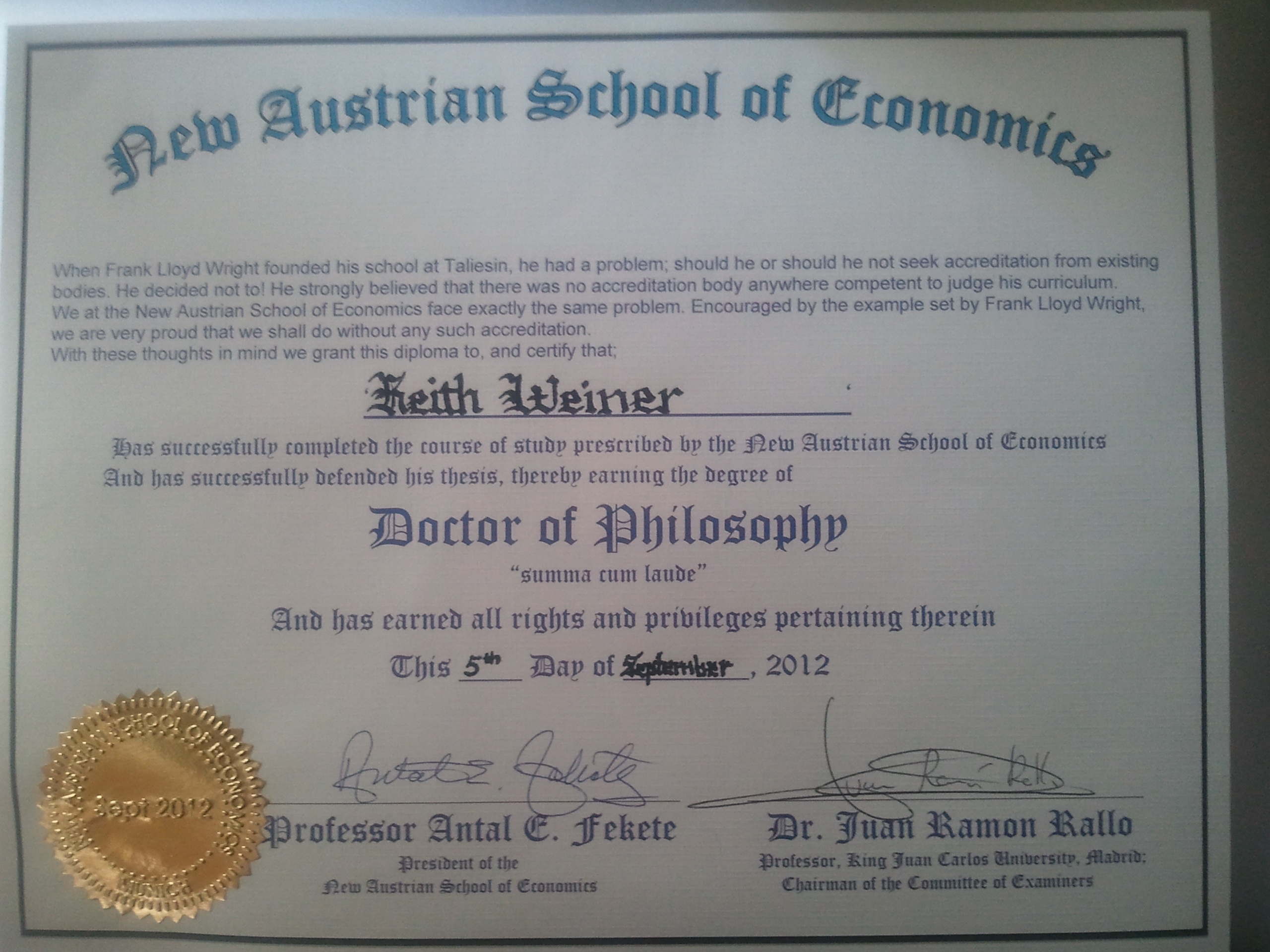
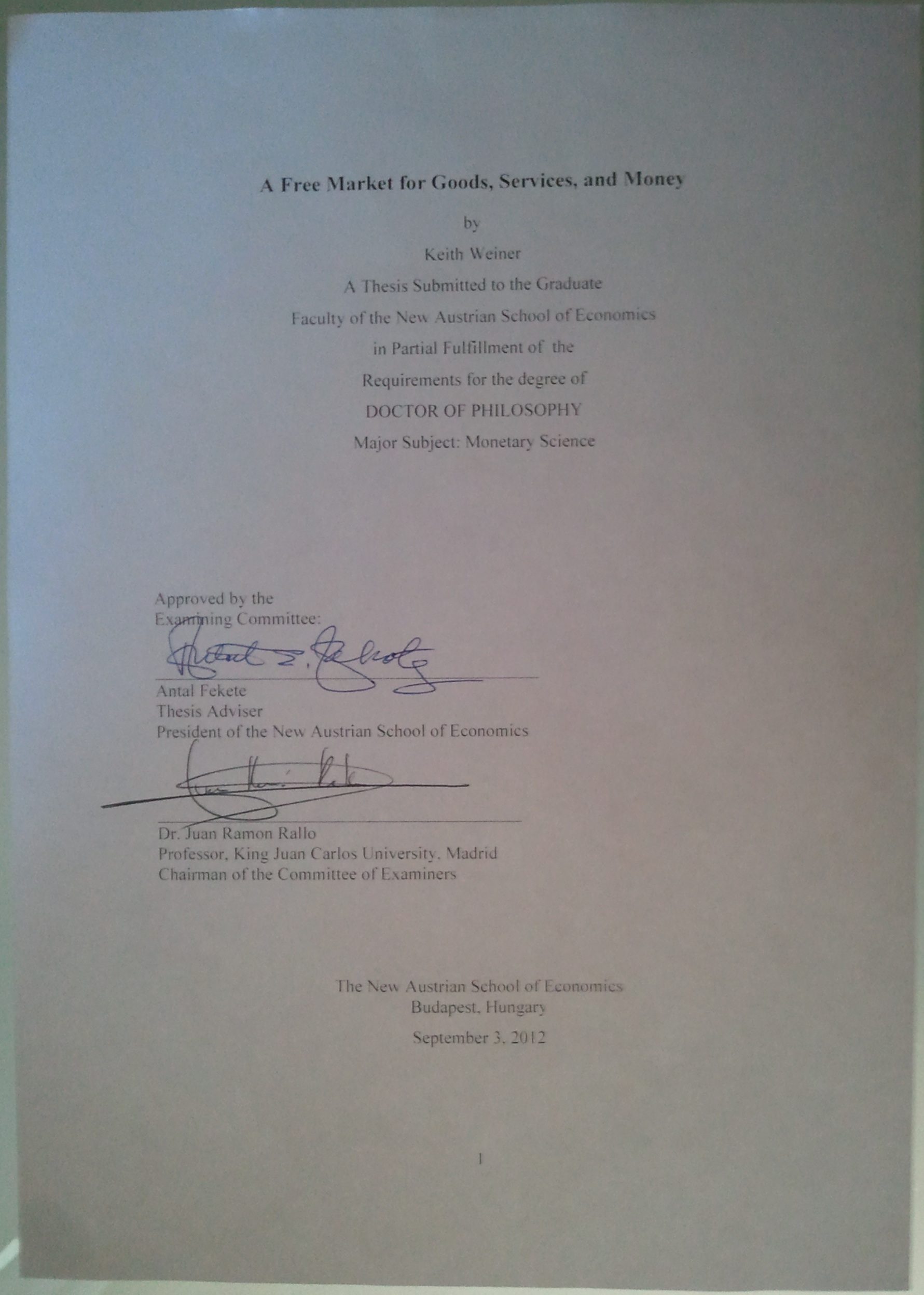
 Keith Weiner Economics