Category Archives: Uncategorized

Antidiscrimination Law

“We need to make it illegal for companies to discriminate.” This applies to employees, and even customers.

Well, either such discrimination—really bigotry—is good for the company, or it isn’t. Either companies benefit from racial or gender preferences in employees, or they don’t. Either bakers benefit from turning away paying customers who want cakes, or not (without discussing those rare cases where someone wants to force the baker to bake a cake with a hateful message on it).

If you believe that corporate decisions made by bigotry are good for companies, then that would seem to justify laws to ban it. Well, it would justify it if you believe that the proper purpose of law is to force people to act against their own interest for the sake of someone else’s good…

…Wait, why is it in the interest of employers to fire the blacks (to name one legally protected group)? If you want go there, then realize that there is no way to make this case without promoting overt racism. Think about it. Take as long as you need.

Perhaps you believe that corporate decisions made by bigotry are not good for companies. Then why the need for a law at all? Do you seriously argue that people need to be forced to use cars rather than horses, to use computers rather than do their books using paper ledgers, and to live in houses rather than be exposed to the elements? Self-interest is its own motivator.

And if the purpose of this law is to help companies, how do you justify fining them, punishing them, and or even bankrupting them?

Antidiscrimination law is entirely uncontroversial. It’s universally supported by the Left, nearly universally on the Right, and even some Libertarians promote it. Yet it’s based on logic so flawed that in a rational culture that actually taught logic in school, middle school students would all be able to write essays explaining why such law is contradictory.

Everyone supports it, yet it’s simple to show it’s bad. Hmm, think about that for a while.

Regulation, Thy Nature is Flawed

Regulation has several inherent flaws.

1. One agency acts as legislative, judicial, and executive branch. It makes the rules, decides who is breaking them, and punishes offenders.

2. Regulation is based on the doctrine of prior restraint. Instead of retaliating by force against criminals, the government initiates the use of force against innocents–because they might commit a crime. So it criminalizes non-crimes.

3. Regulation forces businesses to prove a negative–often at great expense.

4. It ossifies the status quo. It is easy (well relatively) to get permission to do the same thing that everyone else is doing. Much harder to get permission to change how business is done.

5. It is an engraved invitation for cronies to use regulation and regulators to suppress competitors.

6. It gives the unscrupulous a place to hide. Bernie Madoff was highly regulated. Regulation didn’t stop him.

7. It prevents startups from forming in the first place (doubly so because raising capital is itself highly regulated, and startup founders don’t typically have the capital and legal sophistication to navigate the regulations).

8. Regulation makes it impossible to know in advance what is legal and what is not. This is because regulation attempts to control actions A, B, and C in an indirect way to prevent crime X. So it can make arbitrary distinctions between two essentially similar things–but one is illegal.

9. Regulation makes it illegal for you to do something that someone else can do legally.

Should Government Give Us the Infrastructure?

An argument against absolutely free markets comes up often. What about so called natural monopolies? So called infrastructure (e.g. sewage plants) have high barriers to entry, and are a challenge to true competition. Therefore if left to private companies, they would become bad monopolies. So it is best for government to provide them.

I think there are answers on several levels.

  1. Moral. The argument is saying that men need to be forced, like brutes. Horses will do no work unless harnessed, and led around by a bit in their mouth (if not whipped). Haven’t we proven beyond a shadow of a doubt that this is wrong?
  2. Economic. The question of how men coordinate their actions–how they CAN coordinate–is one of the major questions of economics. The answer is: each must pursue his own interest, which in an economics context means profit. Pursuit of profit and only this pursuit leads men to work together. Adam Smith may have used an unfortunate phrase “the invisible hand”. I describe in my dissertation the mechanics of it. But no matter how you slice it, economics is about people coordinating based on their individual interests and individual knowledge. Central planning is about the negation of coordination, and the destruction of economics as such.
  3. Scope. There is an analogy to when people demand of philosophy to explain the latest observation from astronomy or a particle accelerator. It is outside the scope of philosophy. It is not the job of the philosopher to answer what it means when you see a super massive black hole. Similarly, it is not the job of the economist to envision every business model in a free market. It is the job of a million entrepreneurs, each developing his own unique business model. Indeed, economists often make lousy entrepreneurs.
  4. The 8th grader. I love using the standard of a precocious 13 yr old. “So you’re saying that government is smarter than the people, and only government is smart enough to figure out how to build a sewer!?”

Why Does the Left Support Wall Street?

The rhetoric from the Left is intransigent in its denunciation of wealth. As long as someone is wealthy, there is inequality. This is because there has always been and will always be someone who is poor. So the very existence of a rich man serves as a rebuke to the Left’s worldview, and a fly in the social justice ointment.

However, Leftists in power behave differently than their rhetoric would lead us to expect. They enact legislation and regulation which actually helps enrich crony businesses, such as big banks. The common refrain is that these politicians are corrupt, and on the take. Wall Street is simply buying their favor.

While this is true to some extent—certainly Wall Street spends a lot on lobbying—it’s not a satisfying answer. How do we fully explain the seeming anomaly between ideas and action on the Left?

It is no anomaly at all. To see why, look at it from the Left’s point of view. It has to be frustrating when the voters reject the policies of Marxism. Unlike in many other parts of the world, the American people do not hate wealth—not yet. If you were a Leftist, how would you go about changing this?

Even today, many Americans if not most of them, feel at a basic gut level that if you work hard you can get rich, and you deserve it. The Left has to find a way to undermine this. The Left wants to migrate Americans to the attitude held in socialist countries: the feeling that if someone is rich then he must be on the take.

If you wanted to devise a strategy to get the population on board your socialist agenda, I can think of no better way than to create a class of very rich people who get their riches off the backs of the people. Create thousands of real-life fat cats whose villainy is infamous. Show the people that this is what it means to be rich: to be on the take. That the rich do not produce, but amass a fortune at the expense of others, at your expense. Put that in the public spotlight.

Once the voters believe this, deep down in their hearts, it’s over. The free market is done. Stick a fork in it. Support for the rights of property or contract will fade away. Then, the path is paved for some kind of socialist takeover and totalitarianism.

Efficient Malpractice

Take the notion of the efficient market. What does that mean? Today, hordes of people are coming out of economics and finance majors believing an absurdity. Yes, I said absurdity. They think that, if the market is efficient, it’s impossible to beat the average investor. This is based on the premise that stock prices (or commodity prices, bond prices, etc.) always incorporate all relevant information.

This means that it’s impossible to know something that others don’t know.

If that were true, then entrepreneurs could not exist, and central planning committees should decide how to best spend the collectivized resources. But it’s not so.

What everyone knows is sometimes false. For example, at one time people thought the world was flat. No matter how unpopular it may be, it’s always possible to discover the truth. When this happens in regards to the value of an asset, the discoverer can make money. This fact should be uncontroversial.

So how did it become controversial?

Part of the answer may be that the philosophy departments have long ago defaulted. It is accepted in the mainstream that knowledge is out there, literally in the universe. In this view, prices are right out there with knowledge.

Information, and more importantly understanding, only incurs in here—in your head. It takes an individual mind to process information, and form an understanding. This means that there is no direct transmission process from information to prices. It is a process of each individual mind coming into contact with the information, deciding for itself whether it even agrees and if so, what importance to ascribe to it. And then, and only then, whether to buy or sell.

Case in point, I can say that the information is out there that all fiat paper currencies eventually collapse. I have put some of that information out there myself. Does that mean that all market participants sell their fiat paper currencies and bid up the price of gold to infinity (or permanent backwardation) instantly? They haven’t done so yet.

Some people know how fiat currencies fail, but most people don’t. Price is set at the margin, so we can say that the marginal gold trader doesn’t know about fiat currencies. Or, it could be that he doesn’t care. The marginal seller could be a gold mining company with a lot of dollar-denominated debt. It will not stop selling gold, no matter what the CEO believes. If he does not sell the majority of the mine’s output, the company will be in default and the creditors will take over. Different actors in the markets have different motivations, let alone different knowledge.

So what on earth could efficiency mean? What could the original intent of this word have been?

There was a time, not too long ago, when a commodity could have a different price in different markets within a city. Communication was slow, and transportation even slower. Economists of the day were aware of this, and concerned about it. If wheat could be had for 4 shillings in the north of London, and 3 shillings in the east end, then many people were making an obvious mistake. Buyers in the north were overpaying, and sellers in the east were accepting too little.

Distributors entered the market. They developed ways of knowing the price in different places, and sought to profit by buying where goods were cheaper and selling where they were more expensive. The result of this activity was a price closer to 3 ½ shillings in both north and east London.

Suppose that wheat was trading higher in Scotland, but cheaper in France. This is the same problem, on a larger scale. It’s nothing that can’t be fixed by adding telegraphs, railroads, and boats.

Similarly, one might observe a wide spread in wheat. The bid might be 2 ¼, but at the same time the ask is 3 ¾. The market maker comes into the wheat market, ready to buy at the bid and sell at the ask. In so doing, he and his competitors narrow the spread. It could become a bid of 3 and an ask of 3 ¼.

Another kind of spread occurs across calendar time. Suppose the wheat harvest comes in, on August 1. The price of wheat collapses for a while. But bakers will still want this commodity next month, and every month through July next year. By late Spring, the price of wheat skyrockets. So warehousemen enter the market, able to buy spot wheat and sell forward contracts for future delivery.

Economists of the day might say that the wheat price reflected all available information. This does not mean that 3 ¼ shillings is right in any intrinsic sense. These arbitrageurs are not supposed to be omniscient. In fact, all they are doing is closing the price gaps they find, and earning a small profit to do so.

This is the original idea of efficiency. It had to develop, as these market innovations were occurring. Note that these have nothing to do with the belief that the current price represents the absolute or universally right price for wheat. Perhaps wheat demand will soon drop off due to a new diet. Perhaps the price will rise due to an insect working its way west out of Russia. These vague concerns have nothing to do with the arbitrageurs.

Efficiency in this original sense is a concept pertaining to the losses one will take to trade in and out, to buy at one’s preferred location, to buy when one chooses, etc. Efficiency exists when a variety of arbitrageurs are active in the market, able to close gaps of distance, spread, or even calendar time.

The arbitragers can be said, in an abstract sense, to be using information to impact prices. However, one should look past the abstract idea to the mechanics of where the rubber meets the road. The simple processes of arbitrage cannot provide the sort of guarantees in which today’s efficient market theorist believes.

The modern idea of efficient markets switches to an entirely different kind of actor. The speculator is no arbitrageur. The distinction is important, because arbitrage is a powerful lever than can narrow any spread. Speculation cannot do what arbitrage does. Speculation, subject to uncertainty, overshooting, undershooting, and risk, is a generally weaker and always inconsistent force than the lever of arbitrage.

Suppose Joe the speculator thinks that the price of wheat will collapse, because of the paleo diet. He and his buddies may sell wheat short, taking down the price. At the same time, Jen the speculator thinks that the price will rise due to some insect in Russia which is eating wheat. So when Joe is about done selling wheat down, she and her friends begin buying it up. Perhaps Joe and his buddies get squeezed, and are forced to buy wheat at a higher price, and their buying pushes up the price even further.

The result is that the price moves around chaotically. At no point in this maelstrom can we say that the price incorporates all information. Sure, Joe and his buddies have pushed the price down based on their diet theory. Then Jen and her friends push it up, leading Joe and his friends to (unintentionally!) push it up further. Next, it may be too high and now Bob and company can short wheat once more, to get the price down to what Bob calculates is the point where supply meets demand. Jen and her friends could get stopped out, and so the price undershoots to the downside.

The wheat market is not like a pond coming to equilibrium after you toss in a pebble. It can often be more like a pinball machine, with lots of automatic bumpers and actuators slamming the ball this way and that.

It should be noted that there is an important asymmetry between selling short and buying long. Short sellers have the risk of unlimited price rises, but can only make a finite amount when the price drops. They will therefore tend to be timid, and only enter for short periods of time.

There is no way to say that speculators make prices perfect—or make markets efficient—in according with the information they trade on. Unlike arbitrage, speculation cannot guarantee any particular market outcome. It involves numerous risks (sometimes lopsided), uncertainty, doubt, incomplete understanding, and many other challenges.

When reading any economics work (including mine!) you should strive to understand the meaning, nature, and consequences of the ideas. If something is said to be true, ask how that is so. Who would have to do what in order for it to be so? Look at real markets, and ask yourself is the theory working out in practice, or do you observe the exact opposite of what the theory predicts?

Sometimes a writer may not be as clear as he could be, especially if he thinks a relationship is obvious or takes a word or concept for granted. Other times, the problem may be that his choice of words is imprecise. No matter what, never fail to drill down, ask deeper questions, and look beyond the mere word to the truth of how markets work.

An efficient market is one which maximizes the marketability of the goods or securities traded in it. The higher the marketability, the lower the costs of doing business such as getting into and out of a good. An efficient market is one with the minimum possible spreads: bid-ask, geographic, calendar, brokerage commissions, etc.

An efficient market is not omniscient. The concept is closer to frictionless. A car with frictionless bearings does not guarantee you will drive to the right destination. It simply drives with the lowest possible fuel bill.

Minimum Wage Kills Goodwill

Seattle has imposed a $15/hour minimum wage.

Of course, this will kill jobs. It is basic economics: you cannot pay someone $15 to produce $10 worth of value. However, this essay is not about that. Nor is it about the impact on prices.

This essay is about the impact on goodwill. I am developing a series about the concept of goodwill. America once had lots of it. It is now being dribbled down the drain, dripping away, one drop at a time. This new minimum wage hike helps.

How?

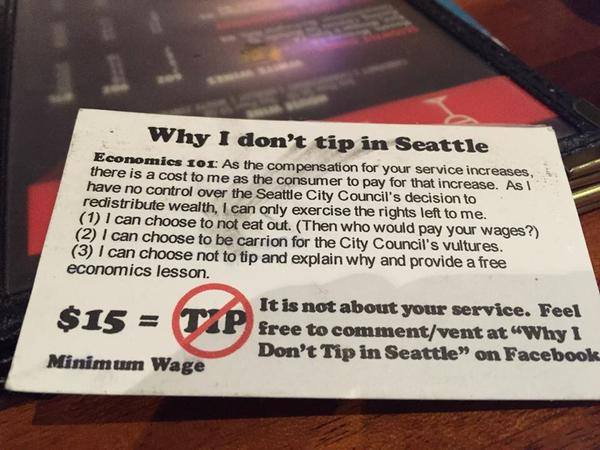
This picture of a card helps explain. This may be just one angry dude, or it could be a big movement. I see it as another notch taken out of goodwill.

min wage

As with the cops and perps I wrote about previously, both sides have a legitimate gripe. Emotions are running high. And no one sees the merit in the other side, only in their own.

It’s the perfect toxic cocktail for killing goodwill all around.

Think on it for a moment. What cultural backdrop is necessary for a whole industry to pay near zero in wages, and workers earn the majority of their compensation from tips given voluntarily by total strangers? It is remarkable how much trust and goodwill must be there. This is not typical in the third world, and it was not typical through most of history.

Will people continue to tip, and tip generously, if they feel workers are overpaid? What if they feel that these workers lobbied the government to mandate their overly rich compensation? And suppose the patron resents that his favorite restaurants have closed, and now in any survivors, he pays a lot more than he used to.

Of course, the workers feel that they are falling farther behind, as real wages are lagging everything else in the economy. They resent their bosses for being too greedy, and they resent politicians for not setting the wage high enough. They are angry and resentful at lots of things, except the root cause: the failing dollar.

What do you get when you cross worker resentment with restaurant patron resentment?

We could be one coercive wage hike away from killing tipping in America.

The Great FreedomFest Debate Was Like Watching Tom and Jerry

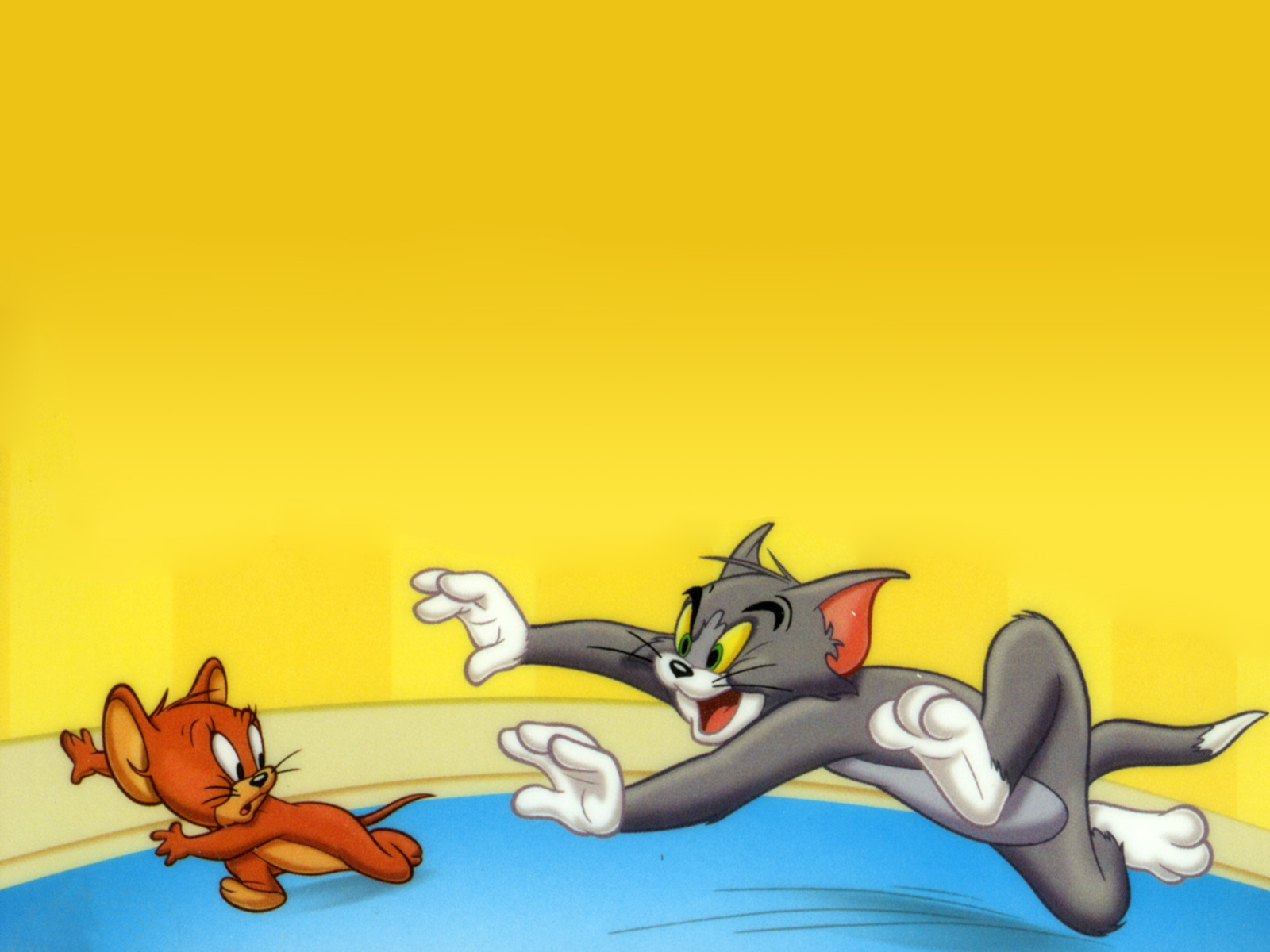
With apologies to his fans, Jerry is an evil little mouse who constantly pesters Tom the Cat. Tom tries and tries, but cannot seem to overpower someone who is a fraction of his size and strength.

Watching Stephen Moore attempt to debate Paul Krugman was like that.

The “economics” of Krugman is Keynesian economics. It consists of central planning your life by force, because market failure. And Krugman repeated this phrase “market failure” several times. Of course the solution was always government intervention.

Here is an interesting endorsement about one of Keynes’ books.

“Fascism entirely agrees with Mr. Maynard Keynes, despite the latter’s prominent position as a Liberal. In fact, Mr. Keynes’ excellent little book, The End of Laissez-Faire (l926) might, so far as it goes, serve as a useful introduction to fascist economics. There is scarcely anything to object to in it and there is much to applaud.”

This was said by someone who knows all about fascism, Benito Mussolini. Fascism is a corporatist system. Although it has private ownership in name, it’s all under government control. Krugman is a real economic lightweight who proposed fascism for nearly everything that came up. His debate tactics consisted of context-dropping, asserting simple fallacies, and cherry-picking data.

Tom-and-Jerry-Wallpaper-tom-and-jerry-2507494-1600-1200

In the TV cartoon, Jerry would steal something and run into his mouse hole. Tom would be left whacking at the hole with a broom, in vain. At FredomFest, Krugman would say that the government must spend more to get the economy out of recession. Moore disagreed, and Krugman displayed a chart showing government spending and GDP growth rates for many countries around the world. Government spending and growth correlated very well.

Instead of flailing away with a blunt instrument, I would have said “Seriously, Paul? What a simple fallacy. The definition of GDP includes government spending. You haven’t proven anything. It’s a tautology that if government spending goes up, GDP goes up. This is the flaw in GDP. Sometimes, rising GDP means the people are being impoverished.”

Next, Krugman moved on to one of the central fallacies of Keynesianism. In Krugman’s words, “You just gave the logic for government deficit spending. Your spending is my income. Where is the income supposed to come from, if everyone cuts spending? Government has to make up the difference.”

I would have said, “Seriously Paul. Again?! This is like the Broken Window fallacy [which Krugman said in 2011 “ceased to be a fallacy”]. Not all spending is consumer spending. Investment spending is important. When people slow consumption, it doesn’t mean they hoard dollar bills. They increase their bank deposits. Banks lend to promising companies. You know, that next new product or lifesaving technology? Except you don’t know it, because government spending has crowded them out.”

In an economic downturn, people go on fewer gambling and drinking binges to Las Vegas. Krugman is basically saying that the government has to take up the slack, and go on gambling binges. Because demand shortfall.

Shortly after telling Moore that one cannot cherry-pick one’s data, Krugman showed a graph comparing Jerry Brown’s California to Sam Brownback’s Kansas. For one year. I felt embarrassed for him, as there were sounds of amused laughter from the audience.

Why did it come to Kansas vs. California for the year 2014 (I didn’t write the year in my notes)? It’s because Moore was defending free markets by appeal to aggregate statistics. Moore used red states as examples of freer markets, and blue for less free markets. He showed a few charts in which red states fared better than blue.

Krugman’s cherry-picking got him safely back to his mouse hole, with Moore stuck outside, banging with a floor cleaning tool.

You cannot defend freedom using statistics, as you cannot get a mouse out of the wallboards with a broom.

Both Krugman and Moore were nervous speakers. Krugman was hunched a bit in on himself (though to be fair, he was in hostile territory and he knew it). Both spoke too rapidly and with a jittery character to their voices. Each has a nervous tell, with Moore incessantly taking little sips from his iced tea and Krugman playing with his fingers.

Krugman took the lead on each issue. Moore often respond with a long caveat, which conceded the point to Krugman. For example, Krugman said that some kids are born disadvantaged, so we need to give them each $8,000 to $10,000 (per year, I assume) in free money. He actually said they “choose the wrong parents.”

Someone please tell him that this is only possible by robbing the taxpayers. Maybe add that it will just accelerate America’s collapse into bankruptcy. Trillions in welfare spending do not fix anyone’s problems, and are actually the cause of the disadvantage Krugman discusses.

Moore said he supports a social safety net, because America is rich, we can afford it, and it’s morally right. When the broom failed to defeat the mouse, not even Tom tried singing to Jerry.

The topic moved to healthcare. Moore noted that government involvement has caused costs to spiral. Krugman offered another whopper. It’s because innovation.

This is absurd, and even Krugman knows it. In computers, there’s been decades of both rapid innovation and falling prices.

Krugman moved on to his shining moment, in the Ellsworth Toohey sense of shine. He unshrunk from his hunch, and his voice rang with moral clarity. “Obamacare is a life saver!”

The audience booed.

“I know someone whose life was saved by Obamacare. If you don’t know anyone like that, then I’m sorry for your narrow little world.”

This is a faux-apology and a presumption. Who the heck is this guy to apologize to me for my life not conforming to his ideology? Not to mention, Krugman glosses over the people harmed by it. There ain’t no such thing as a free lunch, even if handout beneficiaries think there is.

Worse yet Krugman implies that, to be moral, you must sacrifice yourself. He is cashing in on the guilt many people feel, at their own success. He’s learned that all he has to do is raise the specter that someone else is suffering, and they will concede him anything he demands.

This being FreedomFest, and not the People’s Workers’ Party, a large majority of the audience supported Moore. However, moderator Mark Skousen asked a very clever question, “If you did not enter this room in agreement with Paul Krugman, did you change your mind as a result of what he said today?” I estimate about 50 people clapped or cheered.

Krugman won because he appealed to people’s sense of right and wrong. Morality trumps economics any day of the week. Moore didn’t even respond to Krugman’s economic errors, much less smack down his phony judgmentalism.

Securities Regulation Harms Businesses

I attended a panel discussion yesterday on the problems startups have in raising capital caused by securities regulation. Startups have to hire a lawyer before they raise the first dollar of capital. It’s a real catch-22.

Entrepreneurs are often surprised to find that raising capital means selling securities. They cannot legally sell securities to just anyone. They are restricted to Accredited Investors (basically people with high income or high net worth). Most young entrepreneurs don’t have a rolodex full of such investors. There are other restrictions, for example, they can’t hire someone to help them raise capital unless he has a license to sell securities.

Welcome to compliance hell. It’s perfectly legal to fail, to lose your own money and even your house. It’s fine by the law if your dream dies, your marriage fails, and all of the other negative consequences occur when a business does not succeed. But if you raise money, you better be fully compliant. Where’s the concern for people?

The stated purpose of regulation is to protect investors from fraud and bad actors. However, fraud was illegal even before regulation. It is already a crime to lie to someone to take his money. Regulation does not change that. It does not make crime more illegal.

Regulation offers a tantalizing promise. We don’t have to wait for criminals to strike their victims. We can make it impossible for them to commit the crime in the first place. We just force them to comply with regulations. No matter how many Enrons and Bernie Madoffs happen, few stop to ask if the theory is even valid. Can regulators proactively prevent bad things from happening?

Nor do people ask if investors deserve to be treated as children. It used to be (before the Nanny State) that once you reached the age of 18, your majority, you were able to enter into any contract or do anything that any adult could legally do. Now 18 is just one milestone. Until you have a million dollars net worth, you aren’t an adult investor and cannot invest in startups. It’s for your own good, you understand. You might make a bad investment.

While we’re at it, we should also ask the age old question: qui bono–who benefits? Lawyers are one obvious group. More importantly, it protects big and wealthy incumbents. Wall Street can easily afford compliance, unlike its small would-be competitors. More insidiously, regulation implicitly supports Wall Street’s model and makes it more difficult or impossible to develop a new one. This is why no one has done the Uber or AirBnB of the stock market yet.

I found it odd that when several speakers on that panel began with apologies, “of course, we want to protect investors.” They began with total capitulation, saying in effect, “I can’t be trusted without a government minder.” Any reform based on this will be little more than deck chair rearrangement on the Titanic. There is a real solution, and it’s simple. The law should treat adults like adults. Let entrepreneurs raise capital without having to get permission at each step, so they can build new products to offer us, make money for themselves, and create jobs.

The Doctor-Laborer Inversion

The battle over minimum wage is raging. Emotions are running hot. Some cities are setting the bar very high. For example, Seattle is mandating a $15/hour wage.

Economically, the issue is very simple. Minimum wage laws do not raise anyone’s wage. This is because it’s not sustainable to overpay.

Suppose you run a small tailor shop. Customers are willing to pay $20 to repair a pair of slacks. Why are they willing to pay that, and no more? It’s not just their budget, but also the relative value of fixing their old trousers compared to buying new. A higher wage for your employees will have no effect on customer willingness to pay.

You have rent, utilities, insurance, wear and tear on your sewing machines, etc. that add up to $10. Therefore your maximum gross profit is $10. You cannot pay someone $11, much less $15, to do this work. If the law attempts to force you to overpay, then you have to lay off workers or even close your doors. Going out of business is no fun, but it beats losing more money.

This is black and white. Minimum wage law can destroy jobs and businesses but it cannot raise wages. However, many people become very emotional on this issue. So let’s look at the issue from a different angle.

There is an endless outpouring of sympathy and support for the unskilled laborer. How is this poor downtrodden helpless victim supposed to feed a family, cover medical expenses, and save for retirement earning only $7.25 per hour?

I don’t know.

My lack of an answer to this question is no justification for minimum wage laws. This is not even the right question. It is an example of the logical fallacy known as begging the question—when you presume what you should be asking. We should ask if one man’s need creates a duty in anyone else. Then the answer is a lot clearer.

The last time I checked, we had not adopted the Communist Manifesto as our new constitution. There is no law saying that each is to be given according to his need.

In comparison to the general sympathy for unskilled laborers, there is none for doctors. Just look at the endless commentary about Obamacare. What are the most popular complaints today? In my admittedly non-scientific sampling, the most common are higher costs, reduced choices, or a broken website. Some people worry about lower quality or less access to care.

There is virtually no discussion of what Obamacare will do to doctors. Doctors make far more than the minimum wage. One presumes that their needs are covered by their incomes, and therefore of no worry to us.

Need is the wrong way to look at it.

Instead of asking what someone’s need is, you should ask what are these people doing for you? What do they create? What value do they add? This brings the issue into sharp focus.

The unskilled laborer can be put to work turning a crank. He needs lots of supervision, which is an additional cost. The crank is paid for by someone else’s saved and accumulated capital, and this investor must be paid a return on capital for placing it at risk in a business. The laborer can be held accountable for showing up every morning and turning the crank all day, but not for business profitability.

This, by definition and by nature, is what unskilled labor is. He brings no capital, no skills, no knowledge, no expertise, no prior learning. He may be a young and inexperienced worker. Or he may have years of prior experience, but he is the sort of person who learns nothing from experience. Either way, the employer is taking on real risks and expenses.

Finally, the unskilled laborer is virtually indistinguishable. Many towns have a street corner, where construction contractors go to pick up a few laborers for a day’s work. There is a standardized market wage for these workers, and the employer doesn’t care who jumps in the back of the truck on any given workday.

How much does one of these workers impact your life? What would happen to you, if one of them stopped working?

For the next part of the discussion, please bear with me. I am assuming a free market in healthcare. In a free market, patients pay doctors for their services, the same way that homeowners pay plumbers, and diners pay restaurants.

Suppose you notice a lump in your neck. You’re worried it may be cancer. Catching it early is the key to surviving with maximum quality of life. You really want to see the best doctor that you can afford. You get a recommendation, and you call his office. They tell you he just retired. You get a second recommendation. You call this doctor’s office, but her receptionist says she was hit by a car this morning and is in critical condition. You open the phone book and call the last specialist. He is on sabbatical, teaching head and neck surgery in Thailand.

Now what do you do? Three doctors are unavailable, and you already feel a bit desperate.

You widen your search, and keep calling more. Suppose for some reason, all the doctors you call are unavailable. One by one, you hear why they can’t see you and you become increasingly frantic.

Why?

The doctor contributes the most value to your life, including saving it. By contrast, the laborer contributes the least. If 10 doctors stopped practicing medicine, you could die. In comparison, if 100 laborers stopped working, you wouldn’t even notice it.

What would you be willing to pay someone who saved your life?

If you would like a doctor to be available, in case your life needs saving, you must change how you think about wages. Start thinking about the value someone produces, and stop thinking about need. Your willingness, indeed your happiness—no your eagerness—to pay the doctor big money has nothing to do with his need. It has everything to do with what he does for you. Your life is worth more to you than the money you spend.

In comparison you aren’t willing to pay the same to someone who washes your dishes or trims your front lawn. If you would like restaurants and landscaping to be available, you must approach it the same way as with doctors. Start thinking about the value they provide and stop thinking about the needs of their unskilled workers.

Debates That Ought Not to Be

Every so often (ok, at least once a day) I encounter seemingly intelligent, rational, and educated people debating a black-and-white point of contention. The topic under debate is no mere opinion, but a matter of fact. Yet despite this—or perhaps because of this—the contention is irresolvable, and the debate bitter.

For example, ever discuss the probability of a flipped coin coming up heads? Many adults still cling to the belief that if you got tails four times in a row that means heads is now due.

fool


I know an engineer who works at a large corporation. Many engineers and managers there don’t understand how to design experiments. He told me about an hour-long facepalm moment. A manager was trying to order some engineers to do the absurd. Based on his misunderstanding of statistics, he wanted them to achieve a higher confidence interval. This does not mean to become more confident. It basically means to increase the size of the data set—i.e. waste more time and money collecting unnecessary data.

There is only one thing worse than when someone doesn’t know something. It is when what he knows just isn’t so (with due respect to Will Rogers and Ronald Reagan). It’s much easier to teach than to persuade someone to unlearn that which is false.

I see the same kind of error all the time in entrepreneurial circles. Clayton Christiansen defined the term disruptive innovation very precisely. Yet despite this, many entrepreneurs and business managers use the word disruptive merely to mean big, or perhaps competitive. Existing customers of incumbent businesses don’t particularly want the disruptive product. However, it has the potential to slowly eat the market from the low-margin soft underbelly up to the high-margin top end.

The transistor radio is a textbook example. In 1954 when Sony released the first transistor radio, were the existing makers of tube hi-fi equipment thinking to replace their good-sounding sets with tinny transistors? Within a few short decades, transistors took over the market.

Another error, closer to home, is when people think they can raise the wage by raising the minimum wage. Marginal productivity, like confidence interval or disruptive innovation, sounds like something it is not. Who would object to raising productivity?

But that is not what marginal productivity means. If you raise marginal productivity—for example by raising the legally mandated wage—you increase the bar. This is the hurdle all workers must get over, or else be rendered submarginal. Submarginal means unemployable.

When you find yourself in such a debate, be aware of what you’re up against.

The above examples are fictional, and purely for entertainment purposes. Any resemblance to actual errors made in monetary economics is purely coincidental.