Category Archives: Uncategorized

Inflation: an Expansion of Counterfeit Credit

© Jan 3, 2012 Keith Weiner

The Keynesians and Monetarists have fooled people with a clever sleight of hand.  They have convinced people to look at prices (especially consumer prices) to understand what’s happening in the monetary system.

Anyone who has ever been at a magic act performance is familiar with how sleight of hand often works.  With a huge flourish of the cape, often accompanied by a loud sound, the right hand attracts all eyes in the audience.  The left hand of the illusionist then quickly and subtly takes a rabbit out of a hat, or a dove out of someone’s pocket.

Watching a performer is just harmless entertainment, and everyone knows that it’s just a series of clever tricks.  In contrast, the monetary illusions created by central banks, and the evil acts they conceal, can cause serious pain and suffering.  This is a topic that needs more exposure.

The commonly accepted definition of inflation is “an increase in consumer prices”, and deflation is “a decrease in consumer prices.”  A corollary is a myth that stubbornly persists: “today, a fine suit costs the same in gold terms as it did in 1911, about one ounce.”  Why should that be?  Surely it takes less land today to raise enough sheep to produce the wool for a suit, due to improvements in agricultural efficiency.  I assume that sheep farmers have been breeding sheep to maximize wool production too.  And doesn’t it take less labor to shear a sheep, not to mention card the wool, clean it, bleach it, spin it into yarn, weave the yarn into fabric, and cut and stitch the fabric into a suit?

Consumer prices are affected by a myriad of factors.  Increasing efficiency in production is a force for lower prices.  Changing consumer demand is another force.  In 1911, any man who had any money wore a suit.  Today, fewer and fewer professions require one to be dressed in a suit, and so the suit has transitioned from being a mainstream product to more of a specialty market.  This would tend to be a force for higher prices.

I don’t know if a decent suit cost $20 (i.e. one ounce of gold) in 1911.  Today, one can certainly get a decent suit for far less than $1600 (i.e. one ounce), and one could pay 3 or 4 ounces too for a high-end suit.

My point is that consumer prices are a red herring.  Increased production efficiency tends to push prices down, and monetary debasement tends to push prices up.  If those forces balance in any given year, the monetary authorities claim that there is no inflation.

This is a lie.

Inflation is not rising consumer prices.  One can’t understand much about the monetary system from inside this box.  I offer a different definition.

Inflation is an expansion of counterfeit credit.

Most Austrian School economists realize that inflation is a monetary phenomenon.  But simply plotting the money supply is not sufficient.  In a gold standard, does gold mining create inflation?  How about private lending?  Bank lending?  What about Real Bills of Exchange

As I will show, these processes do not create inflation under a gold standard. Thus I contend the focus should be on counterfeit credit.  By definition and by nature, gold production is never counterfeit.  Gold is gold, it is divisible and every piece is equivalent to any other piece of the same weight.

Gold mining is arbitrage: when the cost of mining an ounce of gold is less than one ounce of gold, miners will act to profit from this opportunity.  This is how the market signals that it needs more money.  Gold, of course, has non-declining marginal utility, which is what makes it money in the first place, so incremental changes in its supply cause no harm to anyone.

Similarly, if Joe works hard, saves his money, and gives a loan of 100 ounces to John, this is an expansion of credit.  But it is not counterfeit or illegitimate or inflation by any useable definition of the term.

By extension, it does not matter whether there are market makers or other intermediaries in between the saver and the borrower.  This is because such middlemen have no power to expand credit beyond what the source—the saver—willingly provides.  And thus bank lending is not inflation.

Below, I will discuss various kinds of credit in light of my definition of inflation.

In all legitimate credit, at least two factors distinguish it from counterfeit credit.  First, someone has produced more than he has consumed.  Second, this producer knowingly and willingly extends credit.  He understands exactly when, and on what terms, with what risks he will be paid in full.  He realizes that in the meantime he does not have the use of his money.

Let’s look at the case of fractional reserve banking.  I have written on this topic before (Fractional Reserve Banking).  To summarize: if a bank takes in a deposit and lends for a longer duration than the deposit, that is duration mismatch.  This is fraud and the source of banking system instability and crashes.  If a bank lends deposits only for the same or shorter duration, then the bank is perfectly stable and perfectly honest with its depositors.  Such banks can expand credit by lending, (though they cannot expand money, i.e. gold), but it is real credit.  It is not counterfeit.

Legitimate lending begins with someone who has worked to save money.  That person goes to a bank, and based on the bank’s offer of different interest rates for different durations, chooses how long he is willing to lock up his money.  He lends to the bank under a contract of that duration.  The bank then lends it out for that same duration (or less).

The saver knows he must do without his money for the duration.  And the borrower has the use of the money.  The borrower typically spends it on a capital purchase of some sort.  The seller of that good receives the money free and clear.  The seller is not aware of, nor concerned with, the duration of the original saver’s deposit.  He may deposit the money on demand, or on a time deposit of whatever duration.

There is no counterfeiting here; this process is perfectly honest and fair to all parties.  This is not inflation!

Now let’s look at Real Bills of Exchange, a controversial topic among members of the Austrian School.  In brief, here is how Real Bills worked under the gold standard of the 19th century.  A business buys merchandise from its supplier and agrees to pay on Net 90 terms.  If this merchandise is in urgent consumer demand, then the signed invoice, or Bill of Exchange, can circulate as a kind of money.  It is accepted by most people, at a discount from the face value based on the time to maturity and the prevailing discount rate.

This is a kind of credit that is not debt.  The Real Bill and its market act as a clearing mechanism.  The end consumer will buy the final goods with his gold coin.  In the meantime, every business in the entire supply chain does not necessarily have the cash gold to pay at time of delivery.

This problem of having gold to pay at time of delivery would become worse as business and technology improved to allow additional specialization and thus extend the supply chain with additional value-added businesses.  And it would become worse as certain goods went into high demand seasonally (e.g. at Christmas).

The Real Bill does not come about via saving and lending.  It is commercial credit that is extended based on expectations of the consumer’s purchases.  It is credit that arises from consumption, and it is self-liquidating.  It is another kind of legitimate credit.

For more discussion of Real Bills, see the series of pieces by Professor Antal Fekete (see here, Monetary Economics 101 Lectures 4 through 9).

Now let’s look at counterfeit credit.  By the criteria I offered above, it is counterfeit because there is no one who has produced more than he has consumed, or he does not knowingly or willing forego the use of his savings to extend credit.

First, is the example where no one has produced a surplus.  A good example of this is when the Federal Reserve creates currency to buy a Treasury bond.  On their books, they create a liability for the currency issued and an asset for the corresponding bond purchase.  Fed monetization of bonds is counterfeit credit, by its very nature.  Every time the Fed expands its balance sheet, it is inflation.

It is no exaggeration to say that the very purpose of the Fed is to create inflation.  When real capital becomes more scarce, and thus its owners become more reluctant to lend it (especially at low interest rates), the Fed’s official role is to be the “lender of last resort”.  Their goal is to continue to expand credit against the ever-increasing market forces that demand credit contraction.

And of course, all counterfeit credit would go to default, unless the creditor has strong collateral or another lever to force the debtor to repay.  Thus the Fed must act to continue to extend and pretend.  Counterfeit credit must never end up where it’s “pay or else”.  It must be “rolled”.  Debtors must be able to borrow anew to repay the old debts—forever.  The job of the Fed is to make this possible (for as long as possible).

Next, let’s look at duration mismatch in the financial system.  It begins in the same way as the previous example of non-counterfeit credit—with a saver who has produced more than he has consumed.  So far, so good.  He deposits money in a bank, and this is where the counterfeiting occurs.  Perhaps he deposits money on demand and the bank lends it out.  Or perhaps he deposits money in a 1-year time account and the bank lends it for 5 years.  Both cases are the same.  The saver is not knowingly foregoing the use of his money, nor lending it out on such terms and length.

This, in a nutshell, is the common complaint that is erroneously levied against all fractionally reserved banks.  The saver thinks he has his money, but yet there is another party who actually has it.  The saver holds a paper credit instrument, which is redeemable on demand.  The bank relies on the fact that on most days, they will not face too many withdrawal demands.  However, it is a mathematical certainty that eventually the bank will default in the face a large crowd all trying to withdraw their money at once.  And other banks will be in a similar position.  And the collapsing banking system causes a plunge into a depression.

There are also instances where the saver is not willingly extending credit.  The worker who foregoes 16% of his wage to Social Security definitely knows that he is not getting the use of his money.  He is extending credit, by force—i.e. unwillingly. The government promises him that in exchange, they will pay him a monthly stipend after he reaches the age of retirement, plus most of his medical expenses.  Anyone who does the math will see that this is a bad deal.  The amount the government promises to pay is less than one would expect for lending money for so long, especially considering that the money is forfeit when you die.

But it’s worse than it first seems, because the amount of the monthly stipend, the age of retirement, and the amount they pay towards medical expenses are unknown and unknowable in advance, when the person is working.  They are subject to a political process.  Politics can shift suddenly with each new election.

Social Security is counterfeit credit.

With legitimate credit, there is a risk of not being repaid.  However, one has a rational expectation of being repaid, and typically one is repaid.  On the contrary, counterfeit credit is mathematically certain not to be repaid in the ordinary course.  This is because the borrower is without the intent or means of ever repaying the loan.  Then it is a matter of time before it defaults, or in some circumstances forces the borrower to repay under duress.

Above, I offered two factors distinguishing legitimate credit:

  1. The creditor has produced more than he has consumed
  2. He knowingly and willingly extends credit

Now, let’s complete this definition with the third factor:

3.     The borrower has the means and the intent to repay

Every instance of counterfeit credit also fails on the third factor.  If the borrower had both the means and the intent to repay, he could obtain legitimate credit in the market.

A corollary to this is that the dealers in counterfeit credit, by nature and design, must work constantly to extend it, postpone it, “roll” it, and generally maintain the confidence game.  Counterfeit credit cannot be liquidated the way legitimate credit can be: by paying it back normally.  Sooner, or later, it inevitably becomes a crisis that either hurts the creditor by default or the debtor by threatening or seizing his collateral.

I repeat my definition of inflation and add my definition of deflation:

Inflation is an expansion of counterfeit credit.

Deflation is a forcible contraction of counterfeit credit.

Inflation is only possible by the initiation of the use of physical force or fraud by the government, the central bank, and the privileged banks they enfranchise.  Deflation is only possible from, and is indeed the inevitable outcome of, inflation.  Whenever credit is extended with no means or ability to repay, that credit is certain to eventually become a crisis that threatens to harm the creditor.  That the creditor may have collateral or other means to force the debtor to take the pain and hold the creditor harmless does not change the nature of deflation.

Here’s to hoping that in 2012, the discussion of a more sound monetary and banking system begins in earnest.
A Politically Incorrect Look at Marginal Tax Rates

In my last piece, The Laffer Curve and Austrian Economics, I argued that the “Laffer Maxima” moves depending on where the economy is in the boom-bust credit cycle. I used an example of a marginal restaurant business in the bust phase, which fails when the income tax rate on the people who live nearby rises by 100 basis points.

In that piece, I did not intend to address the impact of taxes on the “middle class” vs. taxes on “the rich”.  A reader raised the question however, and thus motivated me to write this piece.

As I implied in that piece, the middle class are obliged to cut their spending dollar for dollar with any increase in any tax that they must pay.  I stated that this is because their budget is zero-sum, especially in the bust phase.  This leads to an important point: a dollar of tax increase here must necessarily decrease spending by a dollar. And this is just the primary impact. When this decrease forces the marginal business under, the secondary and tertiary impacts may be far in excess of one dollar.

In my example, the marginal restaurant had 8 employees, and a mortgage on some fixtures and tenant improvements.  Ignoring the impacts to the vendors of tomato sauce and mozzarella cheese, the default on perhaps $100,000 in debt is very significant.  And so is putting 8 people out of work.

In the bust phase, the destruction wrought by this tax that most people would consider to be “small”, is anything but small. And of course this process occurs all over the country.

It’s worth noting (though I do not intend to go into detail in this piece) that part of the problem is that the middle class has very little savings.  They live almost entirely on their cash flow, which is inelastic.

But what happens when taxes are increased on “the rich”? Is it not “fair” to redistribute wealth to even out the gaps between the “rich” and the rest of us? What happens if we increase taxes on the “rich”?

One cannot look at the economy on the basis of consumption only. It is important to understand capital accumulation and decumulation.

If a business sells $100,000 worth of product, and it cost $50,000 to make and sell, then they have a $50,000 profit. This is still true, even if they buy a $50,000 manufacturing machine. The business should treat the machine as capital which depreciates over its expected lifetime.

Likewise, if a business is neglecting its tooling, not investing in research and development, and deferring maintenance, it may seem to generate a “profit”.  But this is illusory. In an accurate assessment, it is consuming its capital. If it cannot allocate some of its “profits” towards capital, it is in reality consuming itself. It will eventually go out of business.

And this is important to understand when it comes to assessing taxes on “the rich”.  While there are some “rich” people who earn staggering salaries (e.g. actors and athletes), most “rich” are wealthy because they own productive assets and investments.

One can’t understand the impact of taxes on the rich (nor see it immediately) just by looking at macro economic data.  The “1%” do not reduce their personal consumption if taxes are increased on either incomes or capital gains. This is because they don’t spend all of their income, much less net worth, on consumption.

One needs to understand the concepts of investment, and risk-adjusted rate of return. Obviously, whatever portion of a rich man’s wealth is taken away in taxes will not be invested. The wealth will be consumed, either by the government, or those to whom the government gives it.

An increase in tax serves to replace investment with consumption. This may even boost GDP that year or even for a few years. But eventually, the destruction of capital will be felt in the economy.

This is important, because capital is the leverage on human effort. We don’t work any harder or any longer today than people did 10,000 years ago, but we are vastly more productive due to capital accumulation.  If we deliberately enact policies to decumulate capital in favor of present consumption, this would have a disastrous effect on our quality of life.

There is a more complex and pernicious effect of increasing taxes on the rich. And it is politically incorrect to say it. But it needs to be said.  We need less pandering and more honest discussion.  So bear with me.

Let’s compare and contrast to the wage earner. If the tax on a wage earner who makes $8 per hour goes up 10%, the wage earner may work an additional 10% more hours (if he can find the work), or he must spend 10% less.

The one percenter, however, has different choices. He is investing his wealth to generate a profit. For every investment, he calculates the risks and the returns if the investment is successful. He must then subtract the tax. If the net result does not justify the risk, he won’t invest.  The higher the tax, the more possible investments he will pass over, because they fail this test.  He always has an alternative: the Treasury bond.  Only if the risk-adjusted rate of return exceeds the Treasury will the rich man invest.

If he chooses not to invest, the result is that innovative start-up technology companies, energy exploration projects, new drugs and medical devices are starved for funding. But Treasury bonds go up and up, as does the consumption subsidized by the government.

This piece should not be taken as a recommendation to raise the taxes of the poor wage earner. But if one looks at the true economic impact of taxes, I think I have shown that taxing the rich hurts the economy—especially in the long term.

The correct solution is to cut spending, and cut it some more, and then cut it again, and then really begin to cut. But that is outside the scope of this piece.

Why Can’t We All Just Net Along

Zero Hedge posted an article that asks an interesting question.  Every European country owes money to other European countries.  This creates a web of cross-linked debt.  Instead of each country laboring under the full nominal amount, why don’t they just cooperate and cancel out everything but the net debt?  This remainder would be very manageable for every country.

 Anyone with “common sense” should be able to grasp one thing about this supposition.  Each country borrowed, and hence got itself into debt, to run a budget deficit for many years.  This means each country consumed more goods and services than it could pay for by tax revenues.  Does it make any sense that this accumulated debt over many years or decades could be eliminated by a simple trick?

 As with many errors in politics and management, the fallacy becomes obvious if one eschews the “big picture view” (i.e. woozy floating abstractions) and dives in to the details.

 I read the paper on the site linked in the piece on Zero Hedge.  It was not clear to me if these numbers include only the sovereign debt of each country’s national treasury or if it includes banking system debt.  To make this simpler, let’s assume only sovereign debt.  This makes our case harder to prove, but stronger once proved.

 The paper discusses the problem of maturity and acknowledges that its simplistic method of putting all debt into three categories (short, medium, and long) was not realistic.  It notes that the fact that the true amount of debt at each maturity is withheld by the central banks is telling.

 What the paper neglects to address is that, in our worldwide regime of irredeemable debt-based money, debt is the basis for “money”!  Each central bank that buys this debt uses it on the asset side of the balance sheet against which it can issue money on the liabilities side.  Anyone who takes this asset away would be pulling the rug out from underneath the central bank!  The central bank would either keep the liability but witness the value of its currency crash as this would effectively be massive money printing in the true sense of the word: naked, unbacked paper created ex nihilo.  The affected currency would collapse, and prices of goods in terms of this currency would skyrocket (while they were quoted in this currency at all)!

 Or it would have to somehow call the liabilities, i.e. pull money and hence liquidity out of the markets.  How would this work?  Our system is based on (exponentially) growing amounts of credit and debt.  Every time the economy slows and begins to liquidate the malinvestments, the only antidote is to issue ever-greater amounts of fresh credit.

 So, how can this article blithely suggest that all of this credit could be pulled?  That would bring about a deflationary collapse, wherein every kind of debtor except the sovereign cannot get its hands on cash no way, no how.  The wave of defaults that cascaded through the economy would ensue until no debt, and no money, remained.

 One of the perversities of debt-based irredeemable paper is that it does not survive balance sheet consolidation.  The writers of this paper, and Zero Hedge failed to understand this simple (but unobvious) fact.

Broken Hedges

Peter Tchir wrote a piece yesterday describing yet another hole in the banks’ balance sheets:

I am not sure I fully understand it, but to me it looks something like this:

A bank has a duration mismatch.  Its funding is short-term, which means it must be rolled over frequently.  This subjects the bank to the risk of a rise in interest rates, which would make its cost of funding higher.  And of course if rates rise, then the market value of the bond it bought is lower.

So when they go to buy a new bond, they also buy an interest rate swap.  The calculus is as follows:

1) if interest rates fall, their funding will get cheaper (a gain), the bond they bought will go up in value (a gain), and the swap loses value (a loss);

2) if interest rates rise, their funding will get more expensive (a loss), the bond will go down in value (a loss), and the swap will rise in value (a gain)

 By calculating the amount of swaps to buy, the bank thinks it is controlling its risk.  The bank wants to make a pure spread: Interest on bond – funding cost – swap cost.

 But today as Mr. Tchir writes, the problem is that the bond is losing value not because rates are rising but because the issuer is in trouble.  So the swap is not providing the protection that the bank hoped for.  The bank’s funding costs may or may not be falling, but it is certainly taking a loss from the fall in the price of the bond due to credit risk and a loss due on the interest rate swap as well.

Capitalism: Death by a Thousand Cuts

Capitalism: Death By A Thousand Cuts

Capitalism died when they decided to subsidize railroads for the sake of national prestige in the mid 19th century.

Capitalism died when, to compensate for the consequences of subsidized railroads, they passed anti-trust laws in 1890, under which it is illegal to have lower prices, the same prices, and higher prices than one’s competitors.

Capitalism died in 1913 when they started taxing income, and created a central bank.

Capitalism died after 1929 under the flailing interventionism of Hoover.

Capitalism died in 1933 when FDR confiscated the gold of US citizens, outlawed gold ownership, and defaulted on the domestic gold obligations of the US government.

Capitalism died when FDR stacked the supreme court, and created a veritable alphabet soup of regulatory agencies that could write law, adjudicate law, and execute law.

Capitalism died when FDR created the welfare state replete with a ponzi “retirement system”.

Capitalism died in 1944 when the rest of the world agreed to use the US dollar as if it were gold, at Bretton Woods.

Capitalism died under Johnson’s Great Expansion of FDR’s welfare state (Medicare).

Capitalism died when Kennedy removed silver from coins.

Capitalism died in 1971 when Nixon defaulted on the remaining gold obligations of the US government to foreign central banks.

Capitalism died when rampant expansion of counterfeit credit led to a near-death experience for the US dollar in the 1970′s.

Capitalism died when they ended the era where investors paid a firm to rate the debt they were going to buy. Congress enacted a law giving a government-protected franchise to Moodys, Fitch, and S&P.

Capitalism died when they decided to tax dividends at a higher rate than capital gains, thus distorting capital markets.

Capitalism died when they created Fannie, Freddie, Ginnie, and Sally.

Capitalism died when in 1981 Reagan and Volcker conspired to begin a long boom by a process of falling interest rates that continues to this very day, destroying inconceivable amounts of capital with every tick either up or (mostly) down.

Capitalism died when Greenspan discovered that market corrections could be overruled by another shot of crack cocaine, i.e. dirt cheap credit effluent, i.e. lowering the rate of interest.

Capitalism died with the growth of laws and court decisions granting legally privileged status to some kinds of employees but not others (and trampling all over the rights of employers). For example, the Americans with Disabilities Act.

Capitalism died with the passage of Medicare Part D.

Capitalism died with the bailouts, stimulus and other lies, deceit, fraud, and theft post 2008.

Capitalism died when Obama set aside the rule of hundreds of years old bankruptcy law and precedent to give unions priority in the bankruptcy of GM.

Capitalism died when Obama socialized medicine.

Capitalism died with every new regulatory package for financial markets: “Operation FD” in the late 1990s (as I recall), Sarbanes-Oxley, and now Dodd-Frank. With each one of these, the process is the same. Congress floats an idea publicly to “go after” the banks and dealers and brokers. Then the banks must go to Washington, spend money like water, and 6 months of back-room deals later, a multi thousand page document emerges as law. Then the regulatory agency must write regulations, so the banks spend more money, and a year of backroom dealings later, a hundred thousand page regulation emerges. Then this is to be enforced by armies of regulators. …

Capitalism died with Zero Interest Rate Forevah(TM).

Capitalism is long since dead. Whatever the name for today’s failed system is, “capitalism” is not that name.

The Laffer Curve and Austrian Economics

The Laffer Curve And Austrian School Economics

Jude Wanniski, a writer for the Wall Street Journal, coined the term “Laffer Curve” after a concept promoted by economist Art Laffer.Laffer himself says the idea goes back to the 14th century

 The idea is that if one wants to maximize the government’s tax revenue, there is an optimal tax rate. (Ignore for the moment whether or not you think this makes good economics in the long run, or whether or not you think this is even moral.)

 Laffer noted that if the tax rate is zero, then the government gets no revenue. But likewise, if the rate is set at 100%, the government also gets no tax revenue. Mainstreamers say that there is no incentive to produce income at 100% tax rate, and this is true. But even more importantly, there is no means: a 100% tax rate is pure capital destruction.

 The “Laffer Maxima”, i.e. the tax rate which maximizes the tax take, is somewhere between 0% and 100%. The Wikipedia article shows a picture of a Laffer Maxima at 70%, and implies that although it’s somewhat controversial this may be the right number.

 There are two points about the Laffer Curve that are important to consider.

 First, what in the world makes any economist think that he can gin up some differential equations and compute the right value for this Maxima? In the first place, every market is composed of an integer number of people transacting an integer number of trades, and each of those trades consists of an integer number of goods. People do not behave like particles in an ideal gas—they have reason and volition. The very idea of modeling a large number of people with equations is preposterous. Never mind that degrees are awarded every year to economists who purportedly do just that.

 Second, what makes anyone think that the Laffer Maxima is a constant?

 Let’s do a thought experiment that is in the vein of the Austrian School of economics. Let’s consider the boom-bust cycle, or what Austrians note is really the credit cycle. The central bank first expands credit, which flows into wealth-creating as well as wealth-destroying activities (malinvestment). As the expansion ages, an even greater proportion of credit funds wealth-destroying activities. Sooner or later the boom turns to bust. Malinvestments are liquidated, people are laid off from their jobs, portfolios take big losses, tax revenues decline, etc.

 One clue can be found right there, in my description of the bust: tax revenues decline.

 OK, maybe the Laffer Curve remains static and the only thing that changes is the absolute tax dollars?

 Let’s continue comparing the boom and the bust phases. In the boom phase what’s happening is that economic activity is being stimulated, i.e. beyond what it would naturally have been. This fuels demand for everything: commodities, labor, construction, fuel, professional services, etc. And all of the people hired in the boom are demanding everything too. It feeds on itself synergistically, for a while.

 At this stage, the frictional cost of taxes may be masked by the lubricant and fuel of credit expansion. This is especially so when everyone feels richer and richer on paper. People spend freely and we saw this in spades in the most recent boom that ended in 2007.

 Now let’s look at the bust phase. The net worth of most people is falling sharply. Many are laid off, their careers, and sometimes lives, shattered. A huge component of the marginal bid for everything is withdrawn. People struggle to make ends meet. Budgets are stretched to the max.

 I submit for the consideration of the reader that in the bust phase, any change in the tax rate drives a big change at the margin of economic activity. The tax rate is more significant in the bust phase than it was in the boom phase. The Laffer Maxima is not a hard-wired, intrinsic value of 70 (or 42 for fans of Douglas Adams). Like everything else in the market, it moves around. It is subject to the forces of the markets.

 I will close with an example. Consider the marginal restaurant. Let’s say it is generating $25,000 per month in gross revenues. Net of $24,700 in expenses, it is generating positive cash flow of $300 per month. Why would the owner even keep it open? Well, times may get better…

Now, let’s say the tax rate goes up a little, say 100 basis points. The restaurant, making little money, pays essentially no taxes anyway. So this does not cause a direct impact. But what about the patrons of the restaurant? If their blended tax rate was 25%, then an increase of 100 basis points (i.e., to 26%) is a tax increase of 4%. These people will have to reduce their budget by 4%.

 One logical place to cut is eating out. Suppose that they reduce their spending in the restaurant by $1,000, in aggregate.  Now our restaurant has $24,000 per month in gross revenues. But its fixed costs cannot be reduced. And even the labor can’t be reduced in this case. The only reduction will be food supplies. So let’s say food supplies are reduced 1/3 of $1,000, or $333. So now the restaurant has expenses of $24,367. Whereas it formerly made $300 profit per month, now it makes a loss of $367 per month.

 The owner can’t continue this very long. And so he closes shop. He defaults on the loans on the fixtures and tenant improvements, lays off 8 people, leaves the electric and gas companies with fixed infrastructure which no longer produces revenue for them, etc.

 The impact to the economy (and hence to the total taxes collected) is negative and disproportionate to the tax increase.

Debunking Gold Manipulation

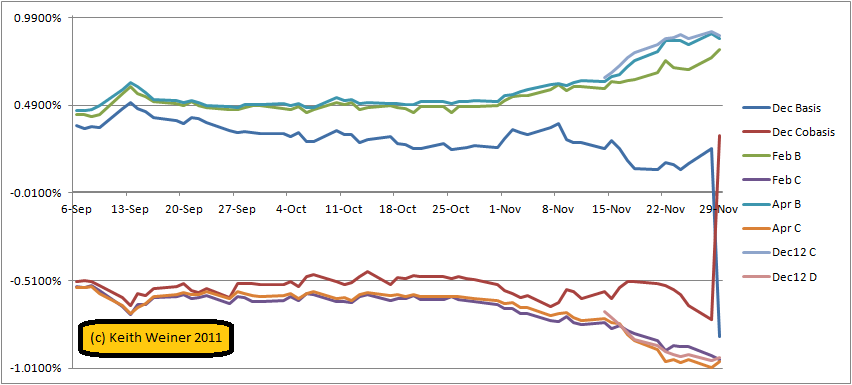
Yesterday [Nov 29, as I wrote this on Nov 30], the December gold contract moved sharply into backwardation (it happened in silver also, but let’s focus on gold).  This means that one could sell physical and simultaneously buy December to make a profit (please see the graph).

So let’s look a little deeper.  December basis fell massively, and cobasis rose equally.  The other months were unaffected.

Basis is the profit you would make to carry gold (buy spot and simultaneously sell a future).  Basis = Future (bid) – spot (offer).

When it falls, it could be either a falling bid on the future or a rising offer on spot.

Cobasis is the profit you would make to de-carry gold (sell spot, buy future).  Cobasis = Spot (bid) – future (offer).  When it rises, it could be a rising bid on spot or a falling offer on the future.

For both to be true, it means either spot is rising or the future is falling.  But since the bases in the other months did not exhibit this behavior, it rules out spot rising, and that means that the Dec gold future fell.

What could cause a gold future to fall relative to spot and the other future months?  Put it another way, what would cause unbalanced selling of a future relative to other months?  One hint is that the February contract deviated from the other farther-out contracts and had a rising basis and falling cobasis.  February moved higher in price relative to other contract months.

This is caused by the contract “roll” as naked longs must sell their Dec futures and if they wish to remain long gold, buy a farther-out contract (i.e. February).  This action, especially if it happens en masse, would sharply press the bid down in Dec.

It is equally interesting that the offer is falling too.  What of the conspiracy theory that the banks have massive naked short positions?

If they did, they would be forced to buy them back as the contract expired.  This would lift the offer on the future.  In that case, the cobasis would be falling, the opposite of what is occurring.

This is the basis (no pun intended) of how one would go about debunking the allegations that the precious metals markets are manipulated by massive short-selling of futures.

As a side note, the spread between the Dec 2011 contract and Feb 2012 contract also widened sharply.  It had been falling since late October, accelerating in November.

Yesterday, it was possible to buy Dec (at the offer) and sell Feb (on the bid) for a profit of almost $6 an ounce.  While this is too small to be actionable if you have to pay commissions and fees and storage for two months (about $8.50 for a retail account), it’s telling.

Dec_backwardation


Videos of my lecture “Irredeemable Currency vs. Gold”

I gave this talk at the Chicago Objectivist Society MiniCon Sep 4, 2011.  Here is the full set of 9 videos on youtube for my presentation plus Q&A at the end, posted on this site to archive the links.

lrredeemable currency vs gold – 1_9 introduction.wmv

lrredeemable currency vs gold – 2_9 the origin of money.wmv

lrredeemable currency vs gold – 3_9 irredeemable debt based paper money.wmv

lrredeemable currency vs gold – 4_9 interest rates.wmv

lrredeemable currency vs gold – 5_9 fractional reserve banking.wmv

lrredeemable currency vs gold – 6_9 arbitrage.wmv

lrredeemable currency vs gold – 7_9 gold backwardation.wmv

lrredeemable currency vs gold – 8_9 questions and answers pt1.wmv

lrredeemable currency vs gold – 9_9 questions and answers pt2.wmv