Category Archives: Uncategorized

The LIBOR Scandal

By now, most readers are aware that Barclays and probably many other banks have been caught red-handed gaming the London Inter-Bank Offer Rate (LIBOR).


No, I am not going to analyze the “cause”, call for more regulation, propose lawsuits, or lament that “banksters” today are “greedy”.  I have a simpler and subtler point.


In the regime of irredeemable paper money, the interest rate is always a manipulation!


The very purpose of a central bank is to be the “bidder of last resort” (on the bond), which means to drive down the rate of interest.  A quick look at the rate of interest on the 10-year Treasury bond shows that they have been succeeding for the last 31 years.


What difference does it make whether a thief at the government / central bank robs the saver of his savings, or whether a liar at a nominally private bank robs the saver of his savings?  Why is the former considered legitimate?  If the latter does it, why do people demand to give more power to the government to “regulate” the nominally private banks?


The fact is that under irredeemable paper, the saver cannot get a yield worthy of his time commitment, much less risk.  Governments and central banks have deliberately pursued a policy of trying to “stimulate” demand by creating artificial disincentives to saving.  If you have cash, the government wants to push you to either spend it or invest it in risky assets.


Instead of jerking our knees at the LIBOR manipulation, isn’t it time that we started to demand a repeal of the legal tender laws and taxes on the “gains” of gold and silver?  These are the primary means by which savers and creditors are forced to use the Fed’s paper scrip.  Without these bad laws, savers would be re-enfranchised and a whole host of changes would occur in the monetary system.  It would be about time.


Duration Mismatch Necessarily Fails

I have written a number of pieces on fractional reserve banking and duration mismatch.  I have argued that the former is perfectly fine, both morally and economically, but the latter is not fine.  I have dissected the arguments made against fractional reserve banking, and pointed out that it is nothing more than a bank lending out some of the money it takes in deposits.

I have debunked the most common errors made by opponents of fractional reserve:

  1. Banks print money
  2. They lend more than they take in deposits
  3. They inflate the money supply
  4. Money is the same as credit
  5. Fractional reserves banking is the same thing as central banking
  6. It is the same thing as duration mismatch

Duration mismatch is when a bank (or anyone else) borrows short to lend long.  Unlike fractional reserve, duration mismatch is bad.  It is fraud, it is unfair to depositors (much less shareholders) and it is certain to collapse sooner or later.  This is not a matter for statistics and probability, i.e. risk.  It is a matter of causality, which is certain as I explain below.

This discussion is of paramount importance if we are to move to a monetary system that actually works.  Few serious observers believe that the current worldwide regime of irredeemable paper money will endure much longer.  Now is the time when various schools of thought are competing to define what should come next.

I have written previously on why a 100% reserve system (so-called) does not work.  Banks are the market makers in loans, and loans are an exchange of wealth and income (http://keithweiner.posterous.com/the-loan-an-exchange-of-wealth-for-income).  Without banks playing this vital role, the economy would collapse back to its level the previous time that the government made it almost impossible to lend (and certainly to make a market in lending).  The medieval village had an economy based on subsistence agriculture, with a few tradesmen such as the blacksmith.

But I have not directly addressed the issue of why duration mismatch necessarily must fail, leading to the collapse of the banks that engage in it.  The purpose of this paper is to present my case.

In our paper monetary system, the dollar is in a “closed loop”.  Dollars circulate endlessly.  Ownership of the money can change hands, but the money itself cannot leave the banking system.  Contrast with gold, where money is an “open loop”.  Not only can people sell a bond to get gold coins, they can take those gold coins out of the monetary system entirely, and stuff them under the mattress. This is a necessary and critical mechanism—it is how the floor under the rate of interest is set.

This bears directly on banks.  In a paper system, they know that even if some depositors withdraw the money, they do not withdraw it to remove it altogether  (except perhaps in dollar backwardation, at the end.  See: http://keithweiner.posterous.com/dollar-backwardation).  They withdraw it to spend it.  When someone withdraws money in order to spend it, the seller of the goods who receives the money will deposit it again.  From the bank’s perspective nothing has changed other than the name attached to the deposit.

The assumption that if some depositors withdraw their money, they will be replaced with others who deposit money may seem to make sense.  But this is only in the current context of irredeemable paper money.  It is most emphatically not true under gold!

There are so many ills in our present paper system, that a forensic exploration would require a very long book (at least) to dissect it.  It is easier and simpler to look at how things work in a free market under gold and without a central bank.

Let’s say that Joe has 17 ounces of gold that he will need in probably around a month.  He deposits the gold on demand at a bank, and the bank promptly buys a 30-year mortgage bond with the money.  They assume that there are other depositors who will come in with new deposits when Joe withdraws his gold, such as Mary.  Mary has 12 ounces of gold that she will need for her daughter’s wedding next week, but she deposits the gold today.  And Bill has 5 ounces of gold that he must set aside to pay his doctor for life-saving surgery.  He will need to withdraw it as soon as the doctor can schedule the operation.

In this instance, the bank finds that their scheme seems to have worked.  The wedding hall and the doctor both deposit their new gold into the bank.  “It’s not a problem until it’s a problem,” they tell themselves.  And they pocket the difference between the rate they must pay demand depositors (near zero) and the yield on a 30-year bond (for example, 5%).

So the bank repeats this trick many times over.  They come to think they can get away with it forever.  Until one day, it blows up.  There is a net flow of gold out of the bank; withdrawals exceed deposits.  The bank goes to the market to sell the mortgage bond.  But there is no bid in the mortgage market (recall that if you need to sell, you must take the bid).  This is not because of the borrower’s declining credit quality, but because the other banks are in the same position.  Blood is in the water.  The other potential bond buyers smell it, and they see no rush to buy while bond prices are falling.

The banks, desperate to stay liquid (not to mention solvent!) sell bonds to raise cash (gold) to meet the obligations to their depositors.  But the weakest banks fail.  Shareholders are wiped out.  Holders of that bank’s bonds are wiped out.  With these cushions that protect depositors gone, depositors now begin to take losses.  A bank run feeds on itself.  Even if other banks have no exposure to the failing bank, there is panic in the markets (impacting the value of the other banks’ portfolios) and depositors are withdrawing gold now, and asking questions later.

And why shouldn’t they?  The rule with runs on the bank is that there is no penalty for being very early, but one could suffer massive losses if one is a minute late (this is contagion http://dailycapitalist.com/2012/05/30/keithgram-contagion-defined/).

What happened to start the process of the bank run?  In reality, the depositors all knew for how long they could do without their money.  But the bank presumed that it could lend it for far longer, and get away with it.  The bank did not know, and did not want to know, how long the depositors were willing to forego the use of their money before demanding it be returned.  Reality (and the depositors) took a while, but they got their revenge.  Today, it is fashionable to call this a “black swan event.”  But if that term is to have any meaning, it can’t mean the inevitable effect caused by acting under delusions.

Without addressing the moral and the legal aspects of this, in a monetary system the bank has a job: to be the market maker in lending.  Its job is not to presume to say when the individual depositors would need their money, and lend it out according to the bank’s judgment rather than the depositors’.  Presumption of this sort will always result in losses, if not immediately.  The bank is issuing counterfeit credit.  In this case, the saver is not willing (or even knowing) to lend for the long duration that the bank offers to the borrower.

Do depositors need a reason to withdraw at any time gold they deposited “on demand”?  From the bank’s perspective, the answer is “no” and the problem is simple.

From the perspective of the economist, what happened is more complex.  People do not withdraw their gold from the banking system for no reason.  The banking system offers compelling reasons to deposit gold, including safety, ease of making payments, and typically, interest.

Perhaps depositors fear that a bank has become dangerously illiquid, or they don’t like the low interest rate, or they see opportunities offshore or in the bill market.  For whatever reason, depositors are exercising their right and what they expressly indicated to the bank: “this money is to be withdrawn on demand at any time.”

The problem is that the capital structure, once erected, is not flexible.  The money went into durable consumer goods such as houses, or it went into partially building higher-order factors of production.  Imagine if a company today began to build a giant plant to desalinate the Atlantic Ocean.  It begins borrowing every penny it can get its hands on, and it spends each cash infusion on part of this enormous project.  It would obviously run out of money long before the plant was complete.  Then, when it could no longer continue, the partially-completed plant would either be disassembled and some of the materials liquidated at auction, or it would sit there and begin to rot.  Either way, it would finally be revealed for the malinvestment that it was all along.

By taking demand deposits and buying long bonds, the banks distort the cost of money.  They send a false signal to entrepreneurs that higher-order projects are viable, while in reality they are not.  The capital is not really there to complete the project, though it is temporarily there to begin it.

Capital is not fungible; one cannot repurpose a partially completed desalination plant that isn’t needed into a car manufacturing plant that is.  The bond on the plant cannot be repaid.  The plant construction project was aborted prior to the plant producing anything of value.  The bond will be defaulted.  Real wealth was destroyed, and this is experienced by those who malinvested their gold as total losses.

Note that this is not a matter of probability.  Non-viable ventures will default, as unsupported buildings will collapse.

People do not behave as particles of an “ideal” gas, as studied by undergraduate students in physics.  They act with purpose, and they try to protect themselves from losses by selling securities as soon as they understand the truth.  Men are unlike a container full of N2 molecules, wherein the motion of some to the left forces others to the right.  With men, as some try to sell out of a failing bond, others try to sell out also.  And they are driven by the same essential cause.  The project is non-viable; it is malinvestment.  They want to cut their losses.

Unfortunately, someone must take the losses as real capital is consumed and destroyed.  A bust of credit contraction, business contraction, layoffs, and losses inevitably follows the false boom.  People who are employed in wealth-destroying enterprises must be laid off and the enterprises shut down.

Busts inflict real pain on people, and this is tragic as there is no need for busts.  They are not intrinsic to free markets.  They are caused by government’s attempts at central planning, and also by duration mismatch.
In a Gold Standard, How Are Interest Rates Set?

Today, short-term interest rates are set by the diktats of the central bank.  And long-term interest rates are set in a “market” in which the central bank is obliged to keep coming back to buy ever more bonds, and speculators front-run the central banks to buy ahead of them.  The result has been that, for 30 years and counting, the bond price has been rising, which is the same as to say that the rate of interest has been spiraling into the black hole of zero.  When it gets there (and probably sooner) the entire monetary system will collapse.

This is the terminal stage of the disease of irredeemable paper currency.  They have banished money (gold) from the monetary system, and the result is a positive-feedback-loop that destabilizes the rate of interest.  The rate of interest has a propensity to fall, just like the value of the paper currency itself.

This leads to the question of how interest rates are set by a free market under a gold standard.  This is a non-trivial question, and the answer is profoundly important as we debate what sort of role gold ought to play and evaluate the various gold standards being proposed.

If people are free to own gold coins directly, then the mechanics of setting the rate of interest are simple.  Let’s define a term.  The marginal saver is the saver who could go either way, either holding a bond or a gold coin.  If the rate of interest ticks downward, he will sell the bond (or withdraw his money from the bank, thus forcing the bank to sell the bond) and buy the gold coin.  He would rather hold the gold than commit to the time and risk for such a low interest rate.  If the rate of interest ticks upward, he will buy the bond (or deposit his coin in the bank).

The marginal saver sets the floor under the rate of interest.  It cannot fall below his preference or else he will vote with his gold.  His preference has real teeth (unlike today).

Now let’s define one more term.  The marginal entrepreneur is the entrepreneur whose rate of profit is the lowest possible, while still being viable.  If his profit falls for any reason, such as due to a rise in costs, he will shut down his enterprise.  One cost is the cost of capital, i.e. the rate of interest.  No entrepreneur can borrow at a rate higher than his rate of profit, and the marginal entrepreneur is the first to buy the bond and sell his capital stock at an uptick in the rate of interest.  He is the first to sell a bond and buy capital stock at a downtick in the rate.

The marginal entrepreneur sets the ceiling over the rate of interest.  It cannot rise above his ability to pay, or else he will vote with his capital stock.  He also has teeth.

Under a proper gold standard, the rate of interest is kept in a band that is not only narrow, but which is also stable over long periods of time.  This is the principle virtue of the gold standard.  It does not fix the level of prices, which would be neither possible nor desirable.  It keeps the rate of interest consistent, which serves the interests of wage earners, pensioners, and other savers, and of entrepreneurs whose work provides the goods, services, jobs, and interest payments that on which everyone else depends (and which they take for granted).

When evaluating any proposed gold standard, one should ask the question: how will it determine the rate of interest?

Dollar Backwardation

The current financial crisis, may progress to a phase where people demand and hoard dollar bills but take electronic deposit credits only at a discount which increases until electronic deposit credits are repudiated entirely.  The Federal Reserve would be powerless to solve the problem, because while they can create unlimited electronic deposit credits they can’t create unlimited paper dollar bills, “money you can fold” as Professor Antal Fekete calls it.  There would be a glut of electronic deposits, but a shortage of dollar bills.

Before the financial crisis metastasized in 2008, Fekete wrote a paper that I think is underappreciated and under-discussed.  Can We Have Inflation and Deflation at the Same Time?  In his paper, he discussed the “tectonic rift” between paper Federal Reserve Notes (i.e. dollar bills) and electronic deposits.  By statute, the Federal Reserve cannot print dollar bills without collateral (e.g. Treasury bonds).  Also, they have limited printing press capacity that is insufficient to keep up with a catastrophic crisis.

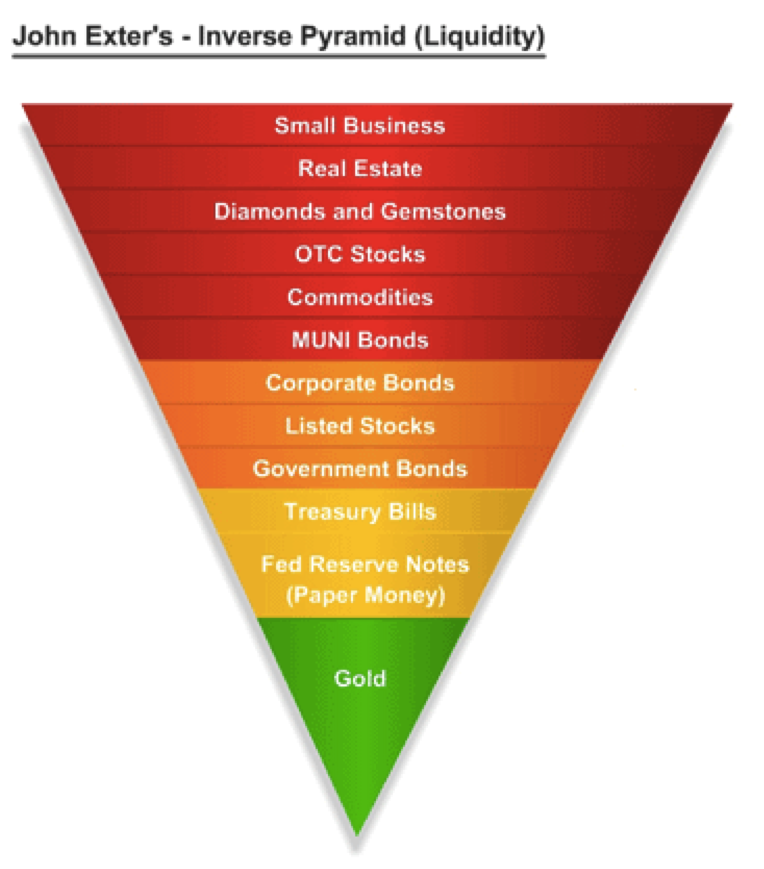
He discussed the inverted pyramid of John Exter.  Gold is the triangle at the bottom, and then above is silver, dollar bills, and then the various kinds of electronic deposits, stocks, real estate, etc.  In a crisis, people want to move from top to bottom of the pyramid, but of course there isn’t enough of the stuff at the bottom.

exter

In a scenario in which desperate, panicky people are trying to cope with the enormity of a collapse that they don’t and can’t understand, I think this split between “physical” dollars and “electronic” dollars is very plausible.

Just as there is nothing to be accomplished by selling an underlying security as it becomes worthless, only to buy a derivative of it, selling Treasury bonds and buying dollars is equally nonsensical.  The dollar is the Federal Reserve’s liability, backed by the Treasury bond as the asset.  If you believe the Treasury bond is worthless, then you ascribe no value to the dollar either.  This is why gold will go into permanent backwardation.  Holders of dollars will provide an unlimited bid for gold that will not be reciprocated by holders of gold.  The latter own the only safe asset, and the only monetary asset that is not ultimately backed by the Treasury bond or the dollar, and they will have no desire to give it up.

The concept of backwardation is simple.  It is when people accept a future promise to deliver only at a discount to physical stuff handed over right now.  This could be when there is a shortage, such as wheat before the harvest.  Or in the case of gold, backwardation signifies a collapse in trust.  But isn’t this the same phenomenon of a tectonic rift between paper dollars and electronic deposits?

In a certain sense, the “money you can fold” behaves like a physical commodity, a present good (I realize I am stretching the concept here more than a bit).  The electronic deposit credit is most definitely a future promise.  In my gold backwardation thesis, the action begins with the offer on the futures contract falling below the bid on spot gold.  The bid-ask spread on spot gold widens, as the offer is relentlessly advancing, pulling the bid behind it.  The bid-ask spread on the futures contract also widens, as the offer remains stubbornly high, but the bid withdraws and retreats as gold buyers don’t trust futures and buy physical gold instead.  Eventually, there are no more sellers of physical gold and that is that (except for the dollar-commodities-gold arbitrage, a backdoor way for dollar holders to get a little gold before the end of the game).

If this split occurs in the dollar, I think it will play out the same way.  At first, sellers of real goods may accept electronic credit money, but demand a higher price.  The spread on the electronic dollar widens, with the bid from real goods falling.  At the same time, virtually unlimited demand for the “real” paper you can fold causes the bid on the paper dollar to rise.

Who knows how long it could last?  People could go on accepting paper dollars out of long habit.  Obviously, this is an unstable situation that must necessarily collapse.  Unlike gold, the paper dollar has no value other than the broken promises that back it.

I dub this “dollar backwardation”.

In Defense of the Corporation

Today, the government of the USA is in an accelerating transition.  For the first 100 years (with a few exceptions) the government of the USA existed to set man free from men.  The rights of the people were respected by the law and by the courts.  And it is no coincidence that the USA grew from a small agrarian society in the 18th century to a wealthy superpower barely a century later.

But today, the government is taking control over every facet of the economy: sector by sector, law by law, regulation by regulation, court decision by court decision, czar by czar, presidential diktat by president diktat.

In this environment, formerly good and honorable words like “police officer”, “banker”, and “corporation” have taken on negative connotations as people become aware of the nature of our present system.  The evil is not in the fact of being a police officer; it is in the nature of enforcement of bad laws (and neglect of enforcement of good laws).  It is not in the nature of lending (i.e. exchanging wealth for income), but in helping the central bank create inflation (i.e. counterfeit credit).  It is not in the nature of forming a large-scale enterprise, but in buying coercive powers and in forming an evil alliance with government.

By Corporation, I do not refer to the modern parasite that latches onto the government, seeking to coerce its customers, destroy its competitors, and feed at the public trough.  Benito Mussolini coined the term for this system—fascism—though of course he did not regard it as the terminal stage of civilization.  People today also call this “crony capitalism”, a term I don’t favor, as it is not any kind of capitalism at all, but the negation of capitalism.

Ayn Rand once noted that, “civilization is the process of setting man free from men.”[1]  When the government abandons its legitimate mission of protecting the individual rights of life, liberty, and property and instead institutionalizes their violation, then that society is reaching the end.  What inevitably must follow next is the disintegration of the specialization of labor and then collapse of the civilization back into a dark age.  Without the specialization of labor, each man must learn to produce—and physically labor to produce—everything he needs on his own, using only the resources of the patch of ground he happens to be on.  This relegates him to the level of a beast, and under such conditions life is short and miserable.

It is in this light that I offer my two (gold!) cents about the nature of the corporation.  Stripped of its pejorative connotations—and of the looting of the current system—what is a corporation?  Earlier, I noted that a corporation is a large-scale enterprise.

Let’s begin there.  I will first propose something that I think should not be controversial.  The production of certain goods and services requires a large scale.  There is no such thing as a local subsistence computer chip manufacturer.  Intel does and must operate on a world-scale.  Only at this scale is it possible to pay for the vast research and development necessary for a chipmaker.  Only at this scale can a factory produce such small and delicate things as computer chips.

The same thing applies to an airline, or even food production.  We take for granted today that we can go to a supermarket and buy almost any fruit or vegetable at any time of year, any meat, or processed food.  It will be safe, and it will be affordable to a wage earner.  This was not true 100 years ago, and it is not true in many places in the world today.

What are the requirements of operating at large scale?  One needs a large amount of capital (more than one man could provide), large numbers of employees, and large numbers of customers.  Let’s look at these in order.

What are the requirements of raising a large amount of capital from strangers?  First there must be a business plan that promises a good chance to pay the investor a good return on his investment.  And there is something else.  The investor understands that the money he invests is at risk.  But beyond that, he will not willingly risk his life’s savings, house, and his family legacy.  If investing an ounce of gold necessarily put the other 99 ounces he owned at risk, then no one would invest, period.  The investor has a choice of how to pursue his goal of exchanging income for wealth.  He can always fall back on hoarding during his working career and dishoarding in retirement.  The entrepreneur, on the other hand, has no choice.  If he cannot raise capital from investors, he cannot get into business (or expand his business beyond his workshop).

What about hiring a large number of employees?  With each hire, the company incurs a risk of loss due to any number of factors including if the employee is injured, the employee causes an injury to someone else, the employee damages the company’s property or the property of a third party, etc.

The same issues apply to selling at world-scale, to numerous customers all over the world.  If a customer is injured due to faulty product design or manufacturing, if customers change their taste and refuse to buy a product which has been manufactured in large quantities in anticipation of big sales numbers, a competitor sues for patent infringement, or any number of other things happen, the company incurs a risk of loss.

One of the requirements of operating at large scale appears to be in conflict with two other requirements.  To raise money from investors, there must be a limitation of liability.  To hire a large workforce and to sell in large volumes incur risk of loss that could exceed the company’s capital.

I propose for consideration by the reader a statement that I realize is controversial today.  I propose that the only solution for the above three constrains is the limited liability corporation.  Without the limitation of liability, it is not possible to operate a business at larger-scale than a family workshop.  It would be possible to make shoes, barrels, swords, and all of the other goods of the Dark and Middle Ages.  It would not be possible to reach the Industrial Revolution, much less to produce refrigerators, cars, computers, or the Internet.

In addition to the limitation of liability, there is another important attribute of the corporation.  The corporation itself owns its capital such as money, land, buildings, tools, inventory, etc.  And the corporation is the party of record in contracts such as with landlords, suppliers, customers, banks, etc.

This is the other controversial aspect of the corporation.  For legal purposes, a corporate entity is a “person” with the rights of speech, liberty, contract, and property.  As described above, it would not be possible to operate a business larger than a family workshop if each tool had to be owned by a person (a wage earner?), each contract had to be signed personally by a person (a manager?), and each debt incurred by an individual person (one of the investors?)  It is the corporation as such which engages in production, owns its means of production, sells its output, contracts with other parties, etc.  It is not merely a loose confederation of family workshops in a cottage industry, wherein each is an independent entity.

Thus we must conclude that our modern, industrial, information-age civilization with its advanced transportation, communication, health care, and other technologies literally owes its existence to the limited liability corporation that has the rights of personhood.  Let us all work towards the day when the corporation returns to this definition and is no longer a large-scale parasite, seeking ill-gotten gains at the public trough.


[1] “The Soul of an Individualist” in For the New Intellectual by Ayn Rand

Dear Professor Keen

Dear Professor Keen,

I am a monetary scientist and a fan of some of your work.  I admire the courage it took for you to call the Australian housing crisis as early as you did, and to make a bet that you would be right.  But I came across this video (), wherein you say:

  “…when a crisis hits, European governments will be forced into imposing austerity on countries that desperately need a stimulus.”

With all due respect, Dr. Keen, isn’t this the same thing as saying that, “when the delirium tremens hits, the medic will be forced into imposing sobriety on a patient who desperately needs a fifth of vodka?”

My analogy is imperfect in that the European Union is hardly a medic.  They are the source of both the free vodka and the motivation to drink it to excess.

There are many problems with the European Union.  From a fiscal perspective, one can simply look at the tragedy of the common greens.  Every country’s politicians have a perverse incentive to outspend the other countries (with which spending they buy the votes of their
electorates).  From a monetary perspective, they have the same flaw that the Federal Reserve has in the USA.  The central bank holds assets to balance its liabilities.  The assets are the bonds of the government, and the liabilities are the currency.  But unlike in the USA, the euro is not backed by a single government’s bonds but by the bonds of diverse and numerous member countries.  It was a mechanism to (temporarily) prop up the lower credits of countries like Greece with the higher perceived credit of Germany, but ultimately to undermine the credit of Germany by forcing Germany to take on the liabilities of Greece.  We shall see how it plays out, but there are no good outcomes that this economist can see.

The only true solution to the increasing frequency and magnitude of financial crises is to go to the root.  In a system based on irredeemable paper money, there is no mechanism to extinguish debt.  So debt is merely pushed around until the inevitable crisis.  In addition, irredeemable paper money systems have two other intractable problems: unstable interest rates and unstable foreign exchange rates.  In their desperate attempts to “hedge” these un-hedgable risks, the banking system creates endless derivatives, and derivatives of derivatives.  And this leads to the other problem.  Markets increasingly become the casinos for speculators.  Speculators push interest rates and foreign exchange rates to even greater extremes.  And with every fluctuation, real damage is done to the real businesses that produce the goods and services necessary to feed us and keep our economy alive.

We need a gold-based monetary system.

Sincerely,
Keith Weiner,
President of the Gold Standard Institute USA

Floating Exchange Rates: Unworkable and Dishonest

Milton Friedman was a proponent of so-called “floating” exchange rates between the various irredeemable paper currencies that he promoted as the proper monetary system. Many have noted that the currencies do not “float”; they sink at differing rates, sometimes one is sinking faster and then another. This article focuses on something else.

Under gold, a nation or an individual cannot sustain a deficit forever. A deficit is when one consumes more than one produces. One has a negative cash flow, and eventually one runs out of money. The economy of a household or a nation is therefore subject to discipline—sooner or later.

Friedman asserted that floating exchange rates would impose the same kind of forces on a nation to balance its exports and imports. He claimed that if a nation ran a deficit, that this would cause its currency to fall in value relative to the other currencies. And this drop would tend to reverse the deficits as the country would find it expensive to import and buyers would find its goods cheap to import.

Friedman was wrong.

To see why, one must look at the concept known to economists as “Terms of Trade”. This phrase refers to the quantity of goods that can be purchased with the proceeds of the goods exported. For example, country X uses the xyz currency. It exports xyz1000 worth of goods and it can thereby pay for xyz1000 worth of imports. But what happens if the xyz drops relative to the currency’s of X’s trading partners, because X is running a trade deficit?

The country exports the same goods as before, but they are now worth less on the export market. So X can pay for fewer goods than before. Buying the same amount of goods will result in a larger deficit.

At this point, one may be tempted to say “Ahah, Friedman was right!” But remember, we are not talking about a gold standard. We are talking about an irredeemable paper money system. Money is borrowed into existence. Looking at the trade deficit from the perspective of Terms of Trade, we see that trade deficits lead to budget deficits, which leads to a falling currency, which leads to increased trade deficits. It is not a negative feedback loop, which is self-limited and self-correcting. It is a positive feedback loop.

There is no particular limit to this vicious cycle until the country in question accumulates so much debt that buyers refuse to come to its bond auctions. And this is not a correction or a reversal of the trend; it is the utter destruction of the currency and the wealth of the people who are forced to use it.

And, of course, Friedman had to be aware that America was likely to be biggest trade deficit runner in the world. Its currency, the dollar, was (and is) the world’s reserve currency. That means that every central bank in the world held dollars as the asset, and pyramided credit in their own currencies on top of the dollars.

What would happen if the dollar weakened because the US was importing real goods and exporting paper dollars? The US would simply import the same goods next year and export even more paper dollars to compensate for the drop in the dollar!

Friedman would have also been aware of the economist Robert Triffin, who wrote in the early 1960’s about a problem that became known as Triffin’s Dilemma. In essence, the issue is that the world needs to expand credit to grow and so has demand for more US dollars. But this can only occur if the US runs a perpetual trade deficit, which would weaken the US dollar.

To the central banks that hold dollars as the reserve asset, this is deadly. Like any bank, a central bank has assets and liabilities. If a significant component of the assets are composed of US dollars, and the US dollar falls, the central bank’s balance sheet deteriorates. The liabilities side, of course, is the central bank’s own currency. So the asset is falling and the liability is not. This is a dangerous situation and unsustainable.

And to blithely propose this as a system is to propose open theft. Why should any country agree to allow the US to dissipate its savings, defaulting on the US dollar obligations in slow motion, a few percent per year as Friedman proposed?

The scheme of floating exchange rates of irredeemable paper currencies is therefore dishonest as well as unworkable. Today, some 40 years after the plunge into the worldwide regime of irredeemable paper currencies, it’s starting to matter.