Author Archives: Keith Weiner

Unknown's avatar

About Keith Weiner

Dr. Keith Weiner is the president of Gold Standard Institute USA, and CEO of Monetary Metals. Keith is a leading authority in the areas of gold, money, and credit and has made important contributions to the development of trading techniques founded upon the analysis of bid-ask spreads. Keith is a sought after speaker and regularly writes on economics. He is an Objectivist, and has his PhD from the New Austrian School of Economics. He lives with his wife near Phoenix, Arizona.

Debunking Gold Manipulation

Yesterday [Nov 29, as I wrote this on Nov 30], the December gold contract moved sharply into backwardation (it happened in silver also, but let’s focus on gold).  This means that one could sell physical and simultaneously buy December to make a profit (please see the graph).

So let’s look a little deeper.  December basis fell massively, and cobasis rose equally.  The other months were unaffected.

Basis is the profit you would make to carry gold (buy spot and simultaneously sell a future).  Basis = Future (bid) – spot (offer).

When it falls, it could be either a falling bid on the future or a rising offer on spot.

Cobasis is the profit you would make to de-carry gold (sell spot, buy future).  Cobasis = Spot (bid) – future (offer).  When it rises, it could be a rising bid on spot or a falling offer on the future.

For both to be true, it means either spot is rising or the future is falling.  But since the bases in the other months did not exhibit this behavior, it rules out spot rising, and that means that the Dec gold future fell.

What could cause a gold future to fall relative to spot and the other future months?  Put it another way, what would cause unbalanced selling of a future relative to other months?  One hint is that the February contract deviated from the other farther-out contracts and had a rising basis and falling cobasis.  February moved higher in price relative to other contract months.

This is caused by the contract “roll” as naked longs must sell their Dec futures and if they wish to remain long gold, buy a farther-out contract (i.e. February).  This action, especially if it happens en masse, would sharply press the bid down in Dec.

It is equally interesting that the offer is falling too.  What of the conspiracy theory that the banks have massive naked short positions?

If they did, they would be forced to buy them back as the contract expired.  This would lift the offer on the future.  In that case, the cobasis would be falling, the opposite of what is occurring.

This is the basis (no pun intended) of how one would go about debunking the allegations that the precious metals markets are manipulated by massive short-selling of futures.

As a side note, the spread between the Dec 2011 contract and Feb 2012 contract also widened sharply.  It had been falling since late October, accelerating in November.

Yesterday, it was possible to buy Dec (at the offer) and sell Feb (on the bid) for a profit of almost $6 an ounce.  While this is too small to be actionable if you have to pay commissions and fees and storage for two months (about $8.50 for a retail account), it’s telling.
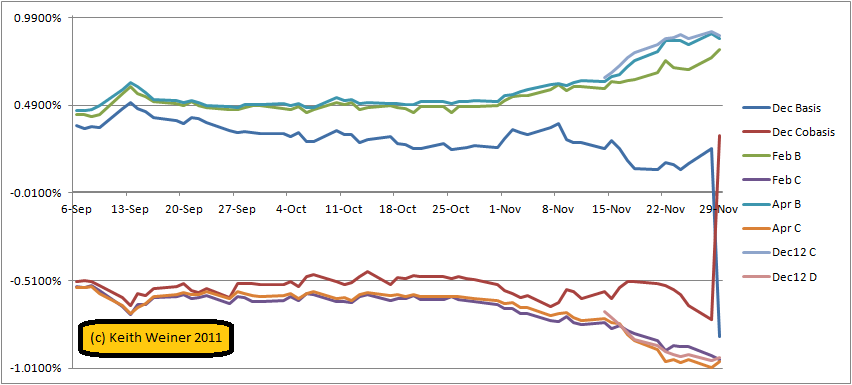
Dec_backwardation


Videos of my lecture “Irredeemable Currency vs. Gold”

I gave this talk at the Chicago Objectivist Society MiniCon Sep 4, 2011.  Here is the full set of 9 videos on youtube for my presentation plus Q&A at the end, posted on this site to archive the links.

lrredeemable currency vs gold – 1_9 introduction.wmv

lrredeemable currency vs gold – 2_9 the origin of money.wmv

lrredeemable currency vs gold – 3_9 irredeemable debt based paper money.wmv

lrredeemable currency vs gold – 4_9 interest rates.wmv

lrredeemable currency vs gold – 5_9 fractional reserve banking.wmv

lrredeemable currency vs gold – 6_9 arbitrage.wmv

lrredeemable currency vs gold – 7_9 gold backwardation.wmv

lrredeemable currency vs gold – 8_9 questions and answers pt1.wmv

lrredeemable currency vs gold – 9_9 questions and answers pt2.wmv


Subjective Theory of Value

© July 25, 2011 by Keith Weiner


The question “what is value” must first be addressed outside the field of economics; it is one of the fundamental questions in the field of philosophy.  It is the core of the branch of philosophy known as ethics.  For millennia, philosophers debated the nature of value.  One view was that value is intrinsic—given by a supernatural being, or given in the nature of things (a variant of this is that value is created by the labor that goes into making something).  The other was that it was subjective—whatever any person wanted it to be.

Of course, these views are a false dichotomy.  The flaw with the intrinsic view can be seen with the example of a drowning man, to whom water is not a value.  The flaw with the subjective view can be seen with the example of the madman who tries to eat lead and drink petrol.

Ayn Rand defined value, in philosophy, as “that which one acts to gain or keep.”   She noted that living things are fundamentally different from non-living things.  They have an attribute that can go out of existence: their lives.  Life requires of every living thing that it act to gain or keep values.  Even a plant must grow its roots towards water, and its stem towards light.

And man is distinguished from all other animals in that he has a choice.  Unlike animals, which act on instincts that are pre-programmed in, man has a choice.   This choice extends to values.  Values are not automatically given as a result of instincts, revelations, or any other process outside of consciousness.  And man can make mistakes.  And some values are “optional”: the preference for vanilla vs. chocolate ice cream, for example.

The proper approach to value in man, therefore, begins with recognizing value is determined by an act of consciousness.  Man’s nature is to think and act based on his conclusions.  But it is also necessary to recognize that value is not arbitrary.  Value is not any whim that a drunk, stoned, or dysfunctional consciousness can dream up.  There is a beat poem “Storm” (http://www.youtube.com/watch?v=HhGuXCuDb1U) which makes the point, among many others, that one is not free to walk out the second story window.

A value, therefore, is based on an act of consciousness and also on reality.  One recognizes that something in existence will sustain or further one’s life.

One cannot ask the question “of value?” without first answering; to whom and for what.

This is where economics begins, after philosophy has done its job as described above.  Carl Menger was the first to apply this approach to value—that it is the individual who is the unit valuer.  It is meaningless to speak of nations, societies, or collectives.  It is as meaningless to speak of value as being intrinsic to an inanimate thing.  And it is as meaningless as speaking of value being arbitrary, capricious, spurious, or disconnected from reality, life, and reason.

This is what I think Menger meant by “subjective”: the individual is the proper subject of economics, not the class of the laborers or the nation of the British.

I think one will find with this concept clearly defined that it does not change the meaning of Menger’s ideas, nor economic analysis.  But it will help explain numerous phenomena, for example that marginal utility declines.

Why is this so?  Why does everyone value the 11th unit of wheat less than the 1st unit?  It is because they value wheat for eating.  But one’s need to eat is finite and once it is satisfied, one moves on to satisfy other needs.

I think this issue is important because Austrian School economics is about free markets and freedom generally.  The statists have a very different (and dishonest) view of economics.  There is a philosophy that leads to and proves that free markets and freedom is not only the way to prosperity but also the only moral kind of system.  I plan to write more about this connection between gold, liberty, and philosophy in future pieces.


This piece was originally published in the August, 2011 issue of The Gold Standard.

Banning Short Selling

In fall, 2008, the US banned short selling of certain stocks.  It triggered a massive short-covering rally.  Then, without the shorts in the market, prices went into freefall.  When prices are falling, the shorts (when taking profits) are the only bidders.  Markets don’t crash because of short sellers.  They crash because the bid is withdrawn.

Every time governments have tried to manipulate markets and impede price discovery, it’s always had the same disastrous result.  And yet today, several European countries have announced bans on short selling.

My prediction is that, after a possible massive short covering rally and possibly piling-on by momentum chasers, whatever securities are not shortable will collapse.  One reason for this is that a ban on short selling tells would-be buyers that there is something wrong.  And they should withdraw their bids.  Then gravity will take over, as first one seller needs to sell “at the market” (i.e. on the bid) and there is no real bid.

I wrote the following in response to a friend’s Facebook post.


First, contrary to popular misconception, the purpose of the stock market is not to go up, ratcheting higher and never lower. Its purpose
is price discovery. This is because it allocates capital, and just as it is important to allocate more capital to the most productive
enterprises, it is equally important to deprive the least productive enterprises of more capital (which they are destroying). Short selling
is a key part of this process.

Second, unlike long buying, short selling tends to be done by more sophisticated investors. With long buying, there is a limit on one’s
potential loss but no limit on the possible gain. Short sellers face the opposite: a limited gain and unlimited losses. This tends to make
them more careful, more selective, and to hold positions for much shorter periods of time.

Third, short sellers keep everyone else honest. When people can act free from negative consequences or downside, they tend to become more
and more aggressive and take risks. Imagine if I said go into the casino, and if you win keep it. But if you lose, I will pay you back.
This is also called “moral hazard”. Greed is one of the two motivators for market participants. People want to make lots of money. Fear is
the check on it. People really want to avoid losses. Short sellers can inflict losses when people become overly, irrationally greedy.

Fourth, short sellers will tend to dampen volatility. The higher a price goes above its fundamentals, the more short sellers will be
attracted to come in to the market. Perhaps more dramatically, when a market is plunging, short sellers may be the only bid in the market.
Consider how a real market works. Forget “the price” of something.  There are always two prices: the bid and the ask (offer). The bid and
the offer are made by different people, motivated by different forces.  And there are asymmetries. Since money is the most liquid, most
trusted thing in the system, it’s never bad to sell an asset and get cash. So there is never a case when the offer is withdrawn. But the
bid is a whole different story. The bid is withdrawn under crisis or stress. This causes a market to plunge, and thus more bids are
withdrawn. Short sellers, on the other hand, have a natural tendency to want to take profits. And thus buy back the shares they shorted.  And thus put in a bid.

Fifth, markets are driven by arbitrage. If the price of copper goes down, an arbitrager can put on the following trades simultaneously:
buy copper (long) and short a copper mining company. If two similarly situated companies are trading at a stable ratio of share prices, and
one’s price suddenly starts to collapse (assuming that it’s not caused by anything real) the arbitrager can buy the fallen shares and short
the shares of the other to bring the spread back to normal. There are endless examples of arbitrage, which involve at least one short “leg”.

The Swiss Franc

The Swiss franc has risen from $0.86 in Jun 2010, spiking to more than $1.40 yesterday.  Unfortunately, I did not have time to write this piece before its mini crash overnight.  It was down more than 5% when I turned on my screen this morning.

So what’s going on with the Swissie?

No one outside the the central banks and their cronies knows the details of what’s happening or what will happen.  But one can apply general principles and put together a big picture.  That is my goal in this today.

Most people who have observed markets for any length of time can tell you that gigantic moves upwards after a long period of relentless upward moves generally do not end well.  Silver had a massive spike to $49, before selling off to $34, a 30% crash.  On Tuesday, Aug 9, the Swiss franc (CHF) moved from $1.32 to $1.39.  Two days later, it has moved (so far) from $1.37 to $1.31.  It’s currently below the opening price on Tuesday.

Whenever a price gets far enough out of whack, it tends to get back into whack.

OK, but this is just chart watching.  I am not generally a believer that past price movements can predict future price movements.  Let’s look at the fundamentals.  First, the swissie is like all other “modern” currencies today: it is the debt paper issued by a central bank.  


http://www.zerohedge.com/news/swiss-franc-plunges-600-pips-peg-speculation-wi…