Author Archives: Keith Weiner

Unknown's avatar

About Keith Weiner

Dr. Keith Weiner is the president of Gold Standard Institute USA, and CEO of Monetary Metals. Keith is a leading authority in the areas of gold, money, and credit and has made important contributions to the development of trading techniques founded upon the analysis of bid-ask spreads. Keith is a sought after speaker and regularly writes on economics. He is an Objectivist, and has his PhD from the New Austrian School of Economics. He lives with his wife near Phoenix, Arizona.

Dollar Backwardation

The current financial crisis, may progress to a phase where people demand and hoard dollar bills but take electronic deposit credits only at a discount which increases until electronic deposit credits are repudiated entirely.  The Federal Reserve would be powerless to solve the problem, because while they can create unlimited electronic deposit credits they can’t create unlimited paper dollar bills, “money you can fold” as Professor Antal Fekete calls it.  There would be a glut of electronic deposits, but a shortage of dollar bills.

Before the financial crisis metastasized in 2008, Fekete wrote a paper that I think is underappreciated and under-discussed.  Can We Have Inflation and Deflation at the Same Time?  In his paper, he discussed the “tectonic rift” between paper Federal Reserve Notes (i.e. dollar bills) and electronic deposits.  By statute, the Federal Reserve cannot print dollar bills without collateral (e.g. Treasury bonds).  Also, they have limited printing press capacity that is insufficient to keep up with a catastrophic crisis.

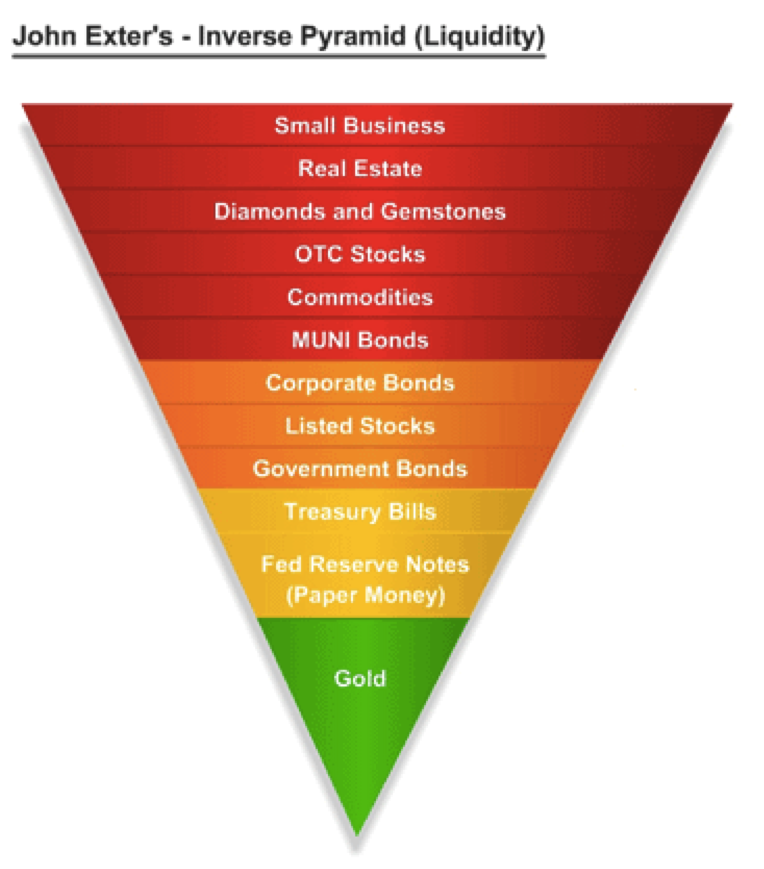
He discussed the inverted pyramid of John Exter.  Gold is the triangle at the bottom, and then above is silver, dollar bills, and then the various kinds of electronic deposits, stocks, real estate, etc.  In a crisis, people want to move from top to bottom of the pyramid, but of course there isn’t enough of the stuff at the bottom.

exter

In a scenario in which desperate, panicky people are trying to cope with the enormity of a collapse that they don’t and can’t understand, I think this split between “physical” dollars and “electronic” dollars is very plausible.

Just as there is nothing to be accomplished by selling an underlying security as it becomes worthless, only to buy a derivative of it, selling Treasury bonds and buying dollars is equally nonsensical.  The dollar is the Federal Reserve’s liability, backed by the Treasury bond as the asset.  If you believe the Treasury bond is worthless, then you ascribe no value to the dollar either.  This is why gold will go into permanent backwardation.  Holders of dollars will provide an unlimited bid for gold that will not be reciprocated by holders of gold.  The latter own the only safe asset, and the only monetary asset that is not ultimately backed by the Treasury bond or the dollar, and they will have no desire to give it up.

The concept of backwardation is simple.  It is when people accept a future promise to deliver only at a discount to physical stuff handed over right now.  This could be when there is a shortage, such as wheat before the harvest.  Or in the case of gold, backwardation signifies a collapse in trust.  But isn’t this the same phenomenon of a tectonic rift between paper dollars and electronic deposits?

In a certain sense, the “money you can fold” behaves like a physical commodity, a present good (I realize I am stretching the concept here more than a bit).  The electronic deposit credit is most definitely a future promise.  In my gold backwardation thesis, the action begins with the offer on the futures contract falling below the bid on spot gold.  The bid-ask spread on spot gold widens, as the offer is relentlessly advancing, pulling the bid behind it.  The bid-ask spread on the futures contract also widens, as the offer remains stubbornly high, but the bid withdraws and retreats as gold buyers don’t trust futures and buy physical gold instead.  Eventually, there are no more sellers of physical gold and that is that (except for the dollar-commodities-gold arbitrage, a backdoor way for dollar holders to get a little gold before the end of the game).

If this split occurs in the dollar, I think it will play out the same way.  At first, sellers of real goods may accept electronic credit money, but demand a higher price.  The spread on the electronic dollar widens, with the bid from real goods falling.  At the same time, virtually unlimited demand for the “real” paper you can fold causes the bid on the paper dollar to rise.

Who knows how long it could last?  People could go on accepting paper dollars out of long habit.  Obviously, this is an unstable situation that must necessarily collapse.  Unlike gold, the paper dollar has no value other than the broken promises that back it.

I dub this “dollar backwardation”.

In Defense of the Corporation

Today, the government of the USA is in an accelerating transition.  For the first 100 years (with a few exceptions) the government of the USA existed to set man free from men.  The rights of the people were respected by the law and by the courts.  And it is no coincidence that the USA grew from a small agrarian society in the 18th century to a wealthy superpower barely a century later.

But today, the government is taking control over every facet of the economy: sector by sector, law by law, regulation by regulation, court decision by court decision, czar by czar, presidential diktat by president diktat.

In this environment, formerly good and honorable words like “police officer”, “banker”, and “corporation” have taken on negative connotations as people become aware of the nature of our present system.  The evil is not in the fact of being a police officer; it is in the nature of enforcement of bad laws (and neglect of enforcement of good laws).  It is not in the nature of lending (i.e. exchanging wealth for income), but in helping the central bank create inflation (i.e. counterfeit credit).  It is not in the nature of forming a large-scale enterprise, but in buying coercive powers and in forming an evil alliance with government.

By Corporation, I do not refer to the modern parasite that latches onto the government, seeking to coerce its customers, destroy its competitors, and feed at the public trough.  Benito Mussolini coined the term for this system—fascism—though of course he did not regard it as the terminal stage of civilization.  People today also call this “crony capitalism”, a term I don’t favor, as it is not any kind of capitalism at all, but the negation of capitalism.

Ayn Rand once noted that, “civilization is the process of setting man free from men.”[1]  When the government abandons its legitimate mission of protecting the individual rights of life, liberty, and property and instead institutionalizes their violation, then that society is reaching the end.  What inevitably must follow next is the disintegration of the specialization of labor and then collapse of the civilization back into a dark age.  Without the specialization of labor, each man must learn to produce—and physically labor to produce—everything he needs on his own, using only the resources of the patch of ground he happens to be on.  This relegates him to the level of a beast, and under such conditions life is short and miserable.

It is in this light that I offer my two (gold!) cents about the nature of the corporation.  Stripped of its pejorative connotations—and of the looting of the current system—what is a corporation?  Earlier, I noted that a corporation is a large-scale enterprise.

Let’s begin there.  I will first propose something that I think should not be controversial.  The production of certain goods and services requires a large scale.  There is no such thing as a local subsistence computer chip manufacturer.  Intel does and must operate on a world-scale.  Only at this scale is it possible to pay for the vast research and development necessary for a chipmaker.  Only at this scale can a factory produce such small and delicate things as computer chips.

The same thing applies to an airline, or even food production.  We take for granted today that we can go to a supermarket and buy almost any fruit or vegetable at any time of year, any meat, or processed food.  It will be safe, and it will be affordable to a wage earner.  This was not true 100 years ago, and it is not true in many places in the world today.

What are the requirements of operating at large scale?  One needs a large amount of capital (more than one man could provide), large numbers of employees, and large numbers of customers.  Let’s look at these in order.

What are the requirements of raising a large amount of capital from strangers?  First there must be a business plan that promises a good chance to pay the investor a good return on his investment.  And there is something else.  The investor understands that the money he invests is at risk.  But beyond that, he will not willingly risk his life’s savings, house, and his family legacy.  If investing an ounce of gold necessarily put the other 99 ounces he owned at risk, then no one would invest, period.  The investor has a choice of how to pursue his goal of exchanging income for wealth.  He can always fall back on hoarding during his working career and dishoarding in retirement.  The entrepreneur, on the other hand, has no choice.  If he cannot raise capital from investors, he cannot get into business (or expand his business beyond his workshop).

What about hiring a large number of employees?  With each hire, the company incurs a risk of loss due to any number of factors including if the employee is injured, the employee causes an injury to someone else, the employee damages the company’s property or the property of a third party, etc.

The same issues apply to selling at world-scale, to numerous customers all over the world.  If a customer is injured due to faulty product design or manufacturing, if customers change their taste and refuse to buy a product which has been manufactured in large quantities in anticipation of big sales numbers, a competitor sues for patent infringement, or any number of other things happen, the company incurs a risk of loss.

One of the requirements of operating at large scale appears to be in conflict with two other requirements.  To raise money from investors, there must be a limitation of liability.  To hire a large workforce and to sell in large volumes incur risk of loss that could exceed the company’s capital.

I propose for consideration by the reader a statement that I realize is controversial today.  I propose that the only solution for the above three constrains is the limited liability corporation.  Without the limitation of liability, it is not possible to operate a business at larger-scale than a family workshop.  It would be possible to make shoes, barrels, swords, and all of the other goods of the Dark and Middle Ages.  It would not be possible to reach the Industrial Revolution, much less to produce refrigerators, cars, computers, or the Internet.

In addition to the limitation of liability, there is another important attribute of the corporation.  The corporation itself owns its capital such as money, land, buildings, tools, inventory, etc.  And the corporation is the party of record in contracts such as with landlords, suppliers, customers, banks, etc.

This is the other controversial aspect of the corporation.  For legal purposes, a corporate entity is a “person” with the rights of speech, liberty, contract, and property.  As described above, it would not be possible to operate a business larger than a family workshop if each tool had to be owned by a person (a wage earner?), each contract had to be signed personally by a person (a manager?), and each debt incurred by an individual person (one of the investors?)  It is the corporation as such which engages in production, owns its means of production, sells its output, contracts with other parties, etc.  It is not merely a loose confederation of family workshops in a cottage industry, wherein each is an independent entity.

Thus we must conclude that our modern, industrial, information-age civilization with its advanced transportation, communication, health care, and other technologies literally owes its existence to the limited liability corporation that has the rights of personhood.  Let us all work towards the day when the corporation returns to this definition and is no longer a large-scale parasite, seeking ill-gotten gains at the public trough.


[1] “The Soul of an Individualist” in For the New Intellectual by Ayn Rand

Dear Professor Keen

Dear Professor Keen,

I am a monetary scientist and a fan of some of your work.  I admire the courage it took for you to call the Australian housing crisis as early as you did, and to make a bet that you would be right.  But I came across this video (), wherein you say:

  “…when a crisis hits, European governments will be forced into imposing austerity on countries that desperately need a stimulus.”

With all due respect, Dr. Keen, isn’t this the same thing as saying that, “when the delirium tremens hits, the medic will be forced into imposing sobriety on a patient who desperately needs a fifth of vodka?”

My analogy is imperfect in that the European Union is hardly a medic.  They are the source of both the free vodka and the motivation to drink it to excess.

There are many problems with the European Union.  From a fiscal perspective, one can simply look at the tragedy of the common greens.  Every country’s politicians have a perverse incentive to outspend the other countries (with which spending they buy the votes of their
electorates).  From a monetary perspective, they have the same flaw that the Federal Reserve has in the USA.  The central bank holds assets to balance its liabilities.  The assets are the bonds of the government, and the liabilities are the currency.  But unlike in the USA, the euro is not backed by a single government’s bonds but by the bonds of diverse and numerous member countries.  It was a mechanism to (temporarily) prop up the lower credits of countries like Greece with the higher perceived credit of Germany, but ultimately to undermine the credit of Germany by forcing Germany to take on the liabilities of Greece.  We shall see how it plays out, but there are no good outcomes that this economist can see.

The only true solution to the increasing frequency and magnitude of financial crises is to go to the root.  In a system based on irredeemable paper money, there is no mechanism to extinguish debt.  So debt is merely pushed around until the inevitable crisis.  In addition, irredeemable paper money systems have two other intractable problems: unstable interest rates and unstable foreign exchange rates.  In their desperate attempts to “hedge” these un-hedgable risks, the banking system creates endless derivatives, and derivatives of derivatives.  And this leads to the other problem.  Markets increasingly become the casinos for speculators.  Speculators push interest rates and foreign exchange rates to even greater extremes.  And with every fluctuation, real damage is done to the real businesses that produce the goods and services necessary to feed us and keep our economy alive.

We need a gold-based monetary system.

Sincerely,
Keith Weiner,
President of the Gold Standard Institute USA

Floating Exchange Rates: Unworkable and Dishonest

Milton Friedman was a proponent of so-called “floating” exchange rates between the various irredeemable paper currencies that he promoted as the proper monetary system. Many have noted that the currencies do not “float”; they sink at differing rates, sometimes one is sinking faster and then another. This article focuses on something else.

Under gold, a nation or an individual cannot sustain a deficit forever. A deficit is when one consumes more than one produces. One has a negative cash flow, and eventually one runs out of money. The economy of a household or a nation is therefore subject to discipline—sooner or later.

Friedman asserted that floating exchange rates would impose the same kind of forces on a nation to balance its exports and imports. He claimed that if a nation ran a deficit, that this would cause its currency to fall in value relative to the other currencies. And this drop would tend to reverse the deficits as the country would find it expensive to import and buyers would find its goods cheap to import.

Friedman was wrong.

To see why, one must look at the concept known to economists as “Terms of Trade”. This phrase refers to the quantity of goods that can be purchased with the proceeds of the goods exported. For example, country X uses the xyz currency. It exports xyz1000 worth of goods and it can thereby pay for xyz1000 worth of imports. But what happens if the xyz drops relative to the currency’s of X’s trading partners, because X is running a trade deficit?

The country exports the same goods as before, but they are now worth less on the export market. So X can pay for fewer goods than before. Buying the same amount of goods will result in a larger deficit.

At this point, one may be tempted to say “Ahah, Friedman was right!” But remember, we are not talking about a gold standard. We are talking about an irredeemable paper money system. Money is borrowed into existence. Looking at the trade deficit from the perspective of Terms of Trade, we see that trade deficits lead to budget deficits, which leads to a falling currency, which leads to increased trade deficits. It is not a negative feedback loop, which is self-limited and self-correcting. It is a positive feedback loop.

There is no particular limit to this vicious cycle until the country in question accumulates so much debt that buyers refuse to come to its bond auctions. And this is not a correction or a reversal of the trend; it is the utter destruction of the currency and the wealth of the people who are forced to use it.

And, of course, Friedman had to be aware that America was likely to be biggest trade deficit runner in the world. Its currency, the dollar, was (and is) the world’s reserve currency. That means that every central bank in the world held dollars as the asset, and pyramided credit in their own currencies on top of the dollars.

What would happen if the dollar weakened because the US was importing real goods and exporting paper dollars? The US would simply import the same goods next year and export even more paper dollars to compensate for the drop in the dollar!

Friedman would have also been aware of the economist Robert Triffin, who wrote in the early 1960’s about a problem that became known as Triffin’s Dilemma. In essence, the issue is that the world needs to expand credit to grow and so has demand for more US dollars. But this can only occur if the US runs a perpetual trade deficit, which would weaken the US dollar.

To the central banks that hold dollars as the reserve asset, this is deadly. Like any bank, a central bank has assets and liabilities. If a significant component of the assets are composed of US dollars, and the US dollar falls, the central bank’s balance sheet deteriorates. The liabilities side, of course, is the central bank’s own currency. So the asset is falling and the liability is not. This is a dangerous situation and unsustainable.

And to blithely propose this as a system is to propose open theft. Why should any country agree to allow the US to dissipate its savings, defaulting on the US dollar obligations in slow motion, a few percent per year as Friedman proposed?

The scheme of floating exchange rates of irredeemable paper currencies is therefore dishonest as well as unworkable. Today, some 40 years after the plunge into the worldwide regime of irredeemable paper currencies, it’s starting to matter.

Keith Weiner to Head Gold Standard Institute USA

Vienna, AUSTRIA and Scottsdale, AZ USA (April 15, 2012)—The Gold Standard Institute is pleased to announce that Keith Weiner will be establishing The Gold Standard Institute USA to promote the gold standard in this large and important market.  The Gold Standard Institute USA will work closely with The Gold Standard Institute in Vienna to further develop the high-quality journal The Gold Standard, a large international mailing list, and papers and quick-sheets explaining how a proper gold standard works.  Further details will be announced soon.

A proper, unadulterated gold standard is not only necessary for the economy to coordinate the actions of millions of productive people, but it is the keystone.  Today, people are suffering as the 40-year-old irredeemable paper money system is becoming unstable and approaches total collapse.  The burden of debt is rising as the rate of interest falls, unemployment is rising, infrastructure is failing due to lack of capital to maintain it, and at the same time the productive class is being replaced by the speculator class and the government-crony class.

“I am excited to work with The Gold Standard Institute, which is the only organization that is defining and promoting a real gold standard.  I think that there are millions of Americans who would be interested and it is now my job to bring them the knowledge and the tools to promote the gold standard in the US,” said Keith Weiner.

“We have been fortunate to have Keith Weiner as a friend and ally for several years, and we are very pleased that he has agreed to take up the task in the USA.  Keith is a successful entrepreneur who understands both urgency and scalability, and the demands and work involved in promoting the gold standard,” said Philip Barton, founder and President of The Gold Standard Institute.


About The Gold Standard Institute

http://www.goldstandardinstitute.net

The Gold Standard Institute, founded in 2009, exists to disseminate the virtues of the gold standard widely and to establish gold as the basis of money.  With the financial system heading towards collapse, and with gold forgotten and misunderstood, this is the most important mission in the world.  The Institute publishes a monthly journal with gold-related news and articles about gold and money.  The Institute is composed of people from all walks of life who cherish the ideals of liberty, prosperity and peace and who understand that sound money is a necessary component to achieve this.

About Keith Weiner

Keith Weiner has been a technology entrepreneur.  He was the founder of DiamondWare, a VoIP software company, which he sold to Nortel in 2008.  Keith is an adherent of Ayn Rand’s philosophy of Objectivism, and a student at the New Austrian School of economics, working on his PhD under Professor Antal Fekete, with a focus on monetary science.  Keith is now a trader and market analyst in precious metals and commodities.  Now that central planning has failed, he would like the world to return to a proper gold standard and laissez-faire capitalism.


For more information, contact:

The Gold Standard Institute Europe
www.goldstandardinstitute.org
Thomas Bachheimer
+43-676-3348-124
bachheimer@yahoo.de

The Gold Standard Institute USA
Keith Weiner
602-478-9275
weiner.keith@gmail.com

Irredeemable Paper Money, Feature #451

I am writing this, having just returned from the fourth course at the New Austrian School of Economics, in Munich. The single biggest theme was the rate of interest and its linkage to prices. Kondratieff, among several others, have observed that rising prices lead to rising interest rates and vice versa. And the opposite case is also true, falling interest rates go with falling prices (all else being equal). I plan to write a separate paper on this topic.

One of the most important ideas proposed by Professor Fekete is that a rise in the rate of interest reduces the burden of debt that has been accumulated previously. And a fall in the rate of interest increases the burden of debt. This is because the present value of a future payment is:

Present Value = Payment / (1 + Interest)^Time

If the payment is $1000 per year, and the interest rate is 10%, then the payment at the end of the first year is worth 1000 / 1.1 = $909 today. The payment at the end of the 30th year is worth $57.31 today (1000 / 1.1^30).

But as the rate of interest falls, the present value of all future payments rises. If the rate of interest fell to zero, then the present value of each future payment would be the nominal value of the payment (1000/1^30 = 1000). The 30th year payment would be worth $1000 today.

burden

Unlike under a gold standard, in paper money the rate of interest is subject to massive volatility. Sometimes, the government has its way, fueling rising prices and interest rates. Other times bond speculators front-run the central bank’s unlimited appetite for purchasing government bonds and the rate of interest falls. We are now in year 31 (so far) of this latter phase.

As the total accumulated debt increases (feature #450 of irredeemable money is that total debt cannot go down), the effect of a change in the rate of interest becomes larger and larger. Today, even very small fluctuations have a disproportionate impact on the burden of debt incurred at every level, from consumer to business to corporate to government at every level. To say that this is destructive is a great understatement.

This, rather than the quantity of money, is what people and especially economists should be focused on.

When Gold Backwardation Becomes Permanent

The Root of the Problem is Debt

Worldwide, an incredible tower of debt has been under construction since 1971, when President Nixon defaulted on the gold obligations of the US government.  His decree severed the redeemability of the dollar for gold and thus eliminated the extinguisher of debt.  Debt has been growing exponentially everywhere since then.  Debt is backed with debt, based on debt, dependent on debt, and leveraged with yet more debt.  For example, today it is possible to buy a bond (i.e. lend money) on margin (i.e. with borrowed money).

The time is now fast approaching when all debt will be defaulted.  In our perverse monetary system, one party’s debt is another’s “money”.  A debtor’s default will impact the creditor (who is usually also a debtor to yet other creditors), causing him to default, and so on.  When this begins in earnest, it will wipe out the banking system and thus everyone’s “money”.  The paper currencies will not survive this.  We are seeing the early edges of it now in the euro, and it’s anyone’s guess when it will happen in Japan, though it seems long overdue already.  Last of all, it will come to the USA.

The purpose of this article is to present the early warning signal and explain the actual mechanism to these events.  Contrary to popular belief, it will not be that the central banks increase the quantity of money to infinity.  The money supply may even be contracting (which is what I expect).

To understand the terminal stages of the monetary system’s fatal disease, we must understand gold.

Defining Backwardation

First, let me introduce a key concept.  Most traders define “backwardation” for a commodity as when the price of a futures contract is lower than the price of the same good in the spot market.

In every market, there are always two prices for a good: the bid and the ask. To sell a good, one must take the bid.  And likewise, to buy the good one must pay the ask.   In backwardation, one can sell a physical good for cash and simultaneously buy a futures contract, and make a profit on the arbitrage.  Note that in doing this trade, one’s position does not change in the end.  One begins with a certain amount of the good and ends (upon maturity of the contract) with that same amount of the good.

Backwardation is when the bid in the spot market is greater than the ask in the futures market

Many commodities, like wheat, are produced seasonally.  But consumption is much more evenly spread around the year.  Immediately prior to the harvest, the spot price of wheat is normally at its highest in relation to wheat futures.  This is because wheat inventories in the warehouses are very low.  People will have to pay a higher price for immediate delivery.  At the same time, everyone in the market knows that the harvest is coming in one month.  So the price, if a buyer can wait one month for delivery, is lower.  This is a case of backwardation.

Backwardation is typically a signal of a shortage in a commodity.  Anyone holding the commodity could make a risk-free profit by delivering it and getting it back later.  If others put on this trade, and others, and so on, this would push down the bid in the spot market, and lift up the ask in the futures market until the backwardation disappeared.  The process of profiting from arbitrage compresses the spread one is arbitraging.

Actionable backwardations typically do not last long enough for the small trader to even see on the screen, much less trade.  This is another way of saying that markets do not normally offer risk-free profits.  In the case of wheat backwardation, for example, the backwardation may persist for weeks or longer.  But there is no opportunity to profit for anyone, because no one has any wheat to spare.  There is a genuine shortage of wheat before the harvest.

Why Gold Backwardation is Important

Could backwardation happen with gold??  Gold is not in shortage..  One just has to measure abundance using the right metric.  If you look at the inventories divided by annual mine production, the World Gold Council estimates this number to be around 80 years.

In all other commodities (except silver), inventories represent a few months of production.  Other commodities can even have “gluts”, which usually lead to a price collapse.  As an aside, this fact makes gold good for money.  The price of gold does not decline no matter how much of the stuff is produced.  Production will certainly not lead to a “glut” in the gold market pulling prices downward.

So, what would a lower price on gold for future delivery mean compared to a higher price of gold in the spot market?  By definition, it means that gold delivered to the market is in short supply.

The meaning of gold backwardation is that trust in future delivery is scarce.

In an ordinary commodity, scarcity of the physical good available for delivery today is resolved by higher prices.  At a high enough price, demand for wheat falls until existing stocks are sufficient to meet the reduced demand.

But how is scarcity of trust resolved?

Thus far, the answer has been via higher prices.  Higher prices do coax some gold out of various hoards, jewelry, etc.  Gold went into backwardation for the first time in Dec 2008.  One could have earned a 2.5% (annualized) profit by selling physical gold and simultaneously buying a Feb 2009 future.  Gold was $750 on Dec 5 but it rocketed to $920—a gain of 23%–by the end of January.

But when backwardation becomes permanent, then trust in the gold futures market will have collapsed.  Unlike with wheat, millions of people and many institutions have plenty of gold they can sell in the physical market and buy back via futures contracts.  When they choose not to, that is the beginning of the end of the current financial system.

Why?

Think about the similarities between the following three statements:

  • “My paper gold future contract will be honored by delivery of gold.”
  • “If I trade my gold for paper now, I will be able to get gold back in the future.”
  • “I will be able to exchange paper money for gold in the future.”

The reason why there was a significant backwardation (smaller backwardations have occurred intermittently since then) is that people did not believe the first statement.  They did not trust that the gold future would be honored in gold.

And if they don’t believe that paper futures will be honored in gold, then they have no reason to believe that they can get gold in the future at all.

If some gold owners still trust the system at that point, then they can sell their gold (at much higher prices, probably).  But sooner or later, there will not be any sellers of gold in the physical market.

Higher Prices Can’t Cure Permanent Gold Backwardation

With an ordinary commodity, there is a limit to what buyers are willing to pay based on the need satisfied by that commodity, the availability of substitutes, and the buyers’ other needs that also must be satisfied within the same budget.  The higher the price, the more that holders and producers are motivated to sell, and the less consumers are motivated (or able) to buy.  The cure for high prices is high prices.

But gold is different.  Unlike wheat, gold is not bought for consumption.  While some people hold it to speculate on increases in its paper price, these speculators will be replaced by others, who hold it because it is money.

Gold does not have a “high enough” price that will discourage buying or encourage selling.  No amount of price change will bring back trust in paper currencies once the gold owners have lost confidence .  Thus gold backwardation will not only recur, but at some point, it will not leave its backwardated state.

In looking at the bid and ask, one other observation is germane to this discussion.  In times of crisis, it is always the bid that is withdrawn -there is never a lack of asks.  Permanent gold backwardation can be seen as the withdrawal of bids denominated in gold for irredeemable government debt paper (e.g. dollar bills).

Backwardation should not be able to happen at all as gold is so abundant.  The fact that it has happened and keeps happening means that it is inevitable that, at some point, backwardation will become permanent.  The erosion of faith in paper money is a one-way process (with some zigs and zags).  But eventually, backwardation will become deeper and deeper (while the dollar price of gold is rising, probably exponentially).

The final step is when gold completely withdraws its bid on paper.  Paper’s bid on gold, however, is unlimited, and this is why paper will inevitably collapse without gold.

The Mechanics of the Collapse of Paper

Let’s look at what will happen to non-monetary commodities when gold goes into permanent backwardation.

People who hold paper but who desire to own gold will discover gold-commodity arbitrage.  They can buy crude or wheat or copper for paper, and then sell the commodity for gold.  This will drive up the price of crude in terms of paper, and drive down the price of crude in terms of gold.  The crude price in dollars will rise exponentially and its price in gold will fall exponentially.

For example, today the price of a barrel of crude in terms of paper is around $100 and an ounce of gold priced in crude is 17 barrels.  It is possible to trade $1700 for one ounce of gold this way.  Right now, there is no gain to this trade.  Anyone buy an ounce of gold directly for $1700.

But when gold is no longer offered for dollars, this indirect way will be the only way to buy gold.  The more this trade is used, the more that both the dollar and gold prices of a commodity will be moved, up and down respectively.  Let’s look at an example.  If the price of crude in paper rises to $2000 and the price of gold in crude rises to 150 barrels, then one would need $300,000 to trade for one ounce of gold this way.  There will always be a gold bid on crude, but it doesn’t have to be high.

Of course, this window will shut sooner or later.  Producers and hoarders of commodities will refuse to sell for dollars when they understand gold-commodity arbitrage, not to mention once they see the dollar losing value so quickly.  And while this is happening, everyone is running to the stores to trade paper for whatever goods they can get their hands on.  This is the “Crack Up Boom.”  The currency will no longer be acceptable in trade.

Conclusion

Permanent gold backwardation leading to the withdrawal of the gold bid on the dollar is the inevitable result of the debt collapse.  Governments and other borrowers have long since passed the point where they can amortize their debts.  Now they merely “roll” the debt and the interest as they come due.  This leaves them vulnerable to the market demand for their bonds.  When they have an auction that fails to attract bids, the game will be over.  Whether they formally default or whether they just print the currency to pay, it won’t matter.

Gold owners, like everyone else, will watch this happen.  If government bonds holders sell their securities in response to this crisis, they will only receive paper backed by that same government and its bonds. But the gold owner has the power to withdraw his bid on paper altogether.  When that happens, there will be an irreconcilable schism between gold and paper, with real goods and services taking the side of gold. And in a process that should play out within a few months once it gets started, paper money will no longer have any value.

Gold is not officially recognized as the foundation of the financial system.  Yet it is still a necessary component.  When it is withdrawn, the worldwide regime of irredeemable paper money will collapse.